Nadene Goldfoot

Jewish Peddler in New York City
My paternal grandparents from Lithuania did not enter New York City. They were deterred and aimed for the West Coast and into the mountains of Idaho. Bubba wound up in a little mining town a few miles from Council, Idaho, where her brothers and sisters were settled. That didn't last long, for when she met her love, Nathan Goldfus, they married in Boise, then hopped on a train for Portland, Oregon, where Nathan was a peddler with a wagon and a horse. It happened at the turn of the century before or after 1900 as my father was born in 1908 in Portland. Nathan died in 1912 when the horse was spooked and Nathan was thrown out, landing on his head. He was not a horseman. New York City had stopped the Jewish immigrants from entering by sending them to other places in the USA.


The Hasidic section of Williamsburg, Brooklyn — roughly
bounded by Division Avenue, Broadway, Heyward Street and
the Brooklyn Navy Yard — is an anachronistic pleasure.
Unlike in the hipster section north of Grand Avenue, the
images here — knife-grinders on the street, bearded men in
19th-century frock coats — are not only vivid, they are also
apparently lost to time. The neighborhood, which is served by
the Marcy Avenue stop on the J, M and Z trains, is home to
thousands of Hasidic Jews. Be forewarned: some of the
residents do not take kindly to intrusion and may greet
strangers with a brusque look.
(New York Times, July 5, 2009)

Throughout the 19th century, more than 80% of the world's
Jews lived in Europe. The proportion was as high as 88.3%
in 1880, just before the 1st wave of immigration to the New
World. Today, more than 50% of the world's Jews live in
North and South America, and less than 30% live in Europe
(including those in the Soviet Union. Jews in Africa, mainly
Morocco and Algeria and South Africa accounted for only
4.4% of the world's Jews in 1840.
Since then their proportion has dwindled to about 1.4%, as
most have migrated to Israel.
The World Jewish Population in 1840 was 4.5 million. By 1880 it was 7.7 million. By 1900 it was 10.7 million. By 1925 when my grandparents were in Portland with my father, born in 1908, it was 14.9 million. When Hitler caused havoc in Europe by 1939, it was 16.7 million. After the Holocaust by 1946, it was 10.8 million. By 1975 it was 14.2 million, not even as many as in 1925.
By today-2022, we have reached 15.3 million with over 7 million living in Israel. The global population is projected to reach 8 billion on 15 November 2022. That makes the Jewish world population only 1.22% of the world population. We've come up being less that 1% before.
India is projected to surpass China as the world's most populous country in 2023, according to World Population Prospects 2022, released today on World Population Day.

The New York Jewish settlement began in 1654 with the arrival of 23 Sephardi and Ashkenazi Jews from Recife, Brazil (a Dutch possession) who were defending the city from Portuguese attack. The director general of New Netherland, Peter Stuyvesant, did not welcome the Jews. They protested to their coreligionists in the Dutch West India company and privileges were granted them. However, they were not allowed to build a synagogue.
Ten years later, the surrender of New Amsterdam to the British in 1664 brought a number of changes to the Jewish settlement. Generally, civil and religious rights were widened, Jews were permitted to hold and be elected to public office, and restrictions on the building of a synagogue were lifted.
Jews have immigrated to New York City since the first settlement in Dutch New Amsterdam in 1654, most notably at the end of the 19th century to the early 20th century, when the Jewish population rose from about 80,000 in 1880 to 1.5 million in 1920.
Jews were facing discrimination by the 1870s.


New York City is the largest urban Jewish community in history; metropolitan area population 11,448,480 (1970), metropolitan area Jewish population 2,381,000 (1968), of which 1,836,000 live in the city itself. Brooklyn was a favorite neighborhood of many of the Jews. As of 2016, about 1.1 million residents of New York City, or about 12% of its residents, were Jewish.
Jews are only 2% of the whole USA, so most lived in New York city. Corrine Eskow nee Cohen remembers not being able to get a
job with the telephone company because she was Jewish. She
lived in Brooklyn on Avenue M. After she married, she did get a job
at a department store as a saleslady.
Many Arab-Jewish immigrants have settled in New York City and formed a Sephardi community. The community is centered in Brooklyn and is primarily composed of Syrian Jews. Other Arab Jews in New York City hail from Egypt, Israel, Lebanon, and Morocco. Arab Jews first began arriving in New York City in large numbers between 1880 and 1924. Immigration was cut off for Jews then.
In 1921 and 1924, the US Congress passed immigration laws that severely limited the number and “national origin” of new immigrants. These laws did not change in the 1930s, as desperate Jewish refugees attempted to immigrate from Nazi Germany.

1921: Emergency Quota Act and Failed Refugee Provision
After World War I, America became an isolationist nation. In December 1920, in the context of this isolationism, the international influenza pandemic, and a postwar economic recession, the US House of Representatives voted to end all immigration to the United States for one year. The vote was bipartisan and was not close (293-41). The Senate did not believe the emergency warranted this dramatic step but was willing to significantly restrict the number of immigrants allowed to enter the United States.

In 1921 and 1924, the United States passed laws to sharply reduce the influx of immigrants into the country. By allocating only small quotas to the nations of southern and eastern Europe, and banning almost all immigration from Asia, the new laws were supposed to stem the tide of foreigners considered especially inferior and dangerous. However, immigrants continued to come, sailing into the port of New York with fake passports, or from Cuba to Florida, hidden in the holds of boats loaded with contraband liquor. Jews, one of the main targets of the quota laws, figured prominently in the new international underworld of illegal immigration. However, they ultimately managed to escape permanent association with the identity of the “illegal alien” in a way that other groups, such as Mexicans, thus far, have not.
During the early years of Jewish immigration, there was very little opportunity for a broad range of employment.
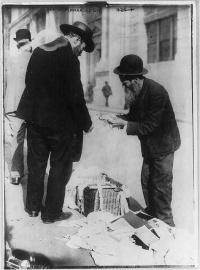

The earliest immigrants became peddlers in hopes of being able to work their way up. Jewish immigrants became peddlers in hopes of being able to earn some capital to be able to one day become pushcart operators or perhaps even open up their own business. Peddling was laborious work but it was preferred by many immigrants because it did not require much skill and it was a way to avoid the garment industry.
Most Jews, however, were not able to escape the garment industry and had to settle for a job in clothing
manufacturing. This industry was growing rapidly and Jewish immigrants were a major part of its labor force as “six of every ten Jewish workers were engaged in the production of clothing." This high number of participation of Jews was due to a number of reasons. First, some Jewish immigrants already brought some tailoring experience from their homelands. Another reason was the accessibility to the garment shops as 80 percent of the garment factories were located under 14th street, close to the Lower East Side. The fact that most of the garment employers were mostly Jewish also lead to the hiring of Jewish workers.
Over time, Jews were able to move up and become owners of their own business. This was shown by that fact that around 1937, “Jews owned two-thirds of the city’s 34,000 factories and 104,000 wholesale and retail enterprises.

Macy's Herald Square (originally named the R. H. Macy and Company Store) is the flagship of Macy's department store, as well as the Macy's, Inc. corporate headquarters, on Herald Square in Manhattan, New York City. Ownership of the company was passed down through the Macy family until 1895, when the company, now called "R. H. Macy & Co.", was acquired by Isidor Straus and his brother Nathan Straus, who had previously held a license to sell china and other goods in the Macy's store.
Gimbels, Macy’s, Filene’s, I Magnin, Neiman-Marcus, Bloomingdales, Bergdorf Goodman, Rich’s of Atlanta, Kauffman’s of Pittsburgh, Lazarus of Columbus, Levi Strauss and even Sears-Roebuck.
All but the last were created by Jews and all were run by Jews, most of them dating back to a German Jewish immigrant peddler who created a family dynasty. These entrepreneurial families not only dominated fashion and retail, but made huge contributions to the cultural, civic and political life of their communities.
In 2002, an estimated 972,000 Ashkenazi Jews lived in New York City and constituted about 12% of the city's population. New York City is also home to the world headquarters of the Chabad, Bobover, and Satmar branches of Hasidism, and other Haredi branches of Judaism. While three-quarters of New York Jews do not consider themselves religiously observant, the Orthodox community is rapidly growing due to the high birth rates of Hasidic Jews, while the numbers of Conservative and Reform Jews are declining. I might mention that most all the Jews were law-obeying people who kept to themselves and their work.
Resource:
Book: Finding Our Fathers by Dan Rottenberg
https://www.jewishagency.org/jewish-population-rises-to-15-3-million-worldwide-with-over-7-million-residing-in-israel/
https://dbs.anumuseum.org.il/skn/en/c6/e256961/Place/New_York_City?utm_source=google&utm_medium=cpc&utm_term=jewish%20in%20new%20york&utm_campaign=g&device=c&gclid=CjwKCAjwv4SaBhBPEiwA9YzZvKNu5tzl4P8Gxg5DwCy5s7LEv-l1
https://en.wikipedia.org/wiki/Jews_in_New_York_City#:~:text=Jews%20have%20immigrated%20to%20New,to%201.5%20million%20in%201920.
https://press.uchicago.edu/ucp/books/book/chicago/A/bo17607449.html
https://encyclopedia.ushmm.org/content/en/article/united-states-immigration-and-refugee-law-1921-1980
https://www.milkenarchive.org/articles/view/yiddish-theater-virtual-tour/?gclid=Cj0KCQjw4omaBhDqARIsADXULuXNlcQHIdL8p3eEd7lmiF3la8gOMLFvvPa1poezMES6ZMDWnOJwgOYaAn7BEALw_wcB
https://jhssc.org/wp-content/uploads/2021/08/The-Jewish-Problem-in-US-Med-Edu-1.pdf
https://en.wikipedia.org/wiki/Macy%27s_Herald_Square


