Showing posts with label Y haplogroups. Show all posts

Wednesday, October 9, 2024

Y Haplogroups of Jews and Persians: Are They The Same?

 Nadene Goldfoot                                            

                  Attacking Amaleks During the Exodus of Israelites

The Israelites were the children of Jacob who later experienced a name change to Israel.  They had moved to Egypt during a drought where they lived and was granted land to live on by the pharaoh. Later on with another pharaoh, they became the slaves of Egypt.

Jews lived in Persia as part of the people taken by the Assyrians back in 721 BCE or 2,745 years ago.  They were there during Queen Esther's period born c 492-460 BCE .    ESTHER (Heb. אֶסְתֵּר), daughter of Abihail, an exile at *Susa, and heroine of the Book of Esther. She was orphaned as a child, and her cousin *Mordecai adopted her and brought her up.

Why the interest in Iran?  They have become Israel's #1 enemy.  Again, Iran, once called Persia, has a leader bound and determined to carry out the first Ayatolla's plot to kill all Jews.  This would mean the destruction of Israel and the other 8 million Jews in the world.  It started with Haman of Persia, a member most likely of the Amaleks, a tribe existing long ago during the Exodus of Jews led by Moses from Egypt to Canaan who were like a wandering tribe of scavenger people, killing off the aged and those needing assistance at the end of the Exodus procession that became easy marks.   It is said that Haman was a member of the Amaleks.  The date of the Exodus varies from happening in 1445 BCE  1250 BCE which would have happened about 3,464 years ago to 3,274 years ago.  

Iran's people had been ruled by the Shah of Iran and got along with Israel, but the Ayatollah somehow took over and the Shah was ousted.  The people have no reason to want to go to war with Israel today, and are not even happy with the ruling Ayatollah.  The Ayatollah's goal is to take over Israel. 

Y Haplogroup of Q:  Native Americans           


The slaves of Egypt who became today's Jews were made up of several family lines; and one was a line of Q's (genetic term of males) who originated with people making up today's native Americans of North America and South America.  The future Jews broke off from this line thousands of years ago to wander into today's land now Israel and became a part of that existing people.  Y haplogroup Q is believed to have originated in the region of Central Asia and Southern Siberia, with most research pointing to a timeframe around 15,000 to 25,000 years ago.I found a lot of writers to be male Q's.  They allowed me to be a part of the group, so they may share some common skills.  

Those people already living in Canaan must have been today's J1 and J2 line, as both male Jews and Muslims  are found to bear this Y haplogroup.  Y-chromosome haplogroup J, and its subgroups J1 and J2, are connected with origins in the Arabian Peninsula, Southern Europe and North Africa, and among many men of Ashkenazi Jewish, Arab Bedouin, Uygur and Uzbek origin. 

We find that King David was of this line, as well as Solomon, his son, and a majority of Jewish men today.  King Saul would be included, though he was of the tribe of Benjamin,  one of the 12 tribes of Jacob, where David came from the the tribe of Levi, also one of the 12 of Jacob.  That goes back to David who reigned  in Jerusalem about 1010 BCE or about 3, 035 years ago.  Y haplogroups J1 and J2 are believed to have originated in the region of Western Asia, specifically around the area of the Fertile Crescent, with the earliest evidence appearing around 31,600 years ago, with both being subclades of the broader haplogroup J which also originated in the same region;

Neanderthals lived from approximately 400,000 to 40,000 years ago: 
Time period
Description


130,000 years ago

Y-chromosome haplogroup J1 and J2 are subgroups of haplogroup J, which originated in Western Asia around 42,900 years ago:  This was in the era of the Neanderthals.  
The best-known Neanderthals lived during this time


40,000 years ago
All physical evidence of Neanderthals vanishes
Why?   It is a much older line than the Q's. 
Neanderthals were a species of hominids that lived in Europe and parts of Asia. They were the closest relatives to modern humans, and some humans today have around 2% Neanderthal DNA.  I'm Jewish with 2% Neanderthal DNA. 

Scientists believe that Neanderthals and modern humans shared a common ancestor in Africa that lived around 800,000 years ago. The Neanderthal ancestor then evolved into Homo neanderthalensis in Europe and Asia, while the human ancestor remained in Africa and evolved into Homo sapiens. However, my paternal grandmother and grandfather came from Lithuania !  

   Why are Jews the scapegoats of the Ayatollas?  

Iran is made up of Shi'ite Muslims.  The other  Arab states they are connected to are Sunnis.   Each group is vying to be the  leadingcountry of the others.  It's like a horse race.  

 It seems as if the Ayatollas come from the line of the Amaleks with their convictionthat the Jews must be wiped out.   

Since the Ayatollas are Persian, we can look at their Y haplogroups.  "The most common Y-chromosome haplogroups in Iran are J, R, G, and E. The J2 subclade is the most prevalent, followed by R1a, E1, J1, G2, R1b, and T1. Here are some other Y-chromosome haplogroups found in Iran: B, C, D, F, H, I, L, N, O, Q, T: These are other main haplogroups found in Iran.  A test would be needed to tell what line they belong to.  There are many possibilities. 

Most Iranian people feel they have no reason to hate Israel.  They are not of thesame mind as the Ayatollas.  They are not happy with their rule.    

J2: This haplogroup spread from the Iranian plateau into the Indian subcontinent during the Neolithic period. 

In this survey, 938 Iranian male DNAs belonging to 15 ethnic groups from 14 Iranian provinces were analyzed for 84 Y-chromosome biallelic markers and 10 STRs. The results show an autochthonous but non-homogeneous ancient background mainly composed by J2a sub-clades with different external contributions. 

Y-chromosome haplogroups can be used to study human migration, evolutionary patterns, and genealogical studies. They can also be used in forensic science. 

Their haplogroup does not show any reason for Persian/Iranian Ayatollas to need to kill Jews.  It's simply a matter of power over the other line ofIslam:  that of the Sunnis vs the Ayatollas and their Shi'ite belief system.  Haman being from the tribe of Amalek shows only that there is a  strain of envy running  throughout the people which came came out in him.  Mordecai would not bow to him and Haman craved that power.  

While there may be some slight differences in the frequencies of specific Y-haplogroups between Shia and Sunni Arab populations, overall, the genetic distinction between Shia and Sunni Muslims is not primarily driven by their religious sect but rather by their geographic origins and historical admixture, meaning there is no single "Shia" or "Sunni" haplogroup; both groups share a significant overlap in their Y-chromosome haplogroups, with the most prevalent ones being J1 and J2 in the Middle East region

However, this may have started a cultural pattern picked up again by the Ayatollas. This sort of anti-Semitism seems to run in many cultures, from the ancient days tothe present; especially in Europe.  It's as if anti-Semitism is genetically inherited.  


Resource:  

https://www.nhm.ac.uk/discover/who-were-the-neanderthals.html#:~:text=Neanderthals%20lived%20alongside%20early%20modern,Read%20more

https://www.nhm.ac.uk/discover/who-were-the-neanderthals.html#:~:text=Neanderthals%20lived%20alongside%20early%20modern,Read%20more

https://www.ncbi.nlm.nih.gov/pmc/articles/PMC3399854/#:~:text=Structure%20of%20the%20Y%2Dchromosome,ethnic%20groups%20(Figure%201).&text=Frequencies%20of%20the%20main%20Y,and%20Pakistan%20%5B24%5D).

https://www.encyclopedia.com/philosophy-and-religion/bible/old-testament/esther

https://en.wikipedia.org/wiki/Lebanese_Shia_Muslims

https://www.yourdnaguide.com/ydgblog/haplogroup-j-j1-j2


Monday, June 12, 2023

Jewish Intelligence And Our DNA Y Haplogroups

 Nadene Goldfoot                                             

Albert Einstein didn't learn to tie his shoes right away, but had a high IQ.                                              

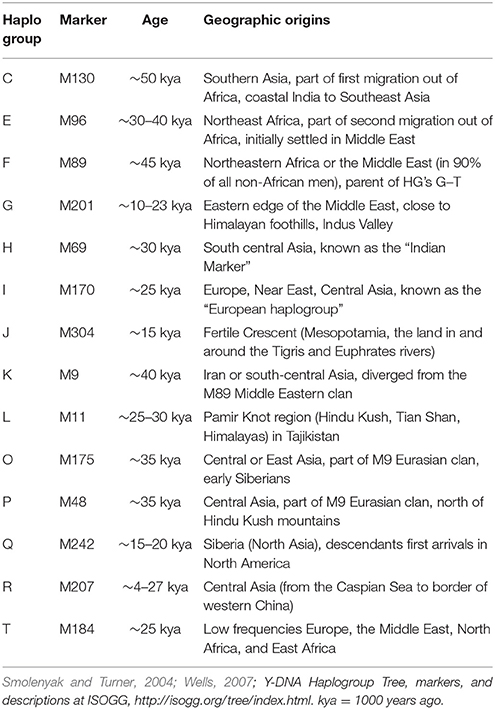
"The geographic origins of the 14 different haplogroups were ascertained from the phylogenetic tree of mankind maintained by the International Society of Genetic Genealogy (ISOGG, 2016), and published sources. They are summarized in Table 4. Table 4. Ancient geographic origins of 14 Y-chromosome haplogroups."  The top-level haplogroups are expressed as letters (A, B, C, etc.). Their sub-haplogroups or subclades are expressed as letters and numbers (G2, R1b1, E3b1b, etc.)."

"The data revealed that 14 different haplogroups representing 14 different geographic origins were present in the 50 ethnic groups used in this study (Table 3), confirming multiple lines of ancestry and geographic origins. Every ethnic group had members that belonged to more than one haplogroup, indicating that they had different lines of ancestors. There was no ethnic group in these analyses that could trace the genetic ancestry of all its members to a single MRCA. For example, members of the large Brahmin ethnic group belonged to 11 different haplogroups, indicating 11 different lines of


ancestors. Similarly, the Malayali and Nair groups had members in 10 different haplogroups, indicating at least 10 different ancestral lines."  

The 14 were:  C,E, F, G, H, I J, K, L, O, P, Q, R and T.  Letters I've highlighted are known Jewish ones of the male line.  My father is a QBZ67 (Q-M378).  Others in my family are E-L117(E1b), J1e,  and  (R-M269)(R-L21) .   E and J have been the most prevalent that I've noticed.  

www.frontiersin.org

TABLE 4. Ancient geographic origins of 14 Y-chromosome haplogroups    

Jews' history shows that we came from one source, the history before and after Moses, following his line of male ancestors.  The results of his brother, Aaron's line shows the haplogroup of J1 being the Cohen line. Other Jewish haplogroups fall under variations of J, such as J1, J2, and G, Q, R, E, I, and T.  That's 7 out of the basic 14 mentioned.  These are found in the era after the Holocaust where 6 million Jews were slaughtered, and some of them could have been carrying a different haplogroup, but we'll never know unless they left a descendant who has been tested today such as my 1st cousin.  However, in our case, the father died and left only daughters, and daughters do not carry the male haplogroups.  Sons carry both the male and female haplogroups.  He was a Jew from Germany, a long line probably going back to RASHI in 1000-1040 CE.  There are many of us who claim to have genealogy to Rashi, and we may come from a variety of haplogroups.  

R-M269 is a most interesting Haplogroup.  It is the sub-clade of human Y-chromosome haplogroup R1b that is defined by the SNP marker M269. According to ISOGG 2020 it is phylogenetically classified as R1b1a1b. It underwent intensive research and was previously classified as R1b1a2 (2003 to 2005), R1b1c (2005 to 2008), R1b1b2 (2008 to 2011) and R1b1a1a2 (2011 to 2020).R-M269 is of particular interest for the genetic history of Western Europe, being the most common European haplogroup. It increases in frequency on an east to west gradient (its prevalence in Poland estimated at 22.7%, compared to Wales at 92.3%). It is carried by approximately 110 million European men (2010 estimate). The age of the mutation M269 is estimated at 4,000 to 10,000 years ago. I believe even King Tut was found with this haplogroup.  It's carried by Gentiles of Europe and some Jews as well. They discovered that King Tut had a DNA profile that belongs to a group called haplogroup R1b1a2.


We are a religious group originating from a family, and were kept from proselytizing to others, so it's mostly genetically-based with a few exceptions.  Jews have been suffering from anti-Semitism for almost their total length of existence, and have become an endogamous people.  One person I've heard of has wanted to be a part of this group and that was Sammy Davis, Jr.  A few women have entered Judaism  through conversion, marrying a Jewish man.  

What happens is that we may have proof of a family being a branch from, let's say, King David, but not all the descendants carry segments from any of his 22 chromosomes or even the 23rd, the sex determiner chromosome.  So some of the siblings may have the gene inheritance and some don't.  Siblings in a family may not look alike, or act alike.  They may have different interests and outlooks in life.  That's because their parents have passed onto them a variety of their segments from many different ancestors.  

My father's DNA group of Qs had a leader at one time who made a survey and found its  Q members held a lot of writers.  They even included me, a female since I had published.  That seems to be one of our talents. I was astonished at how many, mostly all had published, including my own brother.   

                                     Albert Einstein, IQ 180.

Albert Einstein is alleged to belong to Y Haplogroup E. Tested Einsteins from Germany belong to E1b1b1b2* (cluster SNP PF1952, formerly known as the E-Z830-B or "Jewish cluster").

      Einstein had a daughter and two sons.  Albert's three children were from his relationship with his first wife, Mileva Marić, his daughter Lieserl being born a year before they married. He had one grandson and 4 great grandsons and 1 great granddaughter.  

The Einstein family is the family of physicist Albert Einstein (1879–1955). Einstein's great-great-great-great-grandfather, Jakob Weil, was his oldest recorded relative, born in the late 17th century, and the family continues to this day. Albert Einstein's great-great-grandfather, Löb Moses Sontheimer (1745–1831), was also the grandfather of the tenor Heinrich Sontheim (1820–1912) of Stuttgart.


Albert Einstein's second wife was Elsa Einstein, whose mother Fanny Koch was the sister of Albert's mother, and whose father, Rudolf Einstein, was the son of Raphael Einstein, a brother of Albert's paternal grandfather. Albert and Elsa were thus first cousins through their mothers and second cousins through their fathers.  No children were from this marriage.                                 

As a Jewish group, we seem to still be pretty intelligent people, and very creative as we examine the talents in Israel.  They are always coming up with new ideas.  The Nazis tried to brainwash people into thinking we were the scum of the earth, but who has merited and holds  Nobel Prizes in many fields?  Jewish people. Nobel Prizes have been awarded to over 900 individuals, of whom at least 20% were Jews."  That's pretty good, considering we Jews make up only 0.02% of the world population."Jewish laureates Elie Wiesel and Imre Kertész survived the extermination camps during the Holocaust. François Englert survived by being hidden in orphanages and children's homes. Others, such as Walter Kohn, Otto Stern, Albert Einstein, Hans Krebs and Martin Karplus fled Nazi Germany to avoid persecution."

 There were many male Jewish immigrants who were most intelligent but couldn't get into Medical schools in the States because of the quota system;  of only a certain % of Jews being allowed in them.  The country's loss was hopefully the student's gain as they had to enter other areas, hopefully related to medicine.  

That's because for a long time in Shtetles, a man was looked upon as good husband material if he was active in the synagogue, reading Hebrew from the pulpit, etc., something all men who had had a bar-mitzvah at age 13 were expected to do, actually.  Rabbis were high on the list.  Many of us have followed their genealogy to a well-known rabbi.  A rabbi was known to have all the answers people in a community were looking for, spiritually, customs of worship, and worldly.  Women were attracted to the smarted kid on the block, not the brawniest.  It's nice when that comes in one package, though.                               

I would hope that this standard would be combined sometimes, like, wasn't Bar Kokhba, the general in 132 CE who re-took Jerusalem after 63 years of having lost it to the Romans, romantic material?  It's sad,  because he died 3 years later.   He had to be brainy and brawny.  He could have become the idol for many women looking for a mate.  

It is believed that the majority of contemporary Jews descended from the ancient Israelites that had lived in the historic land of Israel until ∼2000 years ago which takes us to 1023 CE. Many of the Jewish diaspora communities were separated from each other for hundreds of years. Therefore, some divergence due to genetic drift and/or admixture could be expected. However, although Ashkenazi Jews were found to differ slightly from Sephardic and Kurdish Jews, it is noteworthy that there is, overall, a high degree of genetic affinity among the three Jewish communities. Moreover, neither Ashkenazi nor Sephardic Jews cluster adjacent to their former host populations, a finding that argues against substantial admixture of males. These findings are in accordance with those described by Hammer et al. ().  In other words, there was no mixing of populations where they lived, no hanky panky going on causing pregnancies.   

Ashkenazi Jews 

Ashkenazi Jews consolidated into a distinct ethnicity in Germany during the Middle Ages and spread eastwards to Poland and Russia in the 13th century (Ben-Sasson ). Previous studies of Y chromosome polymorphisms reported a small European contribution to the Ashkenazi paternal gene pool (Santachiara-Benerecetti et al. ; Hammer et al. ). In our sample, this low-level gene flow may be reflected in the Eu 19 chromosomes, which are found at elevated frequency (12.7%) in Ashkenazi Jews and which are very frequent in Eastern Europeans (54%–60%; Semino et al. ). Alternatively, it is attractive to hypothesize that Ashkenazim with Eu 19 chromosomes represent descendents of the Khazars, originally a Turkic tribe from Central Asia, who settled in southern Russia and eastern Ukraine and converted en masse to Judaism in the ninth century of the present era, as described by Yehuda Ha-Levi in 1140 a.d. (Dunlop ).

Sephardic Jews 

Iraqi and North African Jews are both considered to belong to the ethnically heterogeneous group of Sephardim, although the two communities were probably separated for 1,000 years.

The Jewish community in Iraq was formed by deportees during the Assyrian and Babylonian exiles (723 and 586 b.c.)

and by waves of immigrants in subsequent centuries. Communities in various North African countries and in the Iberian Peninsula were established primarily in the course of the Muslim conquest in the seventh and eighth centuries. After their expulsion from Spain in 1492 a.d., Jews were dispersed in North Africa and Southern Europe (Ben-Sasson ).

The two Sephardic communities and Kurdish Jews are very closely related to each other.

Thus, these populations seem to have preserved, to a large extent, their original Y chromosome pools.


Resource: 

https://www.frontiersin.org/articles/10.3389/fgene.2018.00004/full#:~:text=The%20geographic%20origins%20of%20the,of%2014%20Y%2Dchromosome%20haplogroups.

https://jewishfactsfromportland.blogspot.com/2010/01/what-haplogroup-we-be.html

https://en.wikipedia.org/wiki/Einstein_family

Wednesday, April 13, 2022

Insights Into Male and Female Differences in Genealogy

 Nadene Goldfoot                                           


There are differences between the sexes.  Within males and females are chromosomes identified as the X for females and Y for males that come from our cells.  These are the male line and the female lines. We inherit 23 chromosomes from each parent and the X and Y are the last one, the 23rd.   The male inherits both the X and the Y lines but can only pass on to their children the Y line.  The female does not have the Y line, only her X line which she passes onto her children.  A common Y line for Jewish men is J1 (cohen gene) while the common Jewish line for the Jewish women seems to be K.  


This is why men are so important in  testing our DNA.  Test a man for both the X and the Y lines and you have the knowledge of his father, and all the male grandparents down the line to Adam. 

A man also has the genes of his mother and her mother, so on back to Eve.  If a woman wants information about her inheritance of genes, she should ask her brother to test, which I did.  That way we both have the information about our father and our mother.  If our father lived long enough to test, his test would show the information on his father's line and his mother's line, which is a different mother from our mother, important to us but is not our mother.  She would be our paternal grandmother.  


A female only has the X line so cannot find what the line of her father was.  Each line has a name.  For instance, the Cohens in the Jewish family are found to be the same, so are called J1.  My father's line is a Q, and further testing has labeled it as QBZ67.  A female passes on her X line to her daughters.  


  The oldest male in the family should test as their information can go back further.  They will show genes inherited that we may not receive.  That's another thing.  You and your siblings inherit some of the same genes and some different ones, too.  That's why they are not carbon copies of you.  It's great if all siblings test in a family when they can afford to do it.  You can get a broader picture of your family that way.                                     

Aunts and Uncles are important to test. Male cousins can tell you all about your mother's side of the family if you're a female.  My mother's line was Robinson.  My male 1st cousin was of immense great help in finding out what her father's line was all about. 


 My maternal uncle had an operation on his mitral valve and had to have it replaced with a pig valve, which was done during a certain period.  He was then found to have an irregular heart beat called a-fib.  I inherited this gene and also had a mitral valve problem which could be repaired, thank goodness, without the need for a new valve.  I have a-fib. I'm said to have an enlarged heart.  My father also had an enlarged heart.  We can inherit heart problems from both sides of the family.  Yikes.
This DNA tells us what groups of people were intermarrying with our family groups, and history may tell us why they came to join our settlements.  

Jews who came from Poland are very diverse genetically.  People came from many countries to Poland in medieval times, and in the 18th century migrated from Poland to other lands such as Rumania, where they found Byzantine Jews from Constantinople living there.  They also found some refugees from the Spanish Inquisition of the 15th century already living there.  There was also a Jewish migration from Lithuania into the area around Bialystock, Poland around 1495.  

Back in the 3rd and 4th centuries, Jews fleeing oppression in the Middle East, as the Temple in Jerusalem and the city were destroyed by the Romans in 70 CE, fled and settled in Southern Italy from where they moved to Northern Italy and then into the Rhineland of Germany and then further east into what is the eastern part of Germany and then later into Poland.  

Ashkenazic DNA is a mosaic of the Jewish communities it has lived in and shared with others for hundreds of years, so where the point of origin is for each family is hard to tell.  Was it Western Asia, Europe or the Middle East----or all of these?    That's why scientists in genetics do studies of the male Y chromosome and why it's so important to every diverse group of people.  Jews are a good group to study because they are endogamic, that is that they have intermarried within the family ever since Abraham married his niece, Sarah.  They were from today's Iraq in a city called Ur.  The Egyptians married their sisters and brothers.  Many family groups of Muslims are also endogamic.  Jews tried to marry within their own Jewish circles, but often the men would marry someone in the land area they were in for long periods of time.  
                                                
                    Remember the Frisco Kid with Gene Wilder?
                  I guess my Nathan Goldfus/foot  was the Telsiai Kid

The early settlers of the USA had to marry people within their neighborhood considering travel then was by horse, or horse and buggy.  They didn't go very far unless they just couldn't find a mate in their circle, then had to travel further away from home.  My paternal grandparents were Nathan Goldfoot, formerly "Goldfus" of Telsiai, Lithuania,  whose line was from Germany, and Zlata "Hattie" Jermulowski/e of Lazdijai, Suwalki, Lithuania/Poland who claimed she was a Litvak (Lithuanian).  They met up in the mountains of Idaho in a mining town of Council because the train was recently laid down there.  Of course, they married; the only Jews there and that were single. He was almost 6 feet tall and she was barely taller than a midget.  She had to stand on a chair to kiss him.    Zlata was there with her half-sisters and their husbands as well.  They married in Boise, Idaho, not knowing how to read or write in English.  You should see the spelling on their marriage certificate.  Thank goodness that I could read the witnesses names better.   Nathan had traveled from Lithuania to England, Ireland, Canada, Idaho and then Oregon.                                                         
It has been said that American Jews constitute about 27 to 30% of any group whose distinguishing characteristic is intelligence.  Scientists reveal that the mean Jewish IQ is about one standard deviation above that of other Europeans.  About  27 to 30% of Ashkenazim have the mother's lines of the K haplogroup.  This may be important or not.  Our father's mother was not a K but a W, another female line, and our IQ's are very healthy.  Smart people tend to be drawn to other smart people, and so on.  It becomes something inherited.  Environment draws it out.  Give a child the proper stimulating environment and he can reach his potential. Parents rarely realize that they are the most important teachers of a new life and are laying down the thinking patterns of the children.  Of course a fantastic teacher can do a lot to develop that capability, harumph, hmm!!! Or Squash it!!!!

 Resource:

Tracing Your Jewish DNA For Family History & Ancestry by Anne Hart, 2003, 

https://en.wikipedia.org/wiki/The_Frisco_Kid


Sunday, September 13, 2020

DNA of Jews and Kurds, Syrian Arabs, etc.

Nadene Goldfoot
Syrians are the 17th largest populated state out of the 48
Muslim majority states in the world.  They are 90% Muslim of Sunni/Shio'a.
After 1880, many moved into Palestine, saying they were Syrians,
because they were looking for work with the new Russian Jews who were
building.  Arabs came from other states as well, and all, Jew and Arab,
were called Palestinians.  Arabs kept the name.  

Studying the genetic relation between Jews and Syrians showed that the two populations share close affinity. Apparently, the cultural influence of Arab expansion in the Eastern Mediterranean in the seventh century was more prominent than the genetic influx. However, the expansion of Islam did leave an impact on Levantine genes. 

Jewish religion and culture can be traced back to Semitic tribes that lived in the Middle East approximately 4,000 years ago. The Babylonian exile in 586 B.C. marked the beginning of major dispersals of Jewish populations from the Middle East and the development of various Jewish communities outside of present-day Israel.


In 2001, a team of Israeli, German, and Indian scientists discovered that the majority of Jews around the world are closely related to the Kurdish people -- more closely than they are to the Semitic-speaking Arabs or any other population that was tested.
                                               
Kurdistan is a mountainous region divided among Turkey, Iran and Iraq.  Jews went to Kurdistan way back in the time of Ezra (5th century BCE-400s BCE or 2,420 yrs ago).  

For populations of the Jewish diaspora, the genetic composition of AshkenaziSephardi, and Mizrahi Jewish populations show significant amounts of shared Middle Eastern ancestry. According to Behar and colleagues (2010), this is "consistent with a historical formulation of the Jewish people as descending from ancient Hebrew and Israelites of the Levant" and "the dispersion of the people of ancient Israel throughout the Old World". Jews living in the North African, Italian, and Iberian regions show variable frequencies of admixture with the historical non-Jewish population along the maternal lines. In the case of Ashkenazi and Sephardi Jews (in particular Moroccan Jews), who are closely related, the source of non-Jewish admixture is mainly southern European. Behar and colleagues have remarked on an especially close relationship between Ashkenazi Jews and modern Italians. Some studies show that the Bene Israel and Cochin Jews of India, and the Beta Israel of Ethiopia, while very closely resembling the local populations of their native countries, may have some ancient Jewish descent.                                         


The paternal Y-DNA haplogroup J1, (also called the Jewish Cohen gene) which reaches its highest frequencies in Yemen 72.6% and Qatar 58.3%, accounted for 33.6% of Syrians. The J2 group accounted for 20.8% of Syrians; other Y-DNA haplogroups include the E1B1B 12.0%, I 5.0%, R1a 10.0% and R1b 15.0%.  These are also common with the Jewish people.  
A multidimensional scaling plot placed six of the seven Jewish populations in a relatively tight cluster that was interspersed with Middle Eastern non-Jewish populations, including Palestinians and Syrians. Pairwise differentiation tests further indicated that these Jewish and Middle Eastern non-Jewish populations were not statistically different. The results support the hypothesis that the paternal gene pools of Jewish communities from Europe, North Africa, and the Middle East descended from a common Middle Eastern ancestral population, and suggest that most Jewish communities have remained relatively isolated from neighboring non-Jewish communities during and after the Diaspora.
                                                                       
Ethiopian Jew, Muslim Druse, Christian Arab, Muslim Arab
all in IDF of Israel 
In a study of Israeli Jews and Palestinian Muslim Arabs, more than 70% of the Jewish men and 82% of the Arab men whose DNA was studied, had inherited their Y chromosomes from the same paternal ancestors, who lived in the region within the last few thousand years. "Our recent study of high-resolution microsatellite haplotypes demonstrated that a substantial portion of Y chromosomes of Jews (70%) and of Palestinian Muslim Arabs (82%) belonged to the same chromosome pool." In relation to the region of the Fertile Crescent, the same study noted; "In comparison with data available from other relevant populations in the region, Jews were found to be more closely related to groups in the north of the Fertile Crescent (Kurds, Turks, and Armenians) than to their Arab neighbors."
                                   

Approximately 35% to 43% of Jewish men are in the paternal line known as haplogroup J  and its sub-haplogroups. This haplogroup is particularly present in the Middle East and Southern Europe. 
15% to 30% are in haplogroup E1b1b(or E-M35) and its sub-haplogroups which is common in the Middle EastNorth Africa, and Southern Europe.
The Y chromosome of most Ashkenazi and Sephardi Jews contains mutations that are common among Middle Eastern peoples, but uncommon in the general European population, according to a study of haplotypes of the Y chromosome by Michael Hammer, Harry Ostrer and others, published in 2000. According to Hammer et al. this suggests that the paternal lineages of Ashkenazi Jews could be traced mostly to the Middle East.                                                


Religion drove Levantine Muslims to mix with other Muslim populations, who were close culturally despite the geographic distance, and this produced genetic similarities between Levantine Muslims and Moroccan and Yemeni populations. 

Christians and Druze became a genetic isolate in the predominantly Islamic world.
Genetic tests on Syrians were included in many genetic studies. The genetic marker which identifies descendants of the ancient Levantines is found in Syrians in high proportion. Modern Syrians exhibit "high affinity to the Levant" based on studies comparing modern and ancient DNA samples. Syrians cluster closely with ancient Levantine populations of the Neolithic and Bronze ages. A Levantine ancestral genetic component was identified; it is estimated that the Levantine and the Arabian Peninsula/East African ancestral components diverged 23,700-15,500 years ago, while the divergence between the Levantine and European components happened 15,900-9,100 years ago. The Levantine ancestral component is the most recurrent in Levantines (42–68%); the Arabian Peninsula/East African ancestral components represent around 25% of Syrian genetic make-up.                             

 The Syrians are closest to other Levantine populations: the Palestinians, Lebanese and Jordanians;  this closeness can be explained with the common Canaanite ancestry and geographical unity which was broken only in the twentieth century with the advent of British and French mandates. Regarding the genetic relation between the Syrians and the Lebanese based on Y-DNA, Muslims from Lebanon show closer relation to Syrians than their Christian compatriots. The people of Western Syria show close relation with the people of Northern Lebanon.
Besides religious identities, the Syrian people are split among three identities, the Arab, Syriac, and Syrian identities. Many Muslims and some Arabic-speaking Christians describe themselves as Arabs, while many Aramaic-speaking Christians and some Muslims prefer to describe themselves as Syriacs or Arameans. Also some people from Syria, mainly Syrian nationalists, describe themselves only as Syrians or ethnic Syrians. Most of the divisions in ethnic nomenclature are actually due to religious backgrounds.
                                                  

The researchers suggested that the approximately 12.7 percent of Ashkenazic Jews who have the Eu 19 chromosomes -- which are found among between 54 and 60 percent of Eastern European Christians -- descend paternally from eastern Europeans (such as Slavs) or Khazars. But the majority of Ashkenazic Jews, who possess Eu 9 and other chromosomes, descend paternally from Judeans who lived in Israel two thousand years ago. In the article in the November 2001 issue of The American Journal of Human Genetics1, Ariella Oppenheim of the Hebrew University of Israel wrote that this new study revealed that Jews have a closer genetic relationship to populations in the northern Mediterranean (Kurds, Anatolian Turks, and Armenians) than to populations in the southern Mediterranean (Arabs and Bedouins).
                                    

 Our data suggest that Eu 9 originated in the northern part, and Eu 10 in the southern part of the Fertile Crescent. Genetic dating yielded estimates of the expansion of both haplogroups that cover the Neolithic period in the region. The Neolithic Revolution started around 10,000 B.C. in the Fertile Crescent, a boomerang-shaped region of the Middle East where humans first took up farming. Shortly after, Stone Age humans in other parts of the world also began to practice agriculture.
Palestinian Arabs and Bedouin differed from the other Middle Eastern populations studied here, mainly in specific high-frequency Eu 10 haplotypes not found in the non-Arab groups. These chromosomes might have been introduced through migrations from the Arabian Peninsula during the last two millennia.
Resource:
https://en.wikipedia.org/wiki/Syrians#:~:text=The%20Levantine%20ancestral%20component%20is,accounted%20for%2033.6%25%20of%20Syrians.
https://www.pnas.org/content/97/12/6769 abstract
https://en.wikipedia.org/wiki/Genetic_studies_on_Jews
http://www.jcfk.org/insight/132-the-genetic-bonds-between-kurds-and-jews