Nadene Goldfoot

King Sennacherib of Assyria Attacking Jerusalem
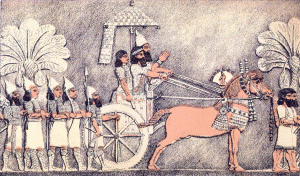 II Kings:19:35-37) By 701 B.C.E. the Assyrians under King Sennacherib had destroyed the northern kingdom of Israel and much of Judah in the south. Only Jerusalem under King Hezekiah 720-692 BCE) remained to be conquered, and it was surrounded by enemy soldiers. Without explanation, however, the Assyrians suddenly folded their tents and returned home.
"The later Assyrian rulers Sargon II and his son and successor, Sennacherib, were responsible for finishing the twenty-year demise of Israel's northern ten-tribe kingdom, although they did not overtake the Kingdom of Judah. Jerusalem was besieged, but not taken. The tribes forcibly resettled by Assyria later became known as the Ten Lost Tribes." They were the northern part of the Kingdom of Israel, 10 of the 12 tribes of Jacob.

Finding the reason for the survival of Jerusalem has confounded scholars for centuries. What is clear, however, is that if Jerusalem had not survived, Western civilization would have been utterly different. Proposals for the reasons have included disease among the Assyrian troops, which was a plague, perhaps the same of the 12 plagues that hit the Pharoah; troubles elsewhere in the Assyrian empire, the approach of the Egypto-Kushite forces and some combination of the above. or cushites/Kushites. The account in II Kings is that angels came down and killed 185,000 soldiers in the Assyrian camp.

Moses' wife is referred to as a Cushite in Numbers 12. Interpretations differ on whether this Cushite wife was one and the same as Zipporah, or another woman. The Cushite is not mentioned by name. Kush was a part of Nubia, which stretched from the Upper Nile to the Red Sea.
The information in our Jewish history is that Sennacherib was forced by a plague in his army to return home. That plague could have been anything that we have experienced in our time of plague history. I doubt if it had been the virus, COVID 19 or Delta, the follow-up mutated virus. it could have been the flu, as it came with the army.
The Naked Archaeologist questioned the theory that the army of Cushites could have come to Jerusalem's rescue. https://www.youtube.com/watch?v=mNhypxWvRmY

Another also thought of the Kushites, a journalist, Henry Aubin. " At the turn of the eighth century B.C., a mighty Assyrian army entered Judah and fought its way to the very gates of Jerusalem, poised, the prophet Isaiah warned, to "smash the city as easily as someone hurling a clay pot against the wall." But the assault never came; instead, the Assyrian army turned and fled, an event that has been called the Deliverance of Jerusalem.
Whereas biblical accounts attribute the Assyrian retreat to divine intervention of a plague, journalist Henry Aubin offers an explanation that is miraculous in its own light: the siege was broken by the arrival of an army from Kushite Egypt--an army, that is, made up of black Africans. These Kushites figured in historical texts, Aubin continues, until the late 19th century, when racist scholars expunged them from the record--a process that, Aubin observes, coincided with the European conquest and colonization of Africa. The Kushite intervention assured the survival of the Hebrew people, Aubin asserts, and it deserves to be acknowledged anew. Well-written and carefully developed, Aubin's argument will doubtless excite discussion." This is probably where Simcha Jacobovici, the Naked Archaeologist, got the idea to question Aubin's theory. Aubin wrote a book about it, called The Rescue of Jerusalem.
There are clues to resolving this conundrum in biblical and extra-biblical evidence, including Sennacherib’s annals and the writings of Herodotus. Professor Bellis will lead us to a likely solution to this enduring mystery.

I'll throw in my revelation now after finding this information. First, Moses had had 2 wives, Zipporah the Midianite and later, a Cushite wife. Perhaps Zipporah had died. Because of that union, when the Assyrians were at the gates of Jerusalem, ready to attack and take the city, not only were they hit by a plague, but at the same time, the Cushites attacked them because of that older union with Moses. How about that? The Assyrians left for home, never to return again, thinking that the Israelites had since put a curse on them if they ever advanced again. Then again, that seems like a very long distance for Cushites to travel north to Jerusalem.
A further check on this history:

Who was the Ethiopian (Cushite) wife that Moses took (Numbers 12:1)? Is she the same wife as Jethro’s daughter Zipporah whom Moses earlier married (Exodus 2:21), and later came back to him in the desert (Exodus 18)? Also, why were Miriam and Aaron upset at Moses for taking a Cushite wife? Did they not like her simply because she was black?

"The Aish Rabbi Replies:
The story of Moses’s Cushite wife is actually quite cryptic. As you observed, we hear earlier of Moses marrying the daughter of Jethro the Midianite. Yet in the Book of Numbers Moses’s sister Miriam is upset about his having taken a “Cushite” wife. Cush is generally translated as Ethiopia (probably the entire region south of Egypt – see Shemot Rabbah 10:2), a place inhabited by blacks. (See e.g. Jeremiah 13:23: “Can a Cushite change his skin, or a leopard its spots?”) Is this a different wife? And where did she come from?"
Herodotus wrote that the Assyrian army was overrun by mice when attacking Egypt. Some Biblical scholars take this to an allusion that the Assyrian army suffered the effects of a mouse- or rat-borne disease such as bubonic plague. Even without relying on that explanation, John Bright suggested it was an epidemic of some kind that saved Jerusalem.

In What If?, a collection of essays on counterfactual history, historian Willian H. McNeill speculates that the accounts of mass death among the Assyrian army in the Tanakh might be explained by an outbreak of cholera (or other water-borne diseases) due to the springs beyond the city walls having been blocked, thus depriving the besieging force of a safe water supply.
"An important introductory point is that the Midrash states that when Moses fled Pharaoh (Exodus 2:15), before arriving in Midian, Moses escaped south to the land of Cush. (Note that Moses was presumably a young man when he fled Egypt, in Midian he married and had two small children, and he was 80 on his return to Egypt at the start of the story of the Exodus. Thus, apparently, many of his early adult years are unrecorded in the Torah.) Moses first served the king of Cush and then upon his death became king himself, ruling for 40 years. He was given the former king’s widow as a wife but he refused to live with her or worship the Cushite god (Yalkut Shimoni Shemot 168). "

Since there was no mention of a Cushite army coming to the rescue of Jerusalem, I can believe that a plague had hit the soldiers as written. When the flu hits, it can hit hard. I don't believe any Cushite army was there, so it was not a deleted fact. We are taught that Moses wrote the Torah (the 5 books of Moses) and that it has remained the exact same writing ever since. Our scribes cannot make one letter incorrect, for if they do, the whole thing is thrown away and they start over again. It was not an era of prejudice against Blacks, as what has since happened. It was an era of trusting in G-d, and this story was an example of that. Jerusalem was saved by the miracle of the plague.
Resource:
https://www.benderjccgw.org/event/did-a-kushite-pharaoh-rescue-jerusalem-from-the-assyrians/
https://www.amazon.com/Rescue-Jerusalem-Alliance-Hebrews-Africans/dp/1569472750
https://en.wikipedia.org/wiki/Zipporah#:~:text=Wife%20of%20Moses,-Moses%20and%20his&text=Moses'%20wife%20is%20referred%20to,him%20a%20polygamist)%20or%20s
uccessively.
https://en.wikipedia.org/wiki/Assyrian_siege_of_Jerusalem


