Nadene Goldfoot

The first Jewish settlements in the United Kingdom
Before the Norman Conquest of 1066, Jewish people lived in England, but not as part of organised communities. The first Jewish settlement of 1070 was comprised of Jewish financiers from Rouen, in the northern region of France, who were invited in by William the Conqueror (William I) to establish themselves in England and Wales in the hopes that they could prop up the administration of his government and consolidate his position as the King of England.
The Norman Conquest of England (or the Conquest) was an 11th-century invasion by an army made up of thousands of Norman, French, Flemish, and Breton troops, all led by the Duke of Normandy, later called William the Conqueror This happened in 1066. Afterwards, a handful of Jewish financiers followed William the Conqueror from the Continent. Communities were established in London, York, Bristol, Canterbury, etc. They traded, lent money to the baronage, and advanced funds for current needs on the security of the revenue to the Crown, which therefore protected them.
Once they arrived in England and Wales, Jewish people became the collective property of the Crown, and, while they were granted a Charter of Liberties which meant that they could rely on the Crown for protection, they were also taxed onerously. The privilege to lend money at interest was exploited by English rulers and, although business dealings prospered between Jews and Christians, as the former grew wealthier, the Jewish community became more and more relied upon as a source of funds, not only for the monarchy, but also for the wider Christian population. Increasing amounts of debt to Jewish creditors, alongside the perceived image of Jews as being on the side of rulers, stoked the growing antisemitic sentiment plaguing Europe at the time.

Emperor Constantine of Rome had caused anti-Semitism to enter the scene with his rulings in the 300's against Jews which his mother, Helen, seemed to bring about with her interest in Jerusalem and Jesus. causing Jews to look for secure countries of refuge. Jews became the scapegoat, with all the ailments blamed on them.
.jpg%20%203rd%20Crusade.jpg)
Then there were the Crusades with King Richard I, also known as Richard the Lionheart, who led the English Crusaders during the Third Crusade (1189–1192) with the goal of capturing Jerusalem, though he did not ultimately succeed in retaking the city from Saladin. He achieved a significant victory at the Battle of Arsuf and a treaty was eventually signed allowing for Christian pilgrimages to the Holy City.


"Edict of Expulsion" refers to official decrees, most notably by King Edward I of England in 1290 and by King Ferdinand and Queen Isabella of Spain in 1492, that banished Jewish populations from their respective realms due to religious, political, and economic reasons, ultimately impacting centuries of Jewish history and diaspora.
By 1290, Edward was under pressure due to debt accrued as a result of his war with France. He was only able to acquire parliament’s permission to raise tax for funds by sacrificing the remaining Jewish population in England.
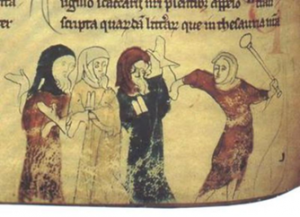
The expulsion of the Jews, marginal illustration from the Rochester Chronicles, Wikipedia
On 18th July in the same year, Edward issued the Edict of Expulsion, in which Jews had until 1st November to leave, lest they were subject to be seized and executed. They were only allowed to take with them all that they could carry, with any property being forfeited to the crown. Around 3,000 Jewish people forcefully left England to settle mostly in France and Germany, while those who remained hid their faith. Edward was granted the single largest tax of the Middle Ages – £116,000 by the Parliament.
England reacted and expelled the Jews in 1290, not letting any back in for 365 years, until the year of 1656. I note that he did that before the Spanish Inquisition acted. England was going through losingPilgrims to Holland who left for a new land, America, on a ship called the Mayflower in 1620.
This major piece of anti-Jewish legislation enacted under King Edward I imposed severe restrictions on Jews across England, including in London.
- Abolished moneylending: It prohibited Jews from usury (lending money with interest), which was one of the few professions legally available to them.
- Required identifying badges: The statute mandated that all Jews over the age of seven wear a distinguishing badge.
- Restricted movement: It dictated that Jews live in specific areas of the king's towns.
- Limited property rights: The ability of Jews to sell property or negotiate debts was severely restricted.

By 1655, MANASSEH BEN ISRAEL went to negotiate with CROMWELL for the readmission of the Jews, so it must have beenbad news all over of finding accepting lands to live in. This rabbi, a Sepahardi, Manoel Dias Soeiro, better known by his Hebrew name Menasseh or Menashe ben Israel, was a Jewish scholar, rabbi, kabbalist, writer, diplomat, printer, publisher, and founder of the first Hebrew printing press in Amsterdam in 1626.
Antonio Robles, requested that he be classified as a Jew rather than Spaniard during the war between England and Spain. He had been a Marrano.
England finally accepted a Marrano group (Jews allowing conversion toCatholic religion to hide their Jewishness) in 1664. The original Sephardicommunity was reinforced by Ashkenazi immigrants from Germany andCentral Europe who established their 1st synagogue in London in 1690and spread out over the rest of England.
In the 19th century, Sir Moses MONTEFIORE led the English Jewsinto Jewish philanthropy. Moses Montefiore (1784-1885) was among the most famous Jews of the 19th century. He served as president of the British Board of Deputies (1835-1874). Queen Victoria appointed him Sheriff of the City of London and bestowed a knighthood on him in 1837, followed later by a baronetcy.
- The year 1829: The Roman Catholic Relief Act of 1829 granted greater civil rights to Catholics, fueling hope among other minorities, including Jews, for their own emancipation. The long struggle for Jewish emancipation: Sir Moses Montefiore was a prominent figure in the subsequent campaign for Jewish emancipation, which was a protracted struggle taking place throughout the 19th century.
- Because of this, Lionel de ROTHSCHILD was admitted to parliament in 1858. From 1881, the older community was strongly reinforced by an immigration of refugees from Russian persecutions; and soon people

No comments:
Post a Comment