Monday, September 29, 2025

Why The Jewish Interest in England ?

 Nadene Goldfoot                                            


           The first Jewish settlements in the United Kingdom

Before the Norman Conquest of 1066, Jewish people lived in England, but not as part of organised communities. The first Jewish settlement of 1070 was comprised of Jewish financiers from Rouen, in the northern region of France, who were invited in by William the Conqueror (William I) to establish themselves in England and Wales in the hopes that they could prop up the administration of his government and consolidate his position as the King of England.                               

The Norman Conquest of England (or the Conquest) was an 11th-century invasion by an army made up of thousands of Norman, French, Flemish, and Breton troops, all led by the Duke of Normandy, later called William the Conqueror  This happened in 1066.  Afterwards, a handful of Jewish financiers followed William the Conqueror from the Continent.  Communities were established in London, York, Bristol, Canterbury, etc.  They traded, lent money to the baronage, and advanced funds for current needs on the security of the revenue to the Crown, which therefore protected them. 

 Once they arrived in England and Wales, Jewish people became the collective property of the Crown, and, while they were granted a Charter of Liberties which meant that they could rely on the Crown for protection, they were also taxed onerously. The privilege to lend money at interest was exploited by English rulers and, although business dealings prospered between Jews and Christians, as the former grew wealthier, the Jewish community became more and more relied upon as a source of funds, not only for the monarchy, but also for the wider Christian population. Increasing amounts of debt to Jewish creditors, alongside the perceived image of Jews as being on the side of rulers, stoked the growing antisemitic sentiment plaguing Europe at the time.

Emperor Constantine  of Rome had caused anti-Semitism to enter the scene with his rulings in the 300's against Jews which his mother, Helen, seemed to bring about with her interest in Jerusalem and Jesus. causing Jews to look for secure countries of refuge. Jews became the scapegoat, with all the ailments blamed on them.   

Then there were the Crusades with King Richard I, also known as Richard the Lionheart, who led the English Crusaders during the Third Crusade (1189–1192) with the goal of capturing Jerusalem, though he did not ultimately succeed in retaking the city from Saladin. He achieved a significant victory at the Battle of Arsuf and a treaty was eventually signed allowing for Christian pilgrimages to the Holy City. 


"Edict of Expulsion" refers to official decrees, most notably by King Edward I of England in 1290 and by King Ferdinand and Queen Isabella of Spain in 1492, that banished Jewish populations from their respective realms due to religious, political, and economic reasons, ultimately impacting centuries of Jewish history and diaspora. 

By 1290, Edward was under pressure due to debt accrued as a result of his war with France. He was only able to acquire parliament’s permission to raise tax for funds by sacrificing the remaining Jewish population in England.
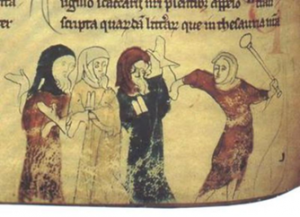
Drawing of 4 people in medieval clothing 3 cowering from one who has his arm raised

The expulsion of the Jews, marginal illustration from the Rochester Chronicles, Wikipedia

On 18th July in the same year, Edward issued the Edict of Expulsion, in which Jews had until 1st November to leave, lest they were subject to be seized and executed. They were only allowed to take with them all that they could carry, with any property being forfeited to the crown. Around 3,000 Jewish people forcefully left England to settle mostly in France and Germany, while those who remained hid their faith. Edward was granted the single largest tax of the Middle Ages – £116,000 by the Parliament.

England reacted and expelled the Jews in 1290, not letting any back in for 365 years, until the year of 1656.  I note that he did that before the  Spanish Inquisition acted.   England was going through losingPilgrims to Holland who left for a new land, America, on a ship called the Mayflower in 1620. 

Historically, Jews have been subject to a number of discriminatory edicts and restrictions in London, particularly during the medieval period, culminating in their expulsion from England in 1290. In contrast, the history of Jews in Greater Manchester began much later, centuries after the readmission of Jews to England, and is not defined by medieval edicts. 
                             London and England: Medieval edicts
The Statute of Jewry (1275)
This major piece of anti-Jewish legislation enacted under King Edward I imposed severe restrictions on Jews across England, including in London. 

  • Abolished moneylending: It prohibited Jews from usury (lending money with interest), which was one of the few professions legally available to them.
  • Required identifying badges: The statute mandated that all Jews over the age of seven wear a distinguishing badge.
  • Restricted movement: It dictated that Jews live in specific areas of the king's towns.
  • Limited property rights: The ability of Jews to sell property or negotiate debts was severely restricted.       

By 1655, MANASSEH BEN ISRAEL went to negotiate with  CROMWELL for the readmission of the Jews, so it must have beenbad news all over of finding accepting lands to live in. This rabbi, a Sepahardi,  Manoel Dias Soeiro, better known by his Hebrew name Menasseh or Menashe ben Israel, was a Jewish scholar, rabbi, kabbalist, writer, diplomat, printer, publisher, and founder of the first Hebrew printing press in Amsterdam in  1626. 

Antonio Robles, requested that he be classified as a Jew rather than Spaniard during the war between England and Spain. He had been a Marrano.  

England finally accepted  a Marrano group (Jews allowing conversion toCatholic religion to hide their Jewishness) in 1664. The original Sephardicommunity was reinforced by Ashkenazi immigrants from Germany andCentral Europe who established their 1st synagogue in London in 1690and spread out over the rest of England.  

In the 19th century, Sir Moses MONTEFIORE  led the   English Jewsinto Jewish philanthropy.  Moses Montefiore (1784-1885) was among the most famous Jews of the 19th century. He served as president of the British Board of Deputies (1835-1874). Queen Victoria appointed him Sheriff of the City of London and bestowed a knighthood on him in 1837, followed later by a baronetcy. 

  • The year 1829: The Roman Catholic Relief Act of 1829 granted greater civil rights to Catholics, fueling hope among other minorities, including Jews, for their own emancipation.  The long struggle for Jewish emancipation: Sir Moses Montefiore was a prominent figure in the subsequent campaign for Jewish emancipation, which was a protracted struggle taking place throughout the 19th century. 
  • Because of this, Lionel de ROTHSCHILD was admitted to parliament in 1858. From 1881, the older community was strongly reinforced by  an immigration of refugees from Russian persecutions;  and soon people 
were adapting o the English Jewish way of life under the CHIEF RABBI,
BOARD OF DEPUTIRS OF BRITISH JEWS, and in London, the UNITED
SYNAGOGUE. New communities of importance existed in
LEEDS, GLASGOW, MANCHESTER, etc.  More refugees
arrived from Germany in 1933-1939 which helped to
stimulate a weak and short-lived organized anti-Semitic
movement.  England was the only important European
country to escape the Nazi persecutions, but the air
bombardment of the main cities and scattering of the
Jewish population changed and weakened the traditional
Jewish life. 

 The Jewish population of Great Britain (including northern
Ireland) is estimated in 1990 at 330,000.  The Jewish population of England was approximately 271,327 according to the 2021 UK Census, representing about 0.5% of the population of England and Wales. Over half of these individuals (53.6%) resided in Greater London, with other significant populations in Greater Manchester, Leeds, and Brighton. 

There are approximately 103,000 English-speaking Jews living in Israel, according to the Joshua Project. This figure represents a significant portion of the Jewish diaspora in Israel, which now numbers over 7 million globally.  
 
This data refers to English-speaking Jews, which includes people from English-speaking countries like the UK, Canada, Australia, and the US who have made Israel their home. 

There were approximately 21,000 Israeli-born residents in Great Britain as of 2019, though only about 8,000 of these individuals held Israeli nationality. Data from 2015 suggested that there were around 25,000 Israelis living in Britain, and recent trends show that the number of Israelis migrating to Britain from Israel has generally outnumbered the number of British Jews migrating to Israel in the 21st century.  In other words,  more Jews are leaving Israel and returning to Britain than the other way around.  

Resource:
https://museumofoxford.org/how-the-jewish-community-of-oxford-
brought-coffee-to-england/#:~:text=The%20first%20Jewish%20settle
ments%20in,as%20the%20King%20of%20England.


Jewish Move To Ireland, Scotland, Wales

 Nadene Goldfoot


When England's behavior turned against people for just being Jews, manyleft for Ireland.  Jews may have lived here in the 12th and 13th centuries,but none survived the expulsion of 1290.  A few Marranos settled in Dublinafter 1660 and more arrived as military purveyors after the 1689 revolu-tion.  The Original Sephardi group was displaced by the European Ashken-azim, but in the 18th century, this community, too, declined and in 1816,there were only 3 Jewish families in Dublin, and a few in the rest of Ireland.  The Dublin community was reconstituted in 1822 when  therewere 400 Jews in Ireland in 1800.  


The chief rabbinate was founded in 1918, its first rabbi being Yitzhak
Halevi HERZOG.  

By 1880 , emigration from Europe at the end of the 19th century, andother communities appeared at the cities of Cork, Waterford, Limerick,Belfast, etc. mainly in Belfast. 

                                 Ray Rivlin is the author

My family Goldfus were from Telsai, Lithuania and went to England and onto  Dublin, living there with a relative in a boarding house,  with name changes, leaving from Londonderry, Ireland for Quebec, and finally getting to theUSA.    His relatives in the boarding house went to South Africa and wereforgotten about by each group until the late 1900's.  It seems they hadleft an opera singer in London, somehow.  This is the problem;  siblingsleft each other for different refuges and lost touch with their family members.    Today with DNA testing, they can rejoin.           


Scotland's Jews

Jewish merchants were found in EDINBURGH and GLASGOW by the 17thcentury.  In the 18th, some Jews studied medicine at Scottish universities. 

A Jewish community leaves evidence in Edinburgh in 1780 but only reallyorganized by 1816, following one in Glasgow in 1823.  The Russian Jewishimmigration resulted in the growth of the latter, which is the 4th in size inGreat Britain.  Edinburgh has only 600 Jews.  Smaller communities weren Aberdeen and Dundee.  1990 was 12,000.which were under English rule.In 2025, the Jewish population in Scotland is estimated to be around 6,000 individuals, according to the 2022 census data, a figure that has remained stable in recent years. The majority of Scotland's Jewish community is concentrated in the Greater Glasgow area, particularly in East Renfrewshire, with a smaller community in Edinburgh. 

  • Jews In Wales

Only a few Jews were found in Wales by the 13th century, but only inplaces under English influence like CHEPSTOW, CAERLEON, though theircharters of new northern Welsh boroughs excluded Jews. 

German Jews settled in SWANSEA from 1731-1741, and its communitymay be dated from 1768.  Later, communities were founded in miningcenters in southern Wales such as CARDIFF in  1840, MERTHYR TYDFIL in 1848, PONTYPRIDD in 1867, TREDEGAR in 1873 etc.  Several otherswere set up by Russian refugees after 1882.  They filled a useful fun-ction economically but during the strikes of 1911, anti-Jewish riotingdeveloped.  

The smaller Jewish communities have been shrinking, even some beingabandoned, and CARDIFF, WITH 1,700 Jews, contained 3/4 of the totalJewish population. 

       London and England: Medieval edicts against Jews
The Statute of Jewry (1275)
This major piece of anti-Jewish legislation enacted under King Edward I imposed severe restrictions on Jews across England, including in London. 

  • Abolished moneylending: It prohibited Jews from usury (lending money with interest), which was one of the few professions legally available to them.
  • Required identifying badges: The statute mandated that all Jews over the age of seven wear a distinguishing badge.
  • Restricted movement: It dictated that Jews live in specific areas of the king's towns.
  • Limited property rights: The ability of Jews to sell property or negotiate debts was severely restricted.    
  •  Medieval Wales had no charters for Jews in London or elsewhere, but instead saw charters that explicitly banned Jews from newly established towns. The history of Jews in Wales is linked to that of Jews in England through the actions of English monarchs, especially during the period before the 1290 Edict of Expulsion, which drove Jews out of the entire kingdom. 
Charters in Wales:  The first organized Jewish communities in Wales did not appear until the 18th century. However, during the medieval period, some individual Jews lived in the Welsh Marches. When Edward I built his new borough towns in North Wales after conquering the region (1277–1283), he issued charters that banned Jews. 

England reacted and expelled the Jews in 1290, not letting any back in for 365 years, until the year of 1656.  I note that he did that before the  Spanish Inquisition acted.   England was going through losingPilgrims to Holland who left for a new land, America, on a ship called the Mayflower in 1620. 

Historically, Jews have been subject to a number of discriminatory edicts and restrictions in London, particularly during the medieval period, culminating in their expulsion from England in 1290. In contrast, the history of Jews in Greater Manchester began much later, centuries after the readmission of Jews to England, and is not defined by medieval edicts. 
  • The expulsion of Jews from England in 1290 also applied to Wales and Ireland, which were under English rule at the time. However, it is unlikely that any official expulsion order was issued for Scotland because it was a separate kingdom from England during that period, and there is no evidence of a Jewish community in Scotland at the time. The expulsion of Jews from England in 1290 also applied to Ireland, since Ireland was part of the English kingdom at the time. However, small groups of Jews later resettled in Ireland in the centuries following the edict. 


Sunday, September 28, 2025

THE GREAT RETURN PROPHECIZED

 Nadene Goldfoot                                            


Making an Aliyah means going up;  rising spiritually in your thinking, understanding. To Jews  it means immigrating to Israel to live. Today we really go up, starting in a Jet Plane.    Long ago people braved it in ships.

The "Great Return of Jews" refers to the biblical prophecies, particularly from Isaiah and Ezekiel, that foretold the Jewish people would be regathered from their scattered positions around the world to their ancient homeland, Israel

While a previous return occurred after the Babylonian captivity, many interpretations, especially in Christian and Zionist thought, see the establishment of the State of Israel in 1948 and the subsequent mass migrations of Jews to the land as the fulfillment of these prophecies, marking the "Great Return". 

Way back in 1121, some 300 Jews went to Palestine from France and England. Life was unbearable for them in France and England. England expelled the Jews in 1290 which lasted for 365 more years till 1656. France has expelled its Jewish population multiple times, with key expulsions occurring in 1182 (under Philip Augustus), 1306 (under Philip IV), and 1394 (under Charles VI)Jews were also targeted during World War II by the Vichy regime and the German occupiers, leading to deportations to concentration and extermination camps.  

In 1267 Nahmanides and Obadiah of Bertinoro in 1488 went to Palestine and were both followed by groups of disciples;  while as a result of the Spanish expulsion in 1492 (when Columbus sailed the ocean blue), many Sephardi Jews,  including an important kabbalistic circle,  entered the country of Palestine.  In 1564 was Joseph Nasi's resettlement attempt which had brought groups from Italy.  


Finally, while in 1700, 1,500 Jews arrived from Eastern Europe in response to Rabbi Judah Hasid's call.  In the latter 18th century, there was a considerable number of both Hasidim and followers of the Vilna Gaon. Approximately 511 disciples of the Vilna Gaon, along with their families, followed him to Eretz Yisrael (the Land of Israel) in the years 1808–1810, a significant aliyah movement that took place a decade after his death. While the Gaon himself promoted immigration to Israel, it was his disciples who made the journey, fulfilling his wish and bolstering the Jewish community in what was then Ottoman Palestine.   

In the 30 years (1850-1880) preceding  the BILU (Bet Yaakov lekhu ve-nelkhah) or "Oh house of Jacob, come ye and let us go.", it is estimated that 20,000-30,000 Jews settled in Palestine.  Organized mainly and influenced by Zionism, this began in 1882

This was the 1st Aliyah (1882-1903) which started under the attacks of Russian pogroms and was led by the BILU (It was the first modern Zionist pioneering movement founded at Kharkov by Jewish students reacting against the wave of Russian pogroms). Several branches of BILU numbered 525 members, with only a few actually going to Palestine, for it was a risky scary move.  

The first group was made up of 15 men and women who reached the town of Jaffa in the summer of 1882 an the others, later that year.  They experienced severe hardship.  Some of them settled on the land in different colonies and others went to Jerusalem to master handicrafts.  They came with their visions of social reform.  Guess what!  It antagonized various circles of Hoveve Zion but they received support from Jehiel Michael Pines who urged them to settle the colony of Gedera by 1884.  

So, in 1882, 300 families and additional smaller groups arrived from Russia, 450 pioneers from Romania, and a few dozen from the Yemen.

There was a conference held in 1884 by Hoveve Zion to coordinate immigration which resulted in the KATTOWITZ CONFERNCE.  The Turkish authorities tried to create difficulties for them and an increasing number of AGRICULTURAL SETTLEMENTS were founded  

Persecutions kept happening in Europe  in 1890 which sent thousands of Russian Jews to Palestine.  The number got smaller during the rest of the decade.  About 25,000 Jews immigrated during the 1st Aliyah, but a number subsequently also emigrated.  They had gone from cold Russia to hot hot Palestine with Turkish guards.  

The 2nd Aliyah (1904-1914) ended with WWI's beginning.  Olim from Russia kept coming, especially from Kishinev and Homel pogroms and the failure of the 1905 revolution in Russia.   Many of these newcomers were motivate by socialist idealism.  35,000-40,000 Jews entered during this period, many from eastern Europe and oriental countries.  A number left the country after a time but in 1914  the Jewish population was 90,000, falling to 50,000 by the end of World War I.  

The Balfour Declaration gave the impetus to the 3rd Aliyah (1919-1923) after the war. This had a youthful element that predominated with members of the HE-HALUTZ being prominent.  In 1920, free immigration was permitted to persons with means of subsistence, craftsmen, those joining their families, and Talmud students whose upkeep was assured.    In addition, a quota was fixed for immigrants whose maintenance was guaranteed by the Zionist Organization.  These regulations were modified the following year but the principle remained.  Annual immigration figures for 1920-1923 averaged 8,000 and at the end of the period the country's Jewish population was again about 90,000.  

80,000 more entered during the next period of the 4th Aliyah (1924-1931).  The largest majority came from 1924-1925.  The main source of Jews came from Poland where Jews suffered from fiscal restrictions.  Many of the newcomers were middle-class some being "capitalists", that is...owners of 500 lbs, and later 1,000 lbs. A number left, especially during the 1926 depression, but there were 190,000 Jews in Palestine in 1931.   

The 5th Aliyah that divides into two periods:

(1932-1935).  This was the beginning of the Nazi persecution,  when 144,000 immigrants of which 62,000 came in 1935, followed by economic prosperity.  During this time YOUTH ALIYAH was founded.  

(1936-1940) This coincided with Arab riots and economic depression, when Aliyah was restricted by the mandatory government of Great Britain;  first for economic and later for political reasons.  Nevertheless, in 1936 to 1938 there were 53,000 immigrants.  In 1939, the MacDonald White Paper recommended that only 75,000 more Jews be allowed admission during the next 5 years and then Aliyah would be dependent on Arab agreement.  However, 36,000 immigrants entered during the 2nd phase of the Fifth Aliyah, including 15,000 "illegal" immigrants meaning they lacked government permits in 1939-1940.

The 6th Aliyah (1941-1947) This was a period of struggle against restrictions on immigration.  Many tragic incidents were recorded  and during the latter years many intending immigrants were interned in Cyprus.  85,000 Jews arrived in this time, of whom 28,000 were "illegal immigrants." 

 There were 750,000 Jews in Israel when the state was established in 1948. Free Jewish immigration waas immediatlaey proclaimed and the period of mass Aliyiot was inauagurated.  The survivors of Nazi rule in Central Europe, the internees in Cyprus, the Jewries of countries behind the Iron Curtain, and the communities under Arab rule like Yemen, Iraq, were transferred to Israel under the auspices of the Jewish Agency's Immigration Department.  Jews have continued a steady immigration since that time again reaching large numbers in the early 1970's with my husband and I making Aliyah in 1980 with 20,428 others that year, mostly Russians  and since 1989 with mass Aliyah from the USSR, of course.  Total immigration figures for the period 1948-1990 were running from:

1948=101,819    and  1991=175,000.  Every year in-between was a 5 figured number.                          

                                             
Marco Rubio, Sec of State just gave a great speech about the Jews and their return and how they have lasted while the others who attacked and took the land have not existed till today.  It was an amazing speech !  Found on you tube.  

This was the time talked about in the Bible, the return of the Jews.  "It's a powerful reminder of the Judeo-Christian values that inspired America's Founding Fathers," he wrote, a reference to the site's biblical significance. The excavated road is believed to have been traversed by visitors to Judaism's Second Temple around the time of Jesus Christ.

The Trump administration's 2017 recognition of Jerusalem as Israel's capital and the subsequent move of the U.S. embassy to the city from Tel Aviv marked a departure from decades of American policy that Jerusalem's status should be determined through Israeli-Palestinian negotiations.
The visit comes ahead of a meeting of world leaders at the United Nations in New York this month where Britain, France, Canada, Australia and Belgium are expected to formally recognize a Palestinian state, which Israel rejects.
Rubio has said that move will only encourage Israel to take its own actions to prevent the formation of a Palestinian state."  He's right.  Netanyahu has said that he will not stand for a Palestinian state next door to Israel.