Nadene Goldfoot

On 8 March 1920, Abdullah was proclaimed King of Iraq by the Iraqi Congress but he refused the position. After his refusal, his brother Faisal who had just been defeated in Syria, accepted the position. In fact, Abdullah I was never King of Iraq. He was initially proclaimed King of Iraq by the Iraqi Congress in 1920, but he declined the position. His brother, Faysal I, accepted the Iraqi throne instead. Abdullah later became the Emir of Transjordan, which later became the Hashemite Kingdom of Jordan.


Faisal was the son that was first thought to become friend of Israel. The individual who met with Chaim Weizmann in Paris was Emir Faisal ibn Hussein, son of Sharif Hussein of Mecca. They signed an agreement on January 3, 1919, during the Paris Peace Conference, known as the Faisal-Weizmann Agreement.
How Jordan became a country of an Arabian son was an event that was very fast. Abdullah I became

Abdullah II, son of King Hussein of Jordan, became the king of Jordan in 1999 after his father's death. Abdullah had been named heir apparent just weeks before his father's passing. His father was Hussein bin ali Sharif.

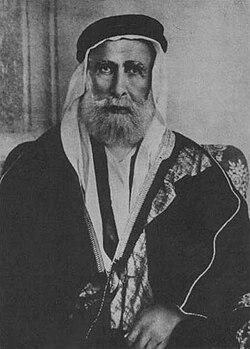
Hussein ibn Ali Sharif of Mecca
Hussein bin Ali, the Sharif of Mecca, primarily aided Great Britain by leading the Arab Revolt against the Ottoman Empire during World War I. He initiated the revolt in 1916 after securing promises of British support for Arab independence, as detailed in the Hussein-McMahon Correspondence. In exchange, the Sharif of Mecca's forces fought against the Ottomans, contributing to the Allied cause in the Middle East. This was the founding father of the king of Jordan today.
 The Hashemites were the royal family of the kingdoms of Hejaz (1916–1925 which was the majority of the western region of Saudi Arabia, covering the cities of Mecca),..and

Syria (1920), and Iraq (1921–1958). The family had ruled the city of Mecca (which we know is in today's Saudi Arabia) continuously from the 10th century, frequently as vassals of outside powers, and ruled the thrones of the Hejaz, Syria, Iraq, and Jordan following their World War I alliance with the British Empire.
The family belongs to the Dhawu Awn, one of the branches of the Ḥasanid Sharifs of Mecca, also referred to as Hashemites. Their eponymous ancestor is traditionally considered to be Hashim ibn Abd Manaf, great-grandfather of the Islamic prophet Muhammad. Talk about having pull!
His problem is the other relative also claiming closeness to Muhammad, and this one was the impedus of Shia Islam. Another claimed ancestor is Ali ibn Abi Talib, the usurped successor of the prophet Muhammad according to Shia Islam. He must have settled in Persia (Iran).

A Shia Muslim relative of Ali ibn Abi Talib was Mohammad Amin al Husseini, who had never been a friend of the Jews. He's the one who was Samuel's designated Grand Mufti of Jerusalem because of his family lines, though he was from the opposing side, the Shia. The irony is that Samuel was Jewish. Husseini was the agitator who told the Arabs to riot against the Jews.

Today's Prince Faisel of Jordan Prince Faisal bin Al Hussein (Arabic: فيصل بن الحسين; born 11 October 1963) is a Jordanian prince who is a son of King Hussein and Princess Muna, and the younger brother of King Abdullah II. Periodically he has served as regent during his brother's absences abroad.
The Hussein-McMahon Correspondence refers to a series of letters exchanged between Sharif Hussein of Mecca and Sir Henry McMahon (British High Commissioner in Egypt) in 1915-1916 during World War I. The correspondence promised British support for an independent Arab state in return for Arab assistance in the war against the Ottoman Empire.
Balfour Doctrine: “His Majesty’s Government views with favour the establishment in Palestine of a national home for the Jewish people, and will use their best endeavours to facilitate the achievement of this object, it being clearly understood that nothing shall be done which may prejudice the civil and religious rights of the existing non-Jewish communities in Palestine, or the rights and political status enjoyed by Jews in any other country.”
In 1915, towards the beginning of the war, the Brits were really feeling the pressure to defeat the Ottomans. They wanted to enlist the support of the Arabs against the Ottomans who were in control of much of the Middle East. The Arab leadership was against the modernizing, secular Ottomans.
Enter Sharif Husayn bin Ali of Mecca. Sharif is Arabic for “noble” and describes the descendants of Prophet Muhammad’s grandson al-Hassan ibn Ali. Basically, he was a primary leader in the Arab world. He had a need — to get rid of the Ottomans. The Brits had the same need — so like any good OL’ fashioned transactional relationship, the Arabs and Brits started talking. “I scratch your back. You scratch mine” sort of thing. In 1915, he began correspondence with Colonel Sir Henry Mcmahon, and essentially made a deal: if the Arabs joined the fight against the Ottomans, the Brits would recognize Arab independence in specific areas, which would include the region of Palestine. These would later be called the M-H correspondence.

Then, in May of 1916, the British and French started dividing up the Middle East like it was a game of fantasy football or something. It was called the Sykes-Picot agreement and it was TOP SECRET (until it wasn’t).The Sykes-Picot Agreement, also known as the Asia Minor Agreement, was a secret agreement made in May 1916 between the UK and France, with the assent of Russia, to divide the Ottoman Empire's Arab territories into British and French spheres of influence after World War I. This agreement aimed to carve out specific regions for each power's control, influencing the future of the Middle East. Representing the UK, coming in at 5’10 (I MADE UP THAT HEIGHT) was Mark Sykes, and repping team France was Francois Georges-Picot. As they divvied up the Middle East, they decided that Palestine (remember, that’s what the region was called then – NOT A STATE BUT THE REGION) would be under “international administration.” British got Palestine and French got
Lebanon, Turkey, Syria and the Kurdistan region.
on the 30 year mandate.

And then, the following year, the Balfour Declaration of 1917 was composed, which gave official British support for a “Jewish national home in Palestine.”
So, you know when you’re dating someone and then you find out they’re kind of dating a few other people? (pause)…hopefully not but if you do or if you can imagine it,, that’s basically what the United Kingdom was doing at the time.
Some people look back at Britain’s negotiations as deceitful… and humorously, or maybe not so humorously, – refer to the Land of Israel as “the much too promised land” or the “twice promised” land, AS OPPOSED TO THE PROMISED LAND.s
Arabs helped to win the war with the Arab leader fighting; and the Jews also had helped to win the war by giving the special umph to the ammunition with Weizmann's bio-chemical ingredients of which without, they would not have won.


