Showing posts with label King Abdullah. Show all posts

Saturday, May 31, 2025

How Jordan Came To Be Under Arabia's Umbrella and Britain's Partner

 Nadene Goldfoot                                                

                                    Abdullah I in 1942 Reign 25 May 1946 – 20 July 1951

On 8 March 1920, Abdullah was proclaimed King of Iraq by the Iraqi Congress but he refused the position. After his refusal, his brother Faisal who had just been defeated in Syria, accepted the position.  In fact, Abdullah I was never King of Iraq. He was initially proclaimed King of Iraq by the Iraqi Congress in 1920, but he declined the position. His brother, Faysal I, accepted the Iraqi throne instead. Abdullah later became the Emir of Transjordan, which later became the Hashemite Kingdom of Jordan. 

 Chaim Azriel Weizmann 27 November 1874 – 9 November 1952) was a Russian-born Israeli statesman, biochemist, and Zionist leader who served as president of the Zionist Organization and later as the first president of Israel. He was elected on 16 February 1949, and served until his death in 1952.
Chaim Weizmann, chemist:  
 His acetone production method was of great importance in the manufacture of cordite explosive propellants for the British war industry during World War I. It helped greatly the British who then won the war.   Weizmann was instrumental in obtaining the Balfour Declaration of November 2, 1917 and convincing the United States government to recognize the newly formed State of Israel in 1948.  Weizmann became the 1st President of Israel May 14,  1948.  Chaim is the one wearing a dark tie.  The Balfour Declaration was written on November 2, 1917.                                  


 It was a letter from British Foreign Secretary Arthur James Balfour to Baron Lionel Walter Rothschild, expressing the British government's support for the establishment of a national home for the Jewish people in Palestine. Lionel Walter Rothschild was born in London as the eldest son and heir of Emma Louise von Rothschild and Nathan Rothschild, 1st Baron Rothschild, an immensely wealthy financier of the international Rothschild financial dynasty and the first Jewish peer in England.

                                                                                                      Balfour above on left; and on right is Rothschild.  

Faisal was the son that was first thought to become friend of Israel. The individual who met with Chaim Weizmann in Paris was Emir Faisal ibn Hussein, son of Sharif Hussein of Mecca. They signed an agreement on January 3, 1919, during the Paris Peace Conference, known as the Faisal-Weizmann Agreement.  

How Jordan became a country of an Arabian son was an event that was very fast.  Abdullah I became Emir of Transjordan in April 1921. He upheld his alliance with the British during World War II, and became king after Transjordan gained independence from the United Kingdom in 1946. In 1949, Jordan annexed Judea and Samaria  (the West Bank), which angered Arab countries including Syria, Saudi Arabia and Egypt.  Israel was also angered, as that piece of land had already been promised to the Jews as the eastern part of the Jewish Homeland, discussed in the Balfour Doctrine in writing.  With the attainment of independence, Abdullah became the first monarch of the Hashemite Kingdom of Transjordan, which later became the Hashemite Kingdom of Jordan. 

King Abdullah II bin Al-Hussein (Arabic: عبد الله الثاني بن الحسين, ʿAbd Allāh aṯ-ṯanī bin Al-Ḥusayn; born 30 January 1962) is King of Jordan, having ascended the throne on 7 February 1999. He is a member of the Hashemites, who have been the reigning royal family of Jordan since 1921, and is considered a 41st-generation direct descendant of the prophet Muhammad.

 Abdullah II, son of King Hussein of Jordan, became the king of Jordan in 1999 after his father's death. Abdullah had been named heir apparent just weeks before his father's passing. His father was Hussein bin ali Sharif. 


                                  Hussein ibn Ali Sharif of Mecca

Hussein bin Ali, the Sharif of Mecca, primarily aided Great Britain by leading the Arab Revolt against the Ottoman Empire during World War I. He initiated the revolt in 1916 after securing promises of British support for Arab independence, as detailed in the Hussein-McMahon Correspondence. In exchange, the Sharif of Mecca's forces fought against the Ottomans, contributing to the Allied cause in the Middle East. This was the founding father of the king of Jordan today.  
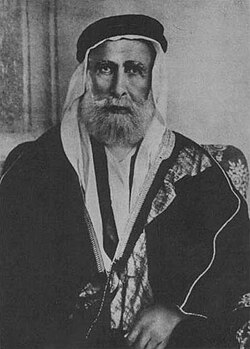
 

The family belongs to the Dhawu Awn, one of the branches of the Ḥasanid Sharifs of Mecca, also referred to as Hashemites. Their eponymous ancestor is traditionally considered to be Hashim ibn Abd Manaf, great-grandfather of the Islamic prophet Muhammad. Talk about having pull!  

His problem is the other relative also claiming closeness to Muhammad, and this one was the impedus of Shia Islam.  Another claimed ancestor is Ali ibn Abi Talib, the usurped successor of the prophet Muhammad according to Shia Islam.  He must have settled in Persia (Iran).                                

Mohammed Amin al-Husseini (Arabic: محمد أمين الحسيني; c. 1897 – 4 July 1974) was a Palestinian Arab nationalist and Muslim leader in Mandatory Palestine. Al-Husseini was the scion of the al-Husayni family of Jerusalemite Arab nobles, who trace their origins to the Islamic prophet Muhammad.😠

A Shia Muslim relative of Ali ibn Abi Talib was Mohammad Amin al Husseini, who had never been a friend of the Jews.  He's the one who was Samuel's designated Grand Mufti of Jerusalem because of his family lines, though he was from the opposing side, the Shia. The irony is that Samuel was Jewish.  Husseini was the agitator who told the Arabs to riot against the Jews. 

Today's Prince Faisel of Jordan Prince Faisal bin Al Hussein (Arabic: فيصل بن الحسين; born 11 October 1963) is a Jordanian prince who is a son of King Hussein and Princess Muna, and the younger brother of King Abdullah II. Periodically he has served as regent during his brother's absences abroad.

The Hussein-McMahon Correspondence refers to a series of letters exchanged between Sharif Hussein of Mecca and Sir Henry McMahon (British High Commissioner in Egypt) in 1915-1916 during World War I. The correspondence promised British support for an independent Arab state in return for Arab assistance in the war against the Ottoman Empire. 

Balfour Doctrine:  “His Majesty’s Government views with favour the establishment in Palestine of a national home for the Jewish people, and will use their best endeavours to facilitate the achievement of this object, it being clearly understood that nothing shall be done which may prejudice the civil and religious rights of the existing non-Jewish communities in Palestine, or the rights and political status enjoyed by Jews in any other country.”

In 1915, towards the beginning of the war, the Brits were really feeling the pressure to defeat the Ottomans. They wanted to enlist the support of the Arabs against the Ottomans who were in control of much of the Middle East. The Arab leadership was against the modernizing, secular Ottomans.

Enter Sharif Husayn bin Ali of Mecca. Sharif is Arabic for “noble” and describes the descendants of Prophet Muhammad’s grandson al-Hassan ibn Ali. Basically, he was a primary leader in the Arab world. He had a need — to get rid of the Ottomans. The Brits had the same need — so like any good OL’ fashioned transactional relationship, the Arabs and Brits started talking. “I scratch your back. You scratch mine” sort of thing. In 1915, he began correspondence with Colonel Sir Henry Mcmahon, and essentially made a deal: if the Arabs joined the fight against the Ottomans, the Brits would recognize Arab independence in specific areas, which would include the region of Palestine. These would later be called the M-H correspondence.

Then, in May of 1916, the British and French started dividing up the Middle East like it was a game of fantasy football or something. It was called the Sykes-Picot agreement and it was TOP SECRET (until it wasn’t).The Sykes-Picot Agreement, also known as the Asia Minor Agreement, was a secret agreement made in May 1916 between the UK and France, with the assent of Russia, to divide the Ottoman Empire's Arab territories into British and French spheres of influence after World War I. This agreement aimed to carve out specific regions for each power's control, influencing the future of the Middle East.  Representing the UK, coming in at 5’10 (I MADE UP THAT HEIGHT) was Mark Sykes, and repping team France was Francois Georges-Picot. As they divvied up the Middle East, they decided that Palestine (remember, that’s what the region was called then – NOT A STATE BUT THE REGION) would be under “international administration.”  British got Palestine and French got 
Lebanon, Turkey, Syria and  the Kurdistan region.  
on the 30 year mandate.  


And then, the following year, the Balfour Declaration of 1917 was composed, which gave official British support for a “Jewish national home in Palestine.”

So, you know when you’re dating someone and then you find out they’re kind of dating a few other people? (pause)…hopefully not but if you do or if you can imagine it,, that’s basically what the United Kingdom was doing at the time.

Some people look back at Britain’s negotiations as deceitful… and humorously, or maybe not so humorously, – refer to the Land of Israel as “the much too promised land” or the “twice promised” land, AS OPPOSED TO THE PROMISED LAND.s

Arabs helped to win the war with the Arab leader fighting; and the Jews also had helped to win the war by giving the special umph to the ammunition with Weizmann's bio-chemical ingredients of which without, they would not have won.  


Friday, March 28, 2025

Golda Meir From Milwaukee, Wisconsin

 Nadene Goldfoot                                         

Golda Meir Memorial Plaque on the building where she was born (5-A Baseina Street, Kyiv), Ukraine

Who would know about Golda's long term education of the United States history as Golda Mabovitch  that had an impact on her?  She spent a lot of time here as an immigrant, born on May 3, 1898 in the Ukraine. They had settled in Milwaukee, Wisconsin.   She was an American that became  the fourth prime minister of Israel from 1969 to 1974.  Her family immigrated in 1906 when she was only 8 years old.  That would place her in the 3rd grade.  She spent a good 15 years of living in the USA, mostly all in Milwaukee while growing up, those very informative years.   

                                   Golda in 1914 at age 16

On 9 July 1917, Golda at 19 became a naturalized US citizen, as her father had naturalized, and at that time children of naturalized citizens under the age of 21 received citizenship by descent.

"On 24 December 1917, Golda Mabovietch  and Morris Meyerson (b:17 December 1893 in Chicago, Illinois) married. He was 5 years older than she.  However, Meir's precondition for marriage was to settle in Palestine. She had intended to make aliyah (immigration to Israel) straight away, but her plans were disrupted when all transatlantic passenger services were canceled due to the entry of the United States into the First World War. She then threw her energies into Poale Zion activities. A short time after their wedding, she embarked on a fund-raising campaign for Poale Zion that took her across the United States." From 1917 to 1921, 4 years, they lived in the USA.  

Golda Mabovitch,  married to Morris Meyerson,  made Aliyah  in 1921 when she was 23;  now Golda Meir and her husband  to Mandatory Palestine, settling in Merhavia, later becoming the kibbutz's representative to the Histadrut.  This was at the time of the end of WWI and the division of the Ottoman Empire.  Palestine was promised to become the Jewish National Homeland in Paris world-wide meetings, then quickly also promised to Prince Abdullah of Arabia most of the land.  

She spent two years (1932–34) in the United States as an emissary for an organization and to get expert medical treatment for her daughter's kidney illness.

                     Golda in Haifa 1947

On 17 November 1947, when Golda was 49, shortly before the outbreak of the 1947-1949 Palestine war, Meir met with King Abdullah I of Jordan. Abdullah I was seen as the only Arab leader willing to ally with a future Israeli state, as he also opposed the Mufti of Jerusalem and was rivals with other Arab countries. The meeting was cordial and confirmed that Abdullah was uninterested in invading and quietly willing to cooperate in the future.

On 6 May, 1948 and now 50 years old,  she visited Haifa after its 22 April occupation by Hagannah. This trip had a significant impact on her. There, she witnessed an elderly Arab woman emerging from a destroyed house, clutching to her few remaining belongings. When the two women made eye contact, they burst into tears. Meir went on to call the mass expulsion and flight of Arabs before the 1948 Palestine war "dreadful", and likened it to what befell the Jews in Nazi-occupied Europe. Jews had tried to stop their leaving but their leadership urged them to stay in refugee camps.  She returned to Tel Aviv, and eventually to Jerusalem two weeks before the end of the 30 year mandate the British had held. 

        Where is Jordan in 1922?  It's Trans-Jordan.  

On 10 May, Meir had a second meeting with Abdullah I. She travelled to Amman in secret, disguised as an Arab woman. He proposed that Palestine be absorbed into Jordan, with autonomy granted to majority-Jewish areas. Golda rejected the proposal. It then seemed likely that Abdullah I would invade.  

  • 1921:
    The Emirate of Transjordan was established with Abdullah as its emir, under the British Mandate for Palestine. 1922:  The League of Nations recognized Transjordan as a state under the terms of the Transjordan memorandum. 1946:March 22: The Treaty of London, also known as the Anglo-Transjordanian treaty, was signed, recognizing the full independence of Transjordan. May 25: Transjordan became the Hashemite Kingdom of Jordan, and Abdullah was proclaimed king. 1948:Following the end of the British Mandate for Palestine and the declaration of the state of Israel, Transjordan, now Jordan, entered the 1948 Arab-Israeli War and annexed the West Bank. 1967:Israel captured the West Bank during the Six Day War, and Jordan gave up its claim to the territory in 1988. 

                             Golda in 1964

In 1969, Meir assumed the role of prime minister following the death of Levi Eshkol. Early in her tenure, she made multiple diplomatic visits to western leaders to promote her vision of peace in the region. 

The outbreak of the Yom Kippur War in 1973 caught Israel off guard and inflicted severe early losses on the army. It was during her 2nd term, and was her downfall.  She resigned the following year and was succeeded as prime minister by Yitzhak Rabin. Meir died in 1978 at age 80 of lymphoma and was buried on Mount Herzl. On October 6, 1973, Meir approved full-scale mobilizing but rejected a preemptive strike, citing concerns that Israel might be perceived as initiating hostilities, which would hurt Israel's access to crucial foreign aid and military support, in particular from the United States, in the resulting conflict. She made it a priority to inform Washington of her decision. U.S. Secretary of State Henry Kissinger later confirmed Meir's assessment by stating that if Israel had launched a preemptive strike, Israel would not have received the backing of the United States. Golda resigned in 1974.  Following the Yom Kippur War, Meir's government was plagued by infighting and questions over Israel's lack of preparation for the war. The Agranat Commission appointed to investigate the war cleared Meir of "direct responsibility". It said about her actions on Yom Kippur morning: She decided wisely, with common sense and speedily, in favour of the full mobilization of the reserves, as recommended by the chief-of-staff, despite weighty political considerations, thereby performing a most important service for the defence of the state. 


She had been the daughter of Moshe Yitzhak Mabovitch (died 1944), a carpenter and Blume Neiditch (died 1951). Moshe moved to Milwaukee, Wisconsin, in search of higher-paying work, and found employment in the workshops of the local railroad yard. The following year, he had saved up enough money to bring his family to the United States. Golda along with her mother and sisters landed in Quebec and traveled to Milwaukee by train.  Golda never divorced Meyerson, but they had lived separated for some time with her in politics.  

She wrote a wonderful book, an autobiography called My Life which I read long ago.  

She was also brilliant with sayings that were so full of thought; so many of them:  Pessimism is a luxury that a Jew can never allow himself.


Read more at https://www.brainyquote.com/authors/golda-meir-quotes

https://en.wikipedia.org/wiki/Golda_Meir