Showing posts with label UNRWA. Show all posts

Saturday, July 5, 2025

Census of Israel and Gaza of 2014 and 2024

 Nadene Goldfoot                                               

                                                  Gaza Before 2005

In 2005, Israel unilaterally withdrew all Israeli settlers and military forces from the Gaza Strip.  Approximately 8,000 to 9,000 Israeli settlers were moved out of the Gaza Strip during Israel's unilateral disengagement in 2005. This withdrawal involved dismantling all 21 Israeli towns/settlements in the territory. 

This action, known as the Israeli disengagement from the Gaza Strip, involved dismantling 21 Israeli towns in Gaza and four in the West Bank. The decision was driven by various factors, including the high costs and casualties associated with maintaining a presence in Gaza amidst fighting with Palestinian groups and concerns about the growing Palestinian population. The disengagement plan, proposed by Prime Minister Ariel Sharon, aimed to improve Israel's security and political situation by reducing friction with Palestinians and focusing on areas considered strategically important for Israel. Although Israel withdrew its physical presence, the United Nations and other international organizations still consider Gaza to be under Israeli occupation due to Israel's control over its external affairs, as reaffirmed by a 2024 International Court of Justice opinion.

Things left for the Palestinians' use:

Israeli Settlements:
  • By 2005, there were 21 Israeli settlements in the Gaza Strip.
  • Examples include Kfar Darom, Netzarim, Morag, Eretz, Katif, Netzer Hazani, Elei Sinai, Dugit, and Nisanit. 
Other Infrastructure:
  • Roads: Existing road networks within the Gaza Strip.
  • Electricity Infrastructure: Power stations were present.
  • Water Infrastructure: Desalination plants existed.
  • Commercial Greenhouses: Present and utilized for trade.
  • Residential Buildings: Housing for the Palestinian population.
  • Refugee Camps: Housing for Palestinian refugees who fled or were driven from their homes during the 1948 war by their own leadership. 

        Tel Aviv

Israel:  Based on data from around the end of 2014:
  • Total Population: Around 8.3 million.
  • Jewish Population: Approximately 6.2 million (74.9% of the population).
  • Arab Population: Approximately 1.7 million (20.7% of the population).
  • Other Population: Around 4.3% (including Christians and individuals not identifying with a religion or nationality). 
Israel:                                                    
                                       Tel Aviv Today
  • Latest estimate (end of 2024): 10.027 million people. This included foreign nationals.
  • Jewish population: Approximately 7.7 million.
  • Arab population: Approximately 2.1 million.
  • Other residents: Approximately 216,000 foreigners and others not classified as Jewish or Arab. Gaza Strip:; Christians in this number
                                      Israel's LAND FOR PEACE :  GAZA

  • Gaza Strip:
  • Based on data from around the end of 2014
    • Total Population: Estimated at 1.76 million people at mid-2014, with around 1.79 million by the end of 2014.
    • Population Density: Very high at 4,822 persons/km².
    • Young Population: The population was relatively young, with a large percentage of individuals under 15 years old, constituting 43.2% of the population in Gaza Strip at mid-2014. Children aged five to nine formed the largest age group. 
Gaza Strip:                                        
                      Gaza 2025  Destruction 
  • Latest estimate (end of 2024): 2.1 million people. The largest age group would
  • have been children now aged 15 to 19. , fighting age.  
  • Decline in population: Gaza's population declined by 6% (about 160,000 people) in 2024 due to the conflict.
  • Refugee population: A large proportion of the population were refugees before the war. According to the United Nations Relief and Works Agency for Palestine Refugees in the Near East (UNRWA), there are eight official Palestine refugee camps in the Gaza Strip. So all homes were supplied by UNRWA.  They are now
  • probably all destroyed by the war.  

Monday, May 26, 2025

United Nations Used To Brainwash Arabs Into Hamas Terrorists

 Nadene Goldfoot                                              

  Sir Herbert Samuel, 1st Viscount in British Government. He was the first nominally-practising Jew to serve as a Cabinet minister and to become the leader of a major British political party.  He showed favoritism to an Arab and we live to regret it.  

Herbert Louis Samuel became the 1st Viscount Samuel due to his political career and significant contributions to the British government. He entered Parliament as a Liberal MP in 1902, eventually serving in various government offices and holding significant roles. He was appointed as the first High Commissioner for Palestine in 1920, which further solidified his political standing and influence. In 1920, the Prime Minister of Great Britain was David Lloyd George. He served as Prime Minister from 1916 to 1922. He was a Liberal Party politician from Wales. 

In 1921, Herbert Samuel, the British High Commissioner of Mandatory Palestine, appointed Haj Amin al-Husseini as the Grand Mufti of Jerusalem. Samuel's decision followed the death of the previous Mufti, Kamil al-Husayni, and aimed to establish a civil government and religious leadership within Palestine. Al-Husseini was a prominent Arab nationalist and Muslim leader, and his appointment was seen as a way to gain support and control within the local Muslim community. 

Let's go back to Great Britain whose Jewish Samuel appointed the Arab leader, Husseini, as the Grand Mufti of Jerusalem. Samuels thought he was acting so fairly.   Husseini turned around and caused his Arab followers to rebel, riot and attack and kill Jews.

The Husseini family served as Grand Mufti of Jerusalem from 1918 until 1948. Specifically, Husein al-Husseini served from 1921 until 1937, and his term was continued by others from his family after his exile.  The role was created in 1918, with Kamil al-Husayni serving as the first Grand Mufti until his death in 1921. 

Yes, many Iraqi Jews hoped for cooperation with King Faisal I, the first king of Iraq after the British Mandate, and his successor, King Ghazi. Faisal I was King of Iraq from 23 August 1921 until his death in 1933. A member of the Hashemite family, he was a leader of the Great Arab Revolt during the First World War. His people were not mentally ready to share life with Jews, and so in order to hold onto his crown, he went along with them instead of the Jews.  Already his people were being brainwashed by Husseini's teachings.  

This hope was rooted in the British administration's promotion of a pro-British king, Faisal, which also brought about a rise in Arab nationalism. During Faisal's reign, Iraqi Jews enjoyed a period of prosperity and increasing importance. 

At the time, there was the League of Nations.  The League of Nations was officially established on January 10, 1920, and its existence was formally terminated on April 19, 1946. Its primary goal was to prevent future wars and promote international cooperation. 

Then the United Nations took over.  The United Nations was established on October 24, 1945.  They seemed to overlap.  The first Arab states to join were Egypt and Syria. These two were founding members, having signed the UN charter in 1945.  Resolution 273 (III) of 11 May 1949, admitting the State of Israel to membership in the United Nations, was adopted at the second part of the third session.  Israel came into statehood on May 14, 1948.  Many Arab states followed.

Fighting occurred 5 minutes after the announcement of Israel being a state.  Israel when :

  • Context: Following the UN Partition Plan of 1947 which proposed dividing Palestine into separate Arab and Jewish states, a civil war erupted between the two communities. The wars fought by Israel from 1947-1949 are generally called the 1948 Arab-Israeli War or the War of Independence by Israelis and al-Nakba ("the Catastrophe") by Palestinians. 
The United Nations began providing assistance and care to Palestinians through the establishment of the UN Relief and Works Agency for Palestine Refugees (UNRWA) in 1950. UNRWA started operating in May 1950, offering direct relief and works programs for Palestine refugees who had been displaced due to the 1948 Arab-Israeli war.  They have never ended the process.  

Palestinian refugees are considered one of the longest-lasting cases of forced 
migration in modern history and are the longest-standing group under the mandate 
of a specific UN agency, the United Nations Relief and Works Agency for Palestine 
Refugees in the Near East (UNRWA). 

Reports and investigations indicate that some UNRWA (United Nations Relief and 
Works Agency for Palestine Refugees in the Near East) employees have been found
 to be affiliated with or have ties to Hamas, a Palestinian Sunni-Islamist 
fundamentalist terrorist fighting force.  Starting from 1950 to this day, they have had
plenty of time, 75 years to brainwash the people, even the children in their classes.  
That goes back to possibly great-grandparents, grandparents, parents, today's 
children...What did they teach Palestinians other than how to dig tunnels?  What skills
did they learn and why didn't they use them in leaving like other refugees?  
  • Suez Crisis started on October 29, 1956
  • Six Day War started June 1967. 
  • War of Attrition continued in 67 to 1970
  • Yom Kippur War started October 1973 
  • Palestinian Insurgency into South Lebanon started 1971-1982
  • Lebanon War started 1982
  • South Lebanon Conflict: 6 June 1982-2000  Nearly 18 years of warfare between the Israel Defense Forces and its Lebanese Christian proxy militias against Lebanese Muslim guerrilla forces, led by Iranian-backed Hezbollah, within what was defined by Israelis as the "Security Zone" in South Lebanon.
  • First Intifada:  1987-1993
  • Second Intifada:  2000-2005
Peace With Gift of Gaza:  While Israel withdrew its military forces and settlements from the Gaza Strip in 2005, transferring control to the Palestinian Authority (PA), it didn't "give" Gaza to the Palestinians in a formal sense. 
  • 2005 Disengagement: Israel unilaterally withdrew from Gaza, dismantling settlements and military presence, but continued to control borders and airspace.
  • Transfer of Control: Control of Gaza was transferred to the Palestinian Authority (PA) in September 2005. 
Well, we know what they have done with Gaza.  They destroyed all Israel had left for them; even
the businesses they had left to carry on.  They have used Gaza as a shooting range platform
to shoot into Israel.  And England, Canada and France have the audacity to ring the bell to allow
them to create their own state out of Gaza and Judea and Samaria?  This trio is saying to Israel
to die, to be destroyed.  Let them instead host the Nazis;  well, like France did.  How did they like
that?  It would be worse for Israel since the fight is one between religion and not anything else.


Saturday, May 3, 2025

Refugee Camps: Tulkarm and Nur Shams In Judea-Samaria

 Nadene Goldfoot                                             

       Old City of Tulkarm:  Tulkarm's center shifted from the Old Mosque to an empty space in the northwest as the town expanded northward with the construction of government buildings, a post office, a school and a hospital in that area.

Tulkarm refugee camp is located in Tulkarm, north of Judea-Samaria ( the West Bank). It was established in 1950 by the UNRWA. A refugee camp typically consists of settlements, sectors, blocks, communities, and families.  In 1950, the Tulkarm Camp was established by UNRWA in the city, comprising an area of 0.18 square kilometres (0.07 sq mi). Most of the refugees who resided in the camp came from Jaffa, Caesarea and Haifa. 

Refugee camps and towns/cities differ significantly in their purpose, structure, and opportunities. Refugee camps should be something temporary, often isolated locations designed to provide immediate protection and assistance, while towns and cities offer more autonomy, access to services, and long-term possibilities for refugees.;Unfortunately, many Palestinian refugee camps have become more like cities with UNRWA's backing.  Unlike a camp, cities allow refugees to live autonomously, make money and build a better future. When most people think about refugees, they think of sprawling camps separated from the rest of society. But in reality, today—World Cities Day—over 60 percent of the world’s 26.4 million refugees and around half of the world’s 48 million IDPs live in urban areas, mostly in low- and middle-income countries."IDP" : Internally Displaced Person (IDP), which is someone forced to flee their home but remains within their country of origin, or Identity Provider.  

Tulkarm is the second largest Palestinian refugee camp in the West Bank.  It has been found that many UNRWA workers are also members of Hamas.  With a population of over 21,000 people in an area of 0.18 sq km, it is one of the most densely populated refugee camps in the West Bank.

In the wake of the 1993 Oslo Accords between Israel and the Palestine Liberation Organization (PLO), control of Tulkarm was transferred to the Palestinian National Authority (PNA) on 10 December 1995, becoming the third Palestinian city from which Israeli forces withdrew. During the early years of the Second Intifada, Israel temporarily reoccupied Tulkarm. Israeli military administration over Tulkarm ended in 2005, when control of the city was handed back to the PNA. Upon assuming control of the city, the PNA instituted new weapons restrictions limiting militants to a single registered weapon that may not be loaded or carried in public.

In 2023, the IDF launched a raid on the camp as part of the spillover of the Gaza war.On 19 October 2023, the IDF entered the city. 

In August 2024, Israeli bulldozers destroyed miles of the city, including homes, businesses and infrastructure; Israeli soldiers blocked emergency responders from assisting residents. News reports include videos of this attack, as well as assertions by the Israel Defense Forces that it is rooting out terrorism; and that it "undertakes all feasible precautions to avoid damaging essential infrastructure," while acknowledging that these "operations in the area have caused unavoidable harm to certain civilian structures."    

On 3 October 2024 the Israeli military carried out an airstrike on the camp, killing 20 people.  This is one year after the October 7th ,2023 attack of Hamas terrorists on Israeli homes along the border of Gaza.                  The IDF is planning to demolish around 60 buildings in the Tulkarm refugee camp and 40 in the nearby Nur Shams camp.

Tulkarm Refugee Camp General information • Established: 1950 • Size: .18 sq km • Population before 1967 (OCHA): 8,450 • Estimated population (PCBS): 12,000 • Registered persons (UNRWA): 21,500 • Estimated density: 119,444 per sq km • Places of origin: Various villages and cities near Haifa, Jaffa, Kissaria areas.  

Ashland, Oregon has a population of 21,374 residents as of the 2020 census. Another city in the same general population range is Milwaukie, with a population of just over 21,000.   That gives you a general idea of the size of this town called a Refugee Camp.  

UNRWA in Tulkarm camp Main UNRWA installations: • Four schools • One health centre UNRWA employees working in Tulkarm camp : 141 • Education: 85 • Health: 30 • Relief and Social Services: 3 • Sanitation services: 17 • Administration: 5  

 The camp was severely affected during the Second Intifada by incursions, arrests, raids and curfews. Incursions still take place, though on a more irregular basis. In 2013, the health centre was reconstructed with project funds amounting to US$1.7 million. Tulkarm camp has four UNRWA schools.

                                        Judea-Samaria

The main challenges in the camp are overcrowding, unemployment and poor infrastructure. Specifically, the sewerage network is overburdened and experiences frequent blockages. The dropout rate in the schools in the camp is also relatively high.                                                                

RAMALLAH, March 3 (Reuters) - Israeli troops demolished houses and cleared a wide roadway through the Nur Shams refugee camp in the occupied Judea-Samaria (West Bank), in a weeks-long operation against militant groups that has forced tens of thousands of Palestinians from their homes.
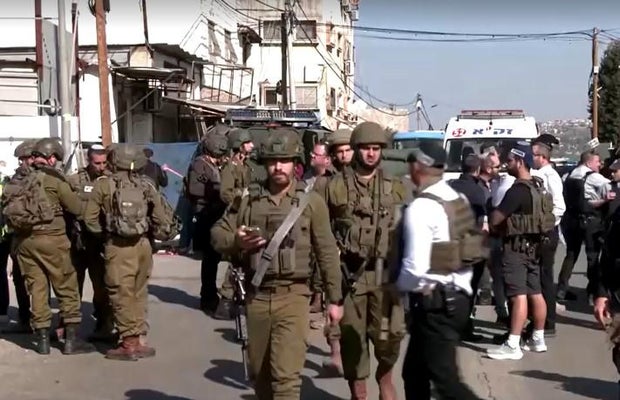
       Israel bus attack near Jenin:  
W

Jerusalem — Gunmen opened fire Monday on a bus and other vehicles near a

 village in the Israeli-occupied West Bank, killing three people and wounding

 seven, the Israel Defense Forces and emergency services said. Violence in the 

West Bank has soared since the war in Gaza erupted on Oct. 7, 2023, after 

Hamas' terrorist attack on Israel.

"Paramedics have confirmed the deaths of three victims, including two women 

and a man," emergency service provider Magen David Adom said.

The IDF said troops were "pursuing the terrorists" who carried out the attack near the village of Al-Funduq.

"We will reach the despicable murderers and hold them, as well as anyone who assisted them, accountable," Israeli Prime Minister Benjamin Netanyahu said in a statement from his office. "No one will be spared."

Magen David Adom said its paramedics were providing treatment to seven 

people who were on the bus, including the driver, who was in serious condition. The two women killed in the shooting were in their 60s, while the man was around 40, MDA reported.

west-bank-shooting-israel-january6.jpg
Israeli security forces are seen near the location of a shooting attack targeting a bus and other vehicles near the village of al-Funduq, in the Israeli-occupied West Bank, that left three people dead and seven wounded, according to the Israeli military, Jan. 6, 2025.REUTERS

"This was a severe attack that spread across multiple scenes where vehicles and a bus were hit by gunfire," paramedic Avichai Ben Zruya said in a statement. 

The operation, during a fragile ceasefire in Gaza that has halted fighting there for the past six weeks, has emptied some of the biggest refugee camps in the northern West Bank in what some Palestinians see as a trial run for wider clearances later.
  • Nur Shams camp cleared in Israel's latest demolition push
  • Tens of thousands of Palestinians evacuated
  • Israel says operation aims to crack down on militant groups

 The two camps have been a focus of ongoing Israeli military activity aimed at dismantling what officials describe as entrenched terror networks. Notice were delivered to residents of the camp yesterday. The IDF said the demolitions are intended to create safe access routes for military forces operating in the area. 

Similar demolitions were carried out recently in the Jenin refugee camp. Palestinians will not be allowed to rebuild the areas demolished.  

Resource:

israelAM

https://www.cgdev.org/blog/most-refugees-live-cities-not-camps-our-response-needs-shift#:~:text=Refugees%20in%20camps%20often%20receive,public%20provision%20of%20these%20services.

https://en.wikipedia.org/wiki/Tulkarm#:~:text=The%201949%20Armistice%20Agreements%20between,south%20were%20annexed%20in%201967.

https://www.unrwa.org/sites/default/files/tulkarm_refugee_camp.pdf

https://www.cbsnews.com/news/israel-war-hamas-west-bank-shooting-attack-deaths-ceasefire-talks/