Showing posts with label Lazdijai. Show all posts

Thursday, May 18, 2023

What Has Driven Russia and Eastern Europe in General Into Strong Anti-Semitism

 Nadene Goldfoot                                                     

    Constantine the Great and facial reconstruction;  how he really looked ;  He really converted to Christianity because of his mother, Helen, who did.  

My original theory stands;  that it has been Eastern Europe's form of Christianity that has turned the people of Lithuania, Latvia, Poland and others into strong anti-Semites. Of course, this goes along with the events happening. The problem has been that of competition for followers; both in religion and in business. On the social ladder, Jews were almost at the bottom rung because of their treatment by the emperors of Rome.  

 On August 13, 339, C.E., Emperor Constantius II enacted a series of new laws restricting the freedom of Jews in the Roman Empire even more than under the anti-Jewish legislation imposed by his father, Constantine the Great.  Judaism faced some severe restrictions under Constantius, who seems to have followed an anti-Jewish policy in line with that of his father. This included edicts to limit the ownership of slaves by Jewish people and banning marriages between Jews and Christian women. Later edicts sought to discourage conversions from Christianity to Judaism by confiscating the apostate's property. However, Constantius' actions in this regard may not have been so much to do with Jewish religion as with Jewish business—apparently, privately owned Jewish businesses were often in competition with state-owned businesses. As a result, Constantius may have sought to provide an advantage to state-owned businesses by limiting the skilled workers and slaves available to Jewish businesses.

An early sign of anti-Semitic attitude was in 1936 with outbreaks of anti-Jewish activity in several states beyond the borders of Germany.  In Lithuania, in an attempt to establish restrictions on the % of Jewish students, not a single Jewish medical student was given a place in the medical faculty of Kovno University. Though Germany had led the way towards attacking Jews with the 1935 Nuremberg Laws, was that reason enough for all others to copy Germany?  Didn't they think for themselves?  Usually, what is normal is to copy something you think is good, valuable, worthy of copying.  Well?  

Surprisingly, The Christianization of Lithuania (Lithuanian: Lietuvos krikštas) occurred in 1387, initiated by King of Poland and Grand Duke of Lithuania Władysław II Jagiełło and his cousin Vytautas the Great. It signified the official adoption of Christianity by Lithuania, the last pagan country in Europe. This event ended one of the most complicated and lengthiest processes of Christianization in European history.

In 1388, one year after the Christian-Catholic religion was introduced all over Lithuania, the latter also granted the Jews a preferred civil status and incomparable bills of rights in many different spheres, such as protecting their bodies and property;  freedom to maintain their religious rituals;  significant alleviation in the field of commerce, and money-lending-this being permitted in relation to Christians.  Would you say that the Lithuanian heads wanted Jews to enter to make such an enticing offer?  Of course;  they couldn't pass this offer up.   

What happened to Lithuania?  What else is the reason for hating Jews so much that was or maybe still is that Jews killed their god?  Of course this makes NO sense to me that any human being can kill G0d, but there you are;  we've been blamed for a Roman decision for the past 2,000 years.  We're somebody to blame, for others to never take responsibility for a thing because somebody is blaming us, the Jews for the bad things in life.  Lithuanians are not the only people who have done this.  

The 1st settlement of Jews took place in the Great Lithuanian Princedom began in the 14th century by invitation of the Grand Dukes Gediminas and Vytautas (Witold). In other words, the Jews were enticed, invited to settle in Lithuania by the highest powers there.  

"In the twelfth and thirteenth centuries, Christian anti-Judaism in the medieval West had intensified, which is reflected in the harsh anti-Jewish measures agreed at the Fourth Council of the Lateran called in 1215 by Pope Innocent III. The peninsular Christian kingdoms were not at all oblivious to the growth of increasingly belligerent anti-Judaism—the Castilian statutory code of Siete Partidas stated that the Jews lived among Christians "so that their presence reminds them that they descend from those who crucified Our Lord Jesus Christ"—but the kings continued to "protect" the Jews for the important role they played in their kingdoms."

It was around this time that Spain was affected by the Pope over Jews.  By 1492 with the Alhambra Decree (also known as the Edict of Expulsion;   they kicked Jews out who wouldn't convert, causing some to go underground and go through a pretense.  This had been growing stronger ever since the 1200s, so the Jews knew that this was a good offer.  They were needed here for their trading skills, and the fact that they were able to read and write and speak several languages, skills needed by those in trading in those days.  

It is not surprising then to read that by 1495, Grand Duke Alexander expelled all Jews--then numbering more than 6,000 people from Lithuania and confiscated their property.  Then 8 years later he was elected King of Poland and allowed Lithuanian Jews to return to their homes and gave them back PART of their property.  It was a good move to hope for re-election, wasn't it?  

 Grant Gochin has been so convinced of their present anti-Semitism that he's written a book "Malice, Murder, and Manipulation-one man's Quest for Truth" about it as well as several articles. "Citizenship and legal status affected every aspect of Jewish life in the “old country.” Follow a 100-year circular story of how the Lithuanian government abused national laws, causing multiple Jewish deaths in 1922, and how the same government still continued that behavior four generations later. Follow the documented saga of one Jewish family’s deportations, starvation, death, abductions, and movement. Understand the implications of heritage citizenships for past, current, and future generations. Testimonials: “A fascinating read!” —The Hon. Dr. Juris Bunkis, Honorary Consul for the Republic of Latvia,"   Grant and I have found out we're 3rd cousins twice removed through genealogy searches and 4th cousins by DNA testing with my brother with  ancestors from 1800s  marrying in Lithuania.  We accuse them of this because Lithuania is in the act of such denial right now, and our ancestors were there; witnesses to and victims of such feelings.

My grandfather, Nathan Goldfus-Goldfoot came from Telsiai/Telz.     I've traced the Goldfus line back to 1730 to Iones "Jonah" Goldfus of Telsiai, Lithuania who died in 1813 at age 83. He was first on the 1910 census in Portland, Oregon at age 38. Grant was also a genealogist of his family and the Gochins were in Papile, Lithuania. Grant's ancestor, Sam Gochin was born in 1902 and was deported from Papile by 1915, then abducted and taken into the Russian army in Belorussia in 1917.   An ancestor of his, Faive Shrago Gochin b; c1837 married my ancestor, Tsipa Goldfus  b: c1842, married in c1857.  We agree on our genealogy and assessment of Lithuania treatment of Jews.  

My grandmother, Zlata Jermulowske, came from Lazdey, Lithuania which was on the border with Poland.I'll use Telz information as the Lithuanian example of how Lithuanians reacted during the war.

              Yaakov Leibowitzs wedding in Mazheik, Lithuania

A shtetl at one time; Mažeikiai was first mentioned in written sources in 1335. A chronicler of the Livonian Order wrote about a campaign of the Order, during which the land of Duke Mažeika was devastated. The town started growing rapidly in 1869 when the Libau–Romny Railway connecting Vilnius and Liepāja was constructed. In 1893, the town had 13 shops and 5 alehouses. In 1894 an Eastern Orthodox church was built, and a synagogue had been founded several years earlier. In 1902 a Catholic church was established, followed by an Evangelical-Lutheran church in 1906. From 1899 to 1918 the town was called Muravyov.

After (July 28, 1914-November 11, 1917 or World War I) , Lithuania became an independent state again. However, the capital and the city with the largest Jewish population, Vilna, had been incorporated into Poland. The remaining Jews living in Lithuania were emancipated—their rights were mostly recognized—but by the early 1930s, the economic crisis known as the Great Depression and rampant antisemitism among ultranationalist groups were having an effect on the Jewish community. On the eve of World War II, despite the earlier loss of Vilna, 160,000 Jews lived in Lithuania—about 7% of the overall population.  

The German invasion of Poland on September 1, 1939 affected all Lithuanians, too.  Telz's Jews had been feeling the affects several months before.  Hitler sent an ultimatum to Lithuania on March 20, 1939 to Jews to leave Memel within 24 hours.  About 7,000 Jews lived in this city and escaped, leaving everything behind, looking for asylum in other regions like Zemaitija and in Kovno.  Many settled in Telz, and the Jewish community there took care of them.  

Report from Kovno: "trained Lithuanians were available in sufficient number.  Only 15% of Lithuanian Jewry remained alive by November 1941.  As a result, the city was, as he expressed it, comparatively speaking, a shooting paradise.  The male work-Jews should be sterilized immediately to prevent any procreation.  a Jewess who, nevertheless, was pregnant is to be liquidated".  So reported SS Colonel Karl Jaeger, the chief of Einsatzkimmando 3. 

The affect was that goods were hard to get or find and some Jews were exiled to Siberia in June 1941.  Buildings were conviscated like the Yeshiva (Jewish school) and turned into city schools.  Telz had had the famous Telz-Stone Yeshiva, known throughout eastern  Europe.  

On Friday, June 27, Telz's Jews were expelled from their houses and directed to the shore of Lake Mastis and had to leave their homes unlocked.  They were surrounded by armed Lithuanians under German command.  the Jews then realized they were to be murdered or drowned.  To make it even more horrific, men and women were separated and the women and children were to return to a home they found to have been previously robbed, left bare, while the men were executed.  

The next day, Shabbat, 28 armed Lithuanians appeared, beating those in the homes and led to the Rainiai farm 4 km away where the men were, a surprise.  The men were set to work, digging up corpses of 73 political prisoners previously in Telz prison and murdered by the Soviet security men.  Telz men were forced to wash the corpses,, kiss them, and lick the decaying wounds that must have been putrid.   All the guards in the camp and in the working places were Lithuanians.  Much more happened and by June 15, 1941 all men were taken out of the camp and led in groups to the grove and murdered.  First they had to undress and stand on a plank across the burying pit and were shot.  

Finally the women met their fate.  On the 30th and 31st of December 1941 the women were taken out from the ghetto and led in groups to the pits where they were murdered.  

Lazdijai's Jews entered on the grant by the Magdeburg Rights in 1579 as well as permission to maintain a weekly market and 2 yearly fairs.  Until 1795 it was part of the Polish Lithuanian Kingdom, when the 3rd division of Poland by the 3 superpowers took over;  Russia, Prussia and Austria.  The German army entered Lazdey on Sunday, June 22, 1941 and the residents were terrorized.  Thousands fled.  Most Lithuanians wouldn't hide or help anyone Jewish, even denied them water to drink.  The Lithuanians yelled, "Go back to Stalin, your father!"  Jewish families had been there for the past 362 years.  The Jews were accused of being Communists.  All the arrested were moved to Mariampol and murdered there.  The Rabbi of Lazdey who was rabbi Ya'akov Aryeh haCohen Gershtein from his shelter in Lazdijai and a German and Lithuanian Zarembo started beating him with riding whips.  Those people who came to see what was happening were also beaten.  Jewish males were taken by Germans and Lithuanians were tortured and robbed.  They suffered from merciless beatings first.  After Church on Sunday, the Lithuanians took male Jews and tortured them, forced them to roll in the dirt, hit each other, perform other acts to the amusement and pleasure of the spectators.  It became like the Roman days and the victims in the amphitheater.  It didn't look like a sermon in their church changed them at all. 

Out of approximately 208,000–210,000 Lithuanian and Polish Jews, an estimated 190,000–195,000 were murdered before the end of World War II, most of them between June and December 1941.  

More than 95% of Lithuania's Jewish population was massacred over the three-year German occupation – a more complete destruction than befell any other country affected by the Holocaust. Historians attribute this to the massive collaboration in the genocide by the non-Jewish local paramilitaries, though the reasons for this collaboration are still debated. The Holocaust resulted in the largest-ever loss of life in so short a period of time in the history of Lithuania.

Ethnic Lithuanian nobles were the main converts to Catholicism, but paganism remained strong among the peasantry. Pagan customs prevailed for a long time among the common people of Lithuania and were covertly practiced. There had been no prosecution of priests and adherents of the old faith. However, by the 17th century, following the Counter-Reformation (1545-1648), the Roman Catholic faith had essentially taken precedence over earlier pagan beliefs.

The conversion and its political implications had lasting repercussions for the history of Lithuania. As the majority of the population of the Grand Duchy of Lithuania outside Lithuania proper was Orthodox and the elite gradually converted to Roman Catholicism, religious tensions increased. Some of the Orthodox Gediminids left Lithuania for Muscovy, where they gave rise to such families as the Galitzine and the Troubetzkoy. The Orthodox population of present-day Ukraine and eastern Belarus often sympathized with the rulers of Muscovy, who portrayed themselves as the champions of Orthodoxy. These feelings contributed to such reverses as the Battle of Vedrosha, which crippled the Grand Duchy and undermined its position as a dominant power in Eastern Europe.

On the other hand, the conversion to Roman Catholicism facilitated Lithuania's integration into the cultural sphere of Western Europe and paved the way to the political alliance of Lithuania and Poland, finalized as the Union of Lublin in 1569.

 Catholicism was one of the officially tolerated religions in the Russian Empire but Orthodoxy was considered to be above all  the religion of the Tsar and the empire. But, having said that, Catholicism continued to shape the lives of people in Lithuania. This was a question of religious politics, identity politics, in general.

Today, if you are Jewish, you cannot obtain citizenship in Lithuania.  Just ask Grant Gochin about it.  He's tried and wrote his book in 2013. I hear they're on the way to improvement.  It's been 10 years.   

Israel and Lithuania signed a new cooperation agreement in the fields of education and culture for the years 2023-2026 in March. The two countries first started working together in these sectors in 1994 and the program has been renewed every few years. The agreement serves as a framework for joint activities in education, higher education, youth and youth exchanges, dance, theatre, music, literature, cinema, cultural heritage, sports and more. As part of the agreement, student exchanges can take place through scholarships awarded by the Foreign Ministry’s Department for Cultural and Educational Cooperation.


Resource:

Malice, Murder, and Manipulation by Grant Arthur Gochin

The Holocaust by Martin Gilbert

Preserving Our Litvak Heritage by Josef Rosin by JewishGen,Inc. 

https://en.wikipedia.org/wiki/The_Holocaust_in_Lithuania

https://en.wikipedia.org/wiki/Alhambra_Decree

https://en.wikipedia.org/wiki/Christianization_of_Lithuania

https://yivo.org/Jewish-Encounters-with-the-Catholic-Church-in-Lithuania

 https://en.wikipedia.org/wiki/Constantius_II

https://yivo.org/cimages/historical_sources_of_antisemitism.pdf

Wednesday, March 9, 2022

To Be a Jew in Poland or Lithuania: Spotlight on Lazdijai (Lazdey)

Nadene Goldfoot                                     

The territory that would become the Pale first began to enter Russian hands in 1772, with the First Partition of Poland. The institution of the Pale became more significant following the Second Partition of Poland in 1793, since, until then, Russia's Jewish population had been rather limited. The dramatic westward expansion of the Russian Empire through the annexation of Polish-Lithuanian territory substantially increased the Jewish population. At its height, the Pale had a Jewish population of over five million, and represented the largest component (40 percent) of the world Jewish population at that time.                                        
             A rare picture of Polish Jewish children--On July 30th, 1933, a delegation of members of the French Union of World War I Veterans embarked upon a tour of the cities of Poland.  This picture wound up in one of their scrapbooks.  

Lazdijai is a little town on the border between Lithuania and Poland. It's in Lithuania, about 7 km (4.3 mi) east of the border with Poland.  

The town of Lazdijai, or Lazdey in Yiddish, was part of the Polish Lithuanian Kingdom until 1795, then were caught in the 3rd partition by the 3 superpowers;  Russia, Prussia and Austria.  The result was that Lithuania became partly Russian and partly Prussian.  Lazdey, on the left side of the Nieman River, was handed over to Prussia that ruled during 1795-1807.  It had been created by the king of Poland, King Zigmunt II in August of 1570 and the Jews were granted the Magdeburg Rights in 1579 as well as permission to maintain a weekly market and 2 yearly fairs. During Prussian rule, Lazdey became the county administrative center.  

      Napoleon Bonaparte, b: 1769-d:1821) Emperor of France

By 1807, Napoleon defeated Prussia (a former German State), and everyone got equal civil rights except the Jews. 

1815 saw Napoleon defeated and all of Lithuania was annexed to Russia.  

In 1827, Lazdey had a population of 1,988 people living in 272 houses.  My paternal great grandparents were among them.  Lazdey was included in the Augustowa Province (Gubernia) and by 1866 became part of the Suwalk Gubernia as a country administrative center.  All during its existence, Lazdey suffered from many fires. 

                The Hebrew pro-gymnasium in 1921

                              Rabbis from Lazdey were:  

1. Avraham Tsevi ben Meir,  

2. Avraham ben Yekhezkel 1798 who was the father in law of 

          "Gaon" from Vilna;(Rabbi Eliyahu (1720-1797) 

3. Yehudah-Leib, son of the famous Rabbi Eliyahu, Gaon of Vilna

 4, Hayim-Yehoshua HaCohen Blumental from 1853 for several years; There was a Nissen Blumenthal (1805-1903)Cantor in Odessa in 1841 for 55 years.  

5. Yosef-Mosheh Aranzon [Aaronson ?](1805-1875), died in Chicago;  

6.Tsevi-Hirsh Kahana; 

7. Yehudah-Leib Ginsburg; 

8. Avraham-Eliver Yaffe (1823-1908) in Lazdey 1873-74;  

9. his son Yehudah-Leib (1842--?) from 1908 in Laszdey.  


My aunt Elsie looks the most like her mother, Zlata Jermulowski of Lazdijai, Suwalki, Lithuania 

Lazdey Jews left for Eretz Yisrael before a Zionist movement started.  In the old cemetery of Jerusalem there lie a3 tombstones of Lazdey Jews:  Gershon son of Moshe-d:in 1910;  Reuven son of Yehudah Frid, d: 1895;  Hayah daughter of Rabbi Yudl Rosh HaGalil, d: 1897.  

My paternal grandmother, Zlata Goldfoot nee Jermulowski/e was born in 1886 in Lazdey. She's buried in Portland, Oregon.   


The independent state of Poland established after world War I in 1917 attempted to protect its minorities, but its attitude toward the Jews left much to be desired The economic position of its Jews deteriorated as the new Polish middle-class tended to push them out of trade, handicrafts and industry.  Lazdey was surrounded by Jewish farms and farmers till WWI.  Many families kept vegetable gardens behind their houses.  

On April 1, 1915, Lazdey Jews were exiled into Russia by order of the retreating Russian army.  After the war, most of them returned home and found that their property had been stolen.  This had been shocking as the Jews were kept in the Pale of Settlement for years by the 2 Catherine empresses and were not allowed into Russia proper.  The Pale of Settlement included all of modern-day Belarus, Lithuania and Moldova, much of Ukraine and east-central Poland, and relatively small parts of Latvia and western Russian Federation.  

In 1919, the Polish army took over in Lazdey, but was expelled after several days.  Lazdey remained inside the border of Lithuania, but the district administrative center, Seyny, was included in Poland.  Today, all my paternal grandmother, Zlata Goldfoot nee Jermulowski's records are in Poland.  My grandmother insisted that she was a Litvak, however.  She immigrated to the US from Lazdijai, Suwalki, Poland in 1903.  

Tifereth Bahurim branch in Kelm in 1933
(This and the next picture are courtesy of the Archives of the Association of the Lithuanian Jews in Israel)

By 1938, 300,000 Jewish men were unemployed and emigration continued on a large scale.  395,223 Jews left Poland from 1921 to 1937.                                                   

In 1939, when the Germans invaded Poland, 3 million Jews were living in Poland.  Under Nazi occupation, they practiced wholesale massacre of Jews.  Ghettos were set up in Warsaw, Lodz, Bialystok, etc.  and these proved the prelude to the concentration camps and gas chambers.  Great numbers of Jews were brought to Poland from other parts of Nazi-occupied Europe for annihilation.

Teen-aged Jews joined the underground struggle of the Partisans, while the ghetto risings at Warsaw, Bialystok, and other places produced acts of desperate courage.  

After WWII in 1945, Jews who had escaped to Russia or had been exiled, returned to try and pick up the threads of life in Poland, mostly settling in Silesia, Lodz, Warsaw, and Cracow.  The Communist regime opposed their settlement, and there were cases of assault and even pogroms at Kielce in 1946, resulting in considerable emigration and a drastic reduction in the size of the new Jewish neighborhoods.  

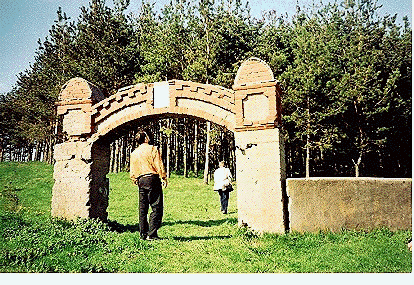
During the war, the tombstones in Lazdey's Jewish cemetery were overturned. Apparently, it was not demolished and built over as the Soviets did to numerous other Jewish cemeteries.

Picture taken by Ruth ben David 1994 (from Pilitovsky family)
The entrance gate of the Jewish cemetery, the only scraps

On the 13th of Mar-Cheshvan every year, natives of Lazdey living in Israel assemble in the Tel Aviv area for a memorial service in memory of the day of the annihilation of the Jews of Lazdey. After the memorial service, there is usually a friendly get-together. The well-known lawyer and native of Lazdey, Avraham (Golub) Tory, often speaks at these meetings. Each year, however, the attendance decreases as fewer natives of Lazdey remain alive".

The names of the Lithuanians who sheltered them are saved at the archives of Yad-Vashem.

Visitors stand at the Crystal Wall of Crying at the Babyn Yar (Babi Yar) outside Kiev, Ukraine memorial. (Photo by Britta Pedersen/picture alliance via Getty Images)  September 1941when thousands of Jews were slaughtered in this ravine was remembered with a memorial that was just hit by the Russians in their invasion of Ukraine.  

After the war the survivors of the above mentioned towns erected a monument on the mass graves at Katkiske (Katkiškė in Lazdijai (Alytus County) is located in Lithuania about 78 mi (or 126 km) south-west of Vilnius, the country's capital town..) In 1991 a new monument was erected with the inscription in Lithuanian and Yiddish: At this place the Hitlerist murderers with their local helpers murdered on the 3.11.1941 1,535 Jews from the Lazdey district, men, women and children.  

After the war in 1945, returning Lazdey Jews, who found their property stolen and most of the houses ruined, started to rebuild their lives anew.  There were riots against the Jews in town over the conflict between Poland and the new Lithuanian state which concerned the sovereignty of Lazdey.  

Starting in 1955,, open anti-Semitic activity took place, and certain Communist circles deliberately directed discontent against the Jews.  After the Gomulka regime came to power in 1956, Jews were permitted to emigrate. 

Begin in his Polish Army uniform with his wife Aliza in Tel Aviv, December 1942.

Menachem Begin(1913-1992) born in Brest in December 1942 wearing the Polish Army uniform of Gen. Anders’ forces with his wife Aliza and David Yutan; (back row) Moshe Stein and Israel Epstein
(photo credit: JABOTINSKY ARCHIVES)
Begin, from Polish soldier to an Israeli politician, founder of Likud and the sixth Prime Minister of Israel, born 16 August 1913  died – 9 March 1992).  

Brest, formerly Brest-Litovsk, Polish Brześć, city and administrative centre of Brest oblast (region), southwestern Belarus, on the right bank of the western Bug River. First mentioned in 1019 as Berestye, it passed to Lithuania in 1319 and later to Poland. 

Between 1948 and 1958, about 140,500 Jews left Poland for Israel.

Krakow was left.  After the Six-Day War in 1967, a strong anti-Semitic reaction in the government deprived Jews of leading positions in many walk of life and led to a further emigration.  

At the time, many historians believed that this anti-Semitic campaign and the resulting migration of Polish Jews was the final chapter for Jewish life in Poland. The estimated Jewish population in 1989 was 5,000-10,000. This latter figure is difficult to gauge due to the fact that many Jews who remained post-1968 choose to conceal their identity. But, after the fall of the communist system and Poland’s entry into the European Union in 2004, the Jewish community began experiencing a cultural resurgence. Festivals and educational initiatives reintroduced Jewish culture into the public sphere. The world’s largest Jewish culture festival was launched in Kraków in 1988. Polish Jews, as well as Israeli Jews of Polish heritage, are reengaging with the past and reinvesting in their former communities. The Jewish community in Poland is finding new ways to express its identity, and to resist the efforts of the twentieth century that attempted to destroy its life.                                         

Gdańsk, 1988. Strike at the Lenin shipyard, photo: Chris Niedenthal / promotional materials

After the fall of the Communist regime in 1989, the situation of Polish Jews became normalized and those who were Polish citizens before World War II were allowed to renew Polish citizenship.  The members remaining in 1990 were estimated at 16,000.                       

Lithuanian nationalists took the repudiation of the Brezhnev Doctrine as a signal that a declaration of independence might be accepted. On March 11, 1990, Lithuania declared that it was an independent nation, the first of the Soviet republics to do so.

    Poland's Chief Rabbi Michael Schudrich speaks during an interview in Warsaw on February 28, 2022. (Lazar Berman/Times of Israel)  Russia began an invasion of Ukraine on 24 February 2022, in a major escalation of the Russo-Ukrainian War that began in 2014. It is the largest conventional military attack in Europe since World War II.

 The contemporary Polish Jewish community is estimated to have between 10,000 and 20,000 members.  Poland’s chief rabbi leads the effort to receive Ukrainian Jewish refugees.  Michael Shudrich says dozens have been helped by an ad hoc crisis group, as community prepares for many more displaced people fleeing the Russian invasion.  

Resource:

The New Standard Jewish Encyclopedia

Preserving Our Litvak Heritage by Josef Rosin

https://en.wikipedia.org/wiki/History_of_the_Jews_in_Poland#:~:text=After%20the%20fall%20of%20the,between%2010%2C000%20and%2020%2C000%20members.

https://en.wikipedia.org/wiki/Pale_of_Settlement#:~:text=The%20Pale%20of%20Settlement%20included,Latvia%20and%20western%20Russian%20Federation.

https://blog.nli.org.il/en/polish-jewry/


Thursday, August 6, 2020

OTTOMAN EMPIRE TAKES ON POLAND AND LITHUANIA and Got To Meet Russia

Nadene Goldfoot                                             
THE OTTOMAN EMPIRE AT ITS GREATEST
The Ottoman Empire lived for 400 years. It was a state and caliphate that controlled much of Southeastern Europe, Western Asia, and Northern Africa between the 14th and early 20th centuries. It was founded at the end of the 13th century in northwestern Anatolia in the town of Söğüt by the Turkoman tribal leader Osman I.

The Turks of the Ottoman Empire teamed up with Germany and lost the 1st WORLD War (1914-1918), losing all this land to the Western forces, the Allies. The Middle East and Eastern Europe went to the United Kingdom, France, Italy and USA.  The Axis were the Ottoman Empire, Austria-Hungary, Germany. 
Did we know this history?  Polish–Ottoman War (1672–1676) was a conflict between the Polish–Lithuanian Commonwealth and the Ottoman Empire, as a precursor of the Great Turkish War. It ended in 1676 with the Treaty of Żurawno and the Commonwealth ceding control of most of its Ukraine territories to the Empire. Ottoman forces, numbering 80,000 men and led by Grand Vizier Köprülü Fazıl Ahmed and Ottoman sultan Mehmed IV, invaded Polish Ukraine in August 1672. 

So the lands occupied by Jews were invaded by the Muslims of eastern Europe.  Russia would later keep Jews out of Russia proper; allowing them to live in the Pale of Settlement.   The Pale of Settlement was a western region of Imperial Russia with varying borders that existed from 1791 to 1917, in which permanent residency by Jews was allowed and beyond which Jewish residency, permanent or temporary, was mostly forbidden. This was under the decree of Catherine the Great. 


Lazdijai, Lithuania was the birthplace of my paternal grandmother, Zlata Hattie Jermulowske b: January 11, 1886 when it was on the border between Poland and  Lithuania, at that time a part of Lithuania, she said.  Zlata immigrated to the states in 1900 at about age 14.  She came  speaking only Yiddish and had had no education.  She ended up in Council, Idaho, a mining town in the mountains of Idaho where her half-sisters and brothers had found a spot for them.  Zlata worked in a nearby mining town of Cuprum, serving food and washing dishes.  She married at 19 to  34 yr old Nathan Abraham Goldfus.  


Lithuania was established by Sigismund II Augustus in 1570 and granted Magdeburg Rights by Sigismund III Vasa in 1587.

Lithuania was mostly in the Russian side (purple). 

Large numbers of Lithuanians had emigrated to the United States in 1867–1868 after a famine in Lithuania. Between 1868 and 1914, approximately 635,000 people, almost 20 percent of the population, left Lithuania. Lithuanian cities and towns were growing under the Russian rule, but the country remained underdeveloped by the European standards and job opportunities were limited; many Lithuanians left also for the industrial centers of the Russian Empire, such as Riga and Saint Petersburg. Many of Lithuania's cities were dominated by non-Lithuanian-speaking Jews and Poles.

Partitions of Poland, (1772, 1793, 1795), three territorial divisions of Poland, perpetrated by Russia, Prussia, and Austria, by which Poland’s size was progressively reduced until, after the final partition, the state of Poland ceased to exist.

Lazdijai (Lazdey) in Yiddish is located in the SW part of Lithuania with several big lakes nearby at the junction of roads leading to Mariamol and Alite and was established in 1570 by King Zigmunt.  It was part of the Polish Lithuanian kingdom up to 1795; then became part Russian and part Prussian.  From 1807-1813 it belonged to the Great Dukedom of WArsaw and was part of the Bialystok district.  In 1827 the population was 1988 living in 272 houses.  By 1887 about 1500 Jews had been affected by fires.  

Jews lived in Lazdijai by end of 16th century (since late 1500s.)  In 1879 200 houses were destroyed by fire and owners became homeless.  In 1886 another fire consumed  250 Jewish houses;  in 1888 another 70 houses.  

Those territorial divisions were altered in 1807, when the emperor Napoleon of France created the duchy of Warsaw out of the central provinces of Prussian Poland, and in 1815, when the Congress of Vienna created the Congress Kingdom of Poland. However, the main result of the partitions—i.e., the elimination of the sovereign state of Poland—was in effect until after World War I, when the Polish republic was finally restored (November 11, 1918).
                                                                   

Where  is Lazdijai, Suwalki, Lithuania/Poland?  Lazdijai (About this soundpronunciation  Polish: Łoździeje) is a small town in Lithuania located about 7 km (4.3 mi) east of the border with Poland.  

 Lithuania and Poland formed a Commonwealth in 1569. Initially, it was successful in deterring enemies. However, the political union led to gradual Polonization of the Lithuanian nobility as Lithuanians of the time regarded Polish culture to be superior.

By the 17th century, Poland-Lithuania was weakened due to a unique yet hard-to-manage political system of "Noble democracy" where a consensus was a prerequisite for any important decision. The Commonwealth lost a series of wars that wiped out its great power position. In the late 18th century (1772-1795) the country was completely partitioned and annexed by Prussia, Austria, and Russia with the main Lithuanian lands falling under the Russian rule.
The Russians banned Lithuanian language and suppressed Catholic religion. There were two unsuccessful revolts to restore Poland-Lithuania (1831 and 1863) but eventually the National Revival established a goal for Lithuania independent of both Russia and Poland. The restoration of statehood for Lithuania finally became possible after both the crumbling Russian Empire and the Germans surrendered in World War 1(1914-1918).

The last and most tenacious of the Polish uprisings of the mid-19th century erupted in the Russian-occupied sector in January 1863 (see January Uprising). Following Russia's disastrous defeat in the Crimean War, the government of Tsar Alexander II enacted a series of liberal reforms, including liberation of the serfs throughout the empire. The high-handed imposition of land reforms in Poland aroused hostility among the conservative landed nobility on the one hand, and a group of young radical intellectuals influenced by Karl Marx and the Russian liberal Alexander Herzen, on the other.

 Repeating the pattern of 1830–31, the open revolt of the January Insurrection by Congress Poland failed to win foreign backing. Although its socially progressive program could not mobilize the peasants, the rebellion persisted stubbornly for fifteen months. 

After finally crushing the insurgency in August 1864, Russia abolished the Congress Poland altogether and revoked the separate status of the Polish lands, incorporating them directly as the Western Region of the Russian Empire. The region was placed under the dictatorial rule of Mikhail Muravyov-Vilensky, who became known as the Hangman of Vilnius. All Polish citizens were assimilated into the empire. When Russia officially emancipated the Polish serfs in early 1864, an act that constituted the most important event in history of nineteenth-century Poland, it removed a major rallying point from the agenda of potential Polish revolutionaries.
On November 3, 1941, 1,535 Jews were murdered in Lazdijai, including 485 men, 511 women and 539 children The perpetrators were members of the Rollkommando Hamann, local policemen and Lithuanian nationalists.
In 1990 Lithuania declared independence from the Soviet Union, and new check points between the borders Poland and Lithuania were established and Lazdijai became the center that oversees and continues to regulate these operations. It is the birthplace of Lithuanian politician and producer Arūnas Valinskas and of Russian-American composer and violinist Joseph Achron.