Showing posts with label King Tut. Show all posts

Saturday, July 16, 2022

Deep History of Saudi Arabia and the USA

 Nadene Goldfoot                                        


Biblically,  according to Gen.10, Eber was the forefather of both Abraham as well as of Joktan, the ancestor of the southern Arabs.  Several Arab tribes are counted among the descendants of Abraham.  Arabs trace their ancestor to Ishmael, who is in the Torah.  

Saudi Arabia traces its roots back to the earliest civilizations of the Arabian Peninsula. Over the centuries, the peninsula has played an important role in history as an ancient trade center and as the birthplace of Islam, one of the world's major monotheistic religions.

The first concrete evidence of human presence in the Arabian Peninsula dates back 15,000 to 20,000 years. Bands of hunter-gatherers roamed the land, living off wild animals and plants.

As the European ice cap melted during the last Ice Age, some 15,000 years ago, the climate in the peninsula became dry. Vast plains once covered with lush grasslands gave way to scrubland and deserts, and wild animals vanished. River systems also disappeared, leaving in their wake the dry river beds (wadis) that are found in the peninsula today.

This climate change forced humans to move into the lush mountain valleys and oases. No longer able to survive as hunter-gatherers, they had to develop another means of survival. As a result, agriculture developed – first in Mesopotamia, then the Nile River Valley, and eventually spreading across the Middle East.

The development of agriculture brought other advances. Pottery allowed farmers to store food. Animals, including goats, cattle, sheep, horses and camels, were domesticated, and people abandoned hunting altogether. These advances made intensive farming possible. In turn, settlements became more permanent, leading to the foundations of what we call civilization – language, writing, political systems, art and architecture.

Located between the two great centers of civilization, the Nile River Valley and Mesopotamia, the Arabian Peninsula was the crossroads of the ancient world. Trade was crucial to the area’s development; caravan routes became trade arteries that made life possible in the sparsely populated peninsula.

The people of the peninsula developed a complex network of trade routes to transport agricultural goods highly sought after in Mesopotamia, the Nile Valley and the Mediterranean Basin. These items included almonds from Taif, dates from the many oases, and aromatics such as frankincense and myrrh from the Tihama plain.
Spices were also important trade items. They were shipped across the Arabian Sea from India and then transported by caravan.

The huge caravans traveled from what is now Oman and Yemen, along the great trade routes running through Saudi Arabia’s Asir Province and then through Makkah and Madinah, eventually arriving at the urban centers of the north and west.

Jews were living in Medina, having fled from Jerusalem after 70 CE when it was burned down by the Romans noticed by the Arabs telling their stories outside their tents to an audience.  Much was learned by Mohammad this way which was incorporated into his Koran.  Some Arabs were even converting to Judaism.  Jews remained in Yemen the longest.  

The people of the Arabian Peninsula remained largely untouched by the political turmoil in Mesopotamia, the Nile Valley and the eastern Mediterranean. Their goods and services were in great demand regardless of which power was dominant at the moment – Babylon, Egypt, Persia, Greece or Rome. In addition, the peninsula’s great expanse of desert formed a natural barrier that protected it from invasion by powerful neighbors.

Muhammad, the Prophet of Islam, was born in Mecca in about 570 and first began preaching in the city in 610, before migrating to Medina in 622. From there, he and his companions united the tribes of Arabia under the banner of Islam and created a single Arab Muslim religious polity in the Arabian Peninsula.

Beginning with Selim I's acquisition of Medina and Mecca in 1517, the Ottomans, in the 16th century, added to their empire the Hejaz and Asir regions along the Red Sea and the al-Hasa region on the Persian Gulf coast, these being the most populous parts of what was to become Saudi Arabia.  They held the land which then belonged to the Ottoman Empire till they lost it at the end of WWI in 1917.  

The emergence of the Saudi dynasty began in central Arabia in 1744. In that year, Muhammad ibn Saud, the tribal ruler of the town of Ad-Dir'iyyah near Riyadh, joined forces with the religious leader Muhammad ibn Abd-al-Wahhab, the founder of the Wahhabi movement. This alliance, formed in the 18th century, provided the ideological impetus to Saudi expansion and remains the basis of Saudi Arabian dynastic rule today. Over the next 150 years, the fortunes of the Saud family rose and fell several times as Saudi rulers contended with Egypt, the Ottoman Empire, and other Arabian families for control of the peninsula.                    


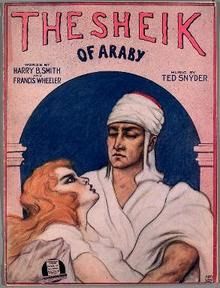
Rudolf Valentino, the love interest for women in USA.  
 The Latin Lover, was an Italian actor based in the United States who starred in several well-known silent films including The Four Horsemen of the Apocalypse, The Sheik, Blood and Sand, The Eagle, and The Son of the Sheik.  Valentino was a sex symbol of the 1920s, known in Hollywood as the "Latin Lover" (a title invented for him by Hollywood moguls), the "Great Lover", or simply Valentino. His early death at the age of 31 caused mass hysteria among his fans, further cementing his place in early cinematic history as a cultural film icon.                      

  In The Sheik (1921)  

"I'm the Sheik of Araby,
Your love belongs to me.
At night when you're asleep
Into your tent I'll creep.
The stars that shine above,
Will light our way to love.
You'll rule this land with me;
ource: LyricFind

Valentino played the starring role of Sheik Ahmed 

Ben Hassan. The film was a major success and 

defined not only his career but his image and 

legacy. Valentino tried to distance the character 

from stereotypical portrayal of an Arab man. Asked if Lady 

Diana (his love interest) would have fallen for a "savage" in real life, Valentino replied, "People are not savages because they have dark skins. The Arabian civilization is one of the oldest in the world ... the Arabs are dignified and keen-brained."  So all the women were in love with a sheik.

 British archaeologist Howard Carter and his workmen discover a step leading to the tomb of King Tutankhamen in the Valley of the Kings in Egypt on November 4, 1922. The world news was centered in Egypt and Sheiks.  

Unification. In 1902, Abdul-Aziz Al Saud, leader of the Al Saud, returned from exile in Kuwait to resume the conflict with the Al Rashid, and seized Riyadh—the first of a series of conquests creating the Third Saudi State, and ultimately leading to the creation of the modern state of Saudi Arabia in 1930.

On March 3, 1938, an American-owned oil well in Dhahran, Saudi Arabia, drilled into what would soon be identified as the largest source of petroleum in the world.

On February 14, 1945, the two countries' partnership is sealed during a historic meeting between king Abdel Aziz bin Saud and president Franklin D Roosevelt on board the cruiser USS Quincy in the Suez Canal.  The agreement sees the US guarantee military protection for the kingdom in return for privileged access to oil reserves, which were discovered in enormous quantities in the 1930s. 

Saudi leaders warmly welcome Donald Trump's arrival in office, and in May 2017 he is received with pomp for his first overseas presidential visit. 

He calls for the isolation of Iran. The US and Saudi Arabia announce huge contracts exceeding $380 billion, including $110 billion for the sale of US arms to Riyadh.

In October 2018, Khashoggi is killed and dismembered by Saudi agents in the kingdom's Istanbul consulate. But his murder does little to disturb relations with the White House under Trump. 

The president vows in the aftermath to "remain a steadfast partner" of Saudi Arabia.

Update: 7/17/22

Resource;

The New Standard Jewish Encyclopedia

https://www.saudiembassy.net/history#:~:text=Saudi%20Arabia%20traces%20its%20roots,the%20world's%20major%20monotheistic%20religions.

https://en.wikipedia.org/wiki/The_Sheik_of_Araby

https://www.wionews.com/photos/united-states-saudi-arabia-a-crisis-peppered-partnership-498032#partners-since-1945-498020--update


Saturday, April 30, 2022

The first King of Saudi Arabia, Ibn Saud and Coincidences That Followed

Nadene Goldfoot                                            

King Ibn Saud/Abdulaziz ibn Abdul Rahman ibn Faisal ibn Turki ibn Abdullah ibn Muhammad Al Saud:  Profession: Founder of Saudi Arabia.  Was this our Sheik of Araby, as the  song went?     https://www.youtube.com/watch?v=n4KPB34K6j4                                    "I'm the Sheik of Araby,

                               Your love belongs to me.
                               At night when you're asleep
                               Into your tent I'll creep.

Suddenly, the world, or at least the USA, was going crazy over this song and the idea of Arab lovers in 1921. This coincided-actually followed   the 1920 meetings going on about the end of WWI and the decisions of what to do with the land in the Middle East that had belonged to the Ottoman Empire which was now the property of the Allies.  The League of Nations had just decided, through the Balfour Doctrine, that Palestine would be held for 30 years by Britain, who would help the Jews create the Jewish Homeland once again, for it had been their land way back in the days of the Old Testament of Kinga Saul, David, Solomon, etc, going back over 3,000 years ago. 

There was no knowledge at this time of any oil laying in Arabia.  All they had to offer the world was a lot of sand.   
                                                  

Coincidently, King Tut of Egypt's tomb was then discovered on November 4, 1922.  Everything Egyptian was suddenly most popular.  People were emulating everything Egyptian, clothing styles, jewelry, etc. It just happened to be a Brit who made the discovery.  "British archaeologist Howard Carter and his workmen discover a step leading to the tomb of King Tutankhamen in the Valley of the Kings in Egypt on November 4, 1922." 

King Ibn Saud as the West knew him, better known to Saudis as Abdulaziz bin Abdul Rahman Al Saud, was born on 15 January 1875 and died on  – 9 November 1953), and was an Arab tribal, political, and religious leader who founded Saudi Arabia, the third Saudi state. He reigned as the first king of Saudi Arabia from 23 September 1932 to his death in 1953. He had ruled parts of the kingdom since 1902, having previously been EmirSultan, and King of Nejd, and King of Hejaz.

Ibn Saud was the son of Abdul Rahman bin Faisal, Emir of Nejd, and Sara bint Ahmed Al Sudairi. The family were exiled from their residence in the city of Riyadh in 1890

Ibn Saud reconquered Riyadh in 1902, starting three decades of conquests that made him the ruler of nearly all of central and north Arabia. He consolidated his control over the Nejd in 1922,signing a new treaty with Great Britain,  then conquered the Hejaz in 1925. He extended his dominions into what later became the Kingdom of Saudi Arabia in 1932.

 As King, he presided over the discovery of petroleum in Saudi Arabia in 1938 and the beginning of large-scale oil production after World War II.          

                                         Abdullah II

 He fathered many children, including 45 sons, and all of the subsequent kings of Saudi Arabia. Out of this line, we meet Abdullah, who had no land, met Churchill and secured 79% of the already deemed land to be the Jewish Homeland, Judea and Samaria.  He was the ancestor of the present king of Jordan, Abdullah II.  It is said that their line goes back to Mohammad.  They are the Hashemites.  " He is a member of the Hashemite dynasty, the royal family of Jordan since 1921, and is considered a 41st-generation direct descendant of Prophet Muhammad."                       


Transjordan, Judea and Samaria originally belonging to the Jews, which became a (region), an area to the east of the Jordan River. Oultrejordain, a Crusader lordship (1118–1187), also called Transjordan. Emirate of Transjordan, British protectorate (1921–1946) Hashemite Kingdom of Transjordan, a former name (1946–1949) for the Hashemite Kingdom of Jordan.    Here's what happened to the Jewish Homeland.  Notice that the piece left for the Jews, the purple area, has been given to the Palestinian Arabs now, called the West Bank, which is really the western part of Judea and Samaria with the Jordan River as the divider. 

Land of Israel (1040-920 BCE) Saul to Solomon's death
                             

interestingly, Jews did live in Arabia, with a great many by the 6th and 7th centuries.  In fact, they were converting to Judaism.  Mohammad (570-632) came across many Jews and incorporated some Judaism into Islam.  It is said that Mohammad even had a Jewish wife.  Rayhāna bint Zayd (Arabic: ريحانة بنت زيد) was a Jewish woman from the Banu Nadir tribe, who is considered by some Muslims as being one of Muhammad's wives. Certainly people know of stories in the Koran about the Jews that were not flattering, as they were told of finding Jews behind rocks and killing them. So by 1920, the land was pretty much devoid of any Jews.  

In truth, being Abdullah I came to his new land of Transjordan with a very small population from Arabia to rule someone, has really become a Palestinian refuge of Arabs; thus here is your Palestine.  Abdullah II has even married a Palestinian woman. The State is made up mostly of Palestinians.   

Resource:

https://houseofsaud.com/profiles/king-saud-bin-abdulaziz-al-saud/

https://en.wikipedia.org/wiki/Ibn_Saud

https://www.onthisday.com/people/ibn-saud

https://www.history.com/this-day-in-history/entrance-to-king-tuts-tomb-discovered


Friday, December 25, 2020

Egypt: A Special Case After the Ottoman Empire's Demise Part IV

 Nadene Goldfoot                                        

Since the onshore discovery of oil in the Eastern Desert in 1886, the petroleum industry in Egypt has accumulated reserves of more than 15.5 billion barrels of oil equivalent.     At the beginning of the 20th century, and specifically in 1904, the Egyptian government had authorized Cairo Syndicate to explore oil in Sinai and Quena, this is when foreign companies began their activities.                                   

On November 26, 1922, Carter and fellow archaeologist Lord Carnarvon entered the interior chambers of the tomb, finding them miraculously intact.  This turned out to be the discovery of King Tut's tomb, causing a revelation of British and America's wild interest in those days.  It affected their thoughts, dress, and interest for years through the 20's.  Perhaps this discovery affected the British minds about what to do with Egypt after WWI had ended and the Ottoman Empire was dissolved into Turkey once again.                                            

Egypt was  a part of the Ottoman Empire.  The Eyalet of Egypt operated as an administrative division of the Ottoman Empire from 1517 to 1867. It originated as a result of the conquest of Mamluk Egypt by the Ottomans in 1517, following the Ottoman–Mamluk War (1516–1517) and the absorption of Syria into the Empire in 1516.  

With the Ottomans’ defeat of the Mamluks in 1516–17, Egyptian medieval history had come full circle, as Egypt reverted to the status of a province governed from Constantinople (present-day Istanbul). Again the country was exploited as a source of taxation for the benefit of an imperial government and as a base for foreign expansion. The economic decline that had begun under the late Mamluks continued, and with it came a decline in Egyptian culture.

Upon Ottoman entry into the war, the British declared Egypt to be an official protectorate (18 December 1914), ending four centuries of Ottoman sovereignty: 'Abbas II, Khedive of Egypt (1874-1944) was deposed and his uncle Husayn Kamil, Sultan of Egypt (1853-1917) was appointed sultan.  

The foremost British interest in Egypt was always because of its strategic position. However profitable contracts and business was in the country, it was the fact that Egypt lay between Britain and India that made it so vitally important for the British.  The British citizens will soon become in love with Egypt in 1922 because of King Tut's discovery.  

                   "The newly appointed British High Commissioner, General Edmund Allenby (1861-1936), allowed the Wafd to travel to Paris. In 1922, Britain unilaterally declared the independence of Egypt; however, it was not until 1956, with the outbreak of the military and political Suez Crisis, that the British occupation of Egypt finally ended".  This is referring to Israel's Sinai War that lasted from October 29th until November 5, 1956. It was a 7 day war in which a threat was removed and a blockade was broken of which was all against Israel.  

When the Ottomans departed, the Arabs proclaimed an independent state in Damascus, but were too weak, militarily and economically, to resist the European powers for long, and Britain and France soon re-established control.                 

    Egypt affected Britain's clothing business as the Flappers were becoming popular and the soon to happen discovery of King Tut's Tomb!
                   Flappers of 20s inspired by Egyptian attire.  

During the 1920s and 1930s Iraq, Syria and Egypt moved towards independence, although the British and French did not formally depart the region until after World War II. But in Palestine, the conflicting forces of Arab nationalism and Zionism created a situation which the British could neither resolve nor extricate themselves from. The rise to power of Nazism in Germany created a new urgency in the Zionist quest to create a Jewish state in Palestine, leading to the Israeli–Palestinian conflict.                                      

                      The official opening of the League of Nations, 15 November 1920

On July 24, 1922, the League of Nations, the precursor to the United Nations, issued a formal recognition of the Jewish nation's connection to the Land of Israel, and approved the decision to establish a Jewish national homeland in the historical Land of Israel.


"The Sheik of Araby" was a Tin Pan Alley hit, and was also adopted by early jazz bands, especially in New Orleans, making it a jazz standard. It was a well recognized part of popular culture. A verse also appears in the novel The Great Gatsby (1925) by F. Scott Fitzgerald. In 1926, Benny Goodman playing-https://www.youtube.com/watch?v=bLFz-X8cpTw--close to flapper style...

It was in November 1922 that King Tut's tomb was discovered and the world went bonkers over that!  Egyptian stuff was sheik, and they all were singing about the Sheik of Araby....it was a love fest--over Egypt.    

During the year of 1955, the USSR (Russia) had been supplying military equipment to Egypt and Syria to use against Israel. Strange, because they had voted for Israel's existence in the UN. The Russian Federation had joined the UN on October 24, 1945.   Israel's application was renewed in 1949 after the Israeli elections. The Security Council by UN Security Council Resolution 69 on 4 March 1949 voted 9 to 1 in favour of membership, with Egypt voting no and Great Britain abstaining.  Those voting in favour were: China (ROC), France, United States, Soviet Union, Argentina, Canada, Cuba, Norway, and Ukrainian SSR.


 Egypt had banned the Suez Canal and the Gulf of Eilat from Israel for navigation to and from Israel.  The Egyptian; Fidayun or Fedayeen) units were attacking Israelis sent by Egypt from Sinai, the Gaza Strip and elsewhere.  Egypt was creating military bases in Sinai in its frontier.  1955 was a year when Egypt had Arab military pacts against Israel with Egypt in the center.  In October 1956, Jordan joined the Egyptian-Syrian pact.  In 7 days, Israel's army occupied the Sinai peninsula and the Gaza Strip.  This opened the Suez Canal for transit of goods to and from Israel.  Israel was promised that the Canal would be open for such transit, but the promise was never honored.   


Egypt–Israel relations are foreign relations between Egypt and Israel. The state of war between both countries which dated back to the 1948 Arab–Israeli War culminated in the Yom Kippur War in 1973, and was followed by the 1979 Egypt–Israel Peace Treaty a year after the Camp David Accords, mediated by U.S. president Jimmy Carter. Full diplomatic relations were established on January 26, 1980, and the formal exchange of ambassadors took place one month later, on February 26, 1980, with Eliyahu Ben-Elissar serving as the first Israeli Ambassador to Egypt, and Saad Mortada as the first Egyptian Ambassador to Israel. Egypt has an embassy in Tel Aviv and a consulate in Eilat. Israel has an embassy in Cairo and a consulate in Alexandria. Their shared border has two official crossings, one at Taba and one at Nitzana. The crossing at Nitzana is for commercial and tourist traffic only. The two countries' borders also meet at the shoreline of the Gulf of Aqaba in the Red Sea.

Peace between Egypt and Israel has lasted for more than thirty years and Egypt has become an important strategic partner of Israel. In January 2011, Binyamin Ben-Eliezer, a former defense minister known for his close ties to Egyptian officials, stated that "Egypt is not only our closest friend in the region, the co-operation between us goes beyond the strategic." Nevertheless, the relationship is sometimes described as a "cold peace", with many in Egypt skeptical about its effectiveness. According to the 2019-2020 survey, 13% of Egyptians support diplomatic recognition of Israel while 85% oppose. The Arab-Israeli conflict kept relations cool and anti-Israeli incitement is prevalent in the Egyptian media. 

While in Israel 1980-1985, we used to watch TV movies from Egypt.  It is a great way to see a country.  While there, my friends were able to visit Egypt on our Ulan's Spring Semester break, and my friend did.  We were too busy going over our Hebrew in order to pass the coming test, so we didn't take the advantage.  I wish we had been able to do it.  


The President of Egypt today is Abdel Fattah Saeed Hussein Khalil el-Sisi.

Abdel Fattah Saeed Hussein Khalil el-Sisi is an Egyptian politician who is the sixth and current President of Egypt, former Director of Military Intelligence, former Minister of Defense, and former General.  He rules with an iron hand.  Relations with Israel have improved significantly following Mohamed Morsi's removal, with Sisi saying he talks to Israel's prime minister, Binyamin Netanyahu, "a lot." Sisi has been described by The Economist as "the most pro-Israeli Egyptian leader ever."

 With continuous support for Palestine, the Sisi administration supports the two-state solution establishing a Palestinian state on lands that were occupied in 1967  with Eastern Jerusalem as its capital for the Israeli–Palestinian conflict achieving the Palestinians needs and granting Israel the security it wants. 

The first months of Sisi's presidency witnessed the 2014 Israel–Gaza conflict. Egypt also criticized the IDF operation in the Gaza Strip as "oppressive policies of mass punishment rejecting 'the irresponsible Israeli escalation' in the occupied Palestinian territory, which comes in the form of 'excessive' and unnecessary use of military force leading to the death of innocent civilians." It also demanded Israel adopt self-restraint and to keep in mind that being an "occupation force", it has a legal and moral duty to protect civilian lives.

Egypt has been the 5th largest Muslim majority Middle East country with 95,000,000 population.  It has from 90 to 94.7% Muslims.  


                           Shopping in Egypt

Sisi doesn't know the half of it, as he continues to support the Arabs, but their peace has been a peaceful one.  May it continue to be so.  It must be hard on the Arab countries to play on 2 sides of the coin, but he does so in keeping everyone happy.  The longer peace continues, the less death there is and everyone can become aware of how nice a peaceful environment can be.                   

    Moshe Dayan, Anawar Sadat (1918-1981) and Menacham Begin

President Sadat had made peace with Israel and was assassinated for doing so.  Everyone in Israel loved that man.  He came personally to Israel to see for himself what it was like.  He had been Egypt's President from 1970 to 1981, and had succeeded Nasser.  It was Sadat who launched the Yom Kippur War of 1973!  By 1977 he initiated a peace process with Israel when he made his visit to Israel.  In 1979 he signed a peace treaty through the Camp David Agreements.  A Moslem extremist assassinated him while he was reviewing a military parade in Cairo.  Watch "Valley of Tears" on  https://www.youtube.com/watch?v=ltSvPE8xw3A  story of Yom Kippur War -HBO Max orginal


Resource:

https://en.wikipedia.org/wiki/Egypt_Eyalet#:~:text=The%20Eyalet%20of%20Egypt%20operated,into%20the%20Empire%20in%201516.

https://www.britannica.com/place/Egypt/The-Ottomans-1517-1798

https://encyclopedia.1914-1918-online.net/article/occupation_during_and_after_the_war_middle_east#:~:text=Upon%20Ottoman%20entry%20into%20the,%2D1917)%20was%20appointed%20sultan.

https://mfa.gov.il/MFA/ForeignPolicy/Issues/Pages/94th-anniversary-of-the-League-of-Nations-affirmation-of-Jewish-self-determination-24-July-2016.aspx#:~:text=%E2%80%A2-,On%20July%2024%2C%201922%2C%20the%20League%20of%20Nations%2C%20the,the%20historical%20Land%20of%20Israel.

https://en.wikipedia.org/wiki/Member_states_of_the_United_Nations

https://en.wikipedia.org/wiki/Abdel_Fattah_el-Sisi