Showing posts with label Sinai War. Show all posts

Sunday, May 1, 2022

Concessions Israel Has Made In The Name Of Peace

 Nadene Goldfoot                                                    

IDF Paratroopers first time on the Temple Mount to see Herod's Western Wall in 1967.  Ever since 1948, the area was kept from Jews by Jordan.  

1. Immediately when the Six Day War of 1967 ended, and Israel had won the battle, Israel offered to return almost all the land it had won in that self defensive war in exchange for peace. This Six Day War lasted from the 5th to the 11th of June,1967.  

The Arabs responded to this offer from Kartoum, Africa with their 3 famous NOs.  No peace, No negotiations, and No recognition of Israel.  

Abba Eban, Israel's Foreign Minister commented, "this is the first war in history which has ended with the victors suing for peace (Israel), and the vanquished calling for unconditional surrender (Arabs).                               

2. Ten years plus later, when Egyptian President Anwar Sadat promised that his country would recognize Israel's right to exist and  establish diplomatic relations if it returned the Sinai Peninsula to Egypt, Israel, led by right-wing Prime Minister Menachem Begin, returned the Sinai in its entirety.  The Sinai War lasted from October 29 until November 5, 1956.  It took 7 days to end.  This had been a war where Russia had meddled, supplying military equipment to Egypt and Syria which increased their military strength.  This was fought to remove the threat and break the Egyptian blockade against Israel.  They had barred the Suez Canal and the Gulf of Eilat to navigation to and from Israel.  

  President Anwar Sadat, President Jimmy Carter of USA and PM Menacham Begin of Likud party  in Peace Pact

 Sinai was 3 times as large as Israel;  made up 91% of the land the Jewish state had captured in the Six Day War.  Israel also gave up the oil field it had developed in Sinai, which would have saved Israel billions of dollars each year on oil and enabled it to become largely energy dependent.  

The Sinai was the mountain where Moses received the Law.  It's also the name of the surrounding desert where the Israelites encamped and received most of the directions (Exod 19:2) and later to the entire peninsula between Egypt and Palestine.  The Sinai Desert is the peninsula between the two branches of the Red Sea.  Throughout its history, it was crossed by the Israelites after the Exodus from Egypt.  It was captured by Israel from Egypt at the time of the Sinai Operation of 1956 but evacuated shortly afterwards.  It was again captured by the Israel army in the Six-Day War of 1967 and evacuated following the Camp David Agreements.  

At Camp David in the summer of 2000, the Labor Party's Prime Minister Ehud Barak of Israel offered Yasser Arafat of the PLO more than 95% of Judea and Samaria (West Bank) AND part of Israel proper.  He did this to make up for the % of Judea Samaria it was not returning due to the Jewish population already living there, so that the Palestinians could establish a Palestinian state.

Arafat not only rejected the offer, he then launched the 2nd intifada during which the Jews of Israel, civilians especially, were targeted for death by suicide/homicide bombers.

Israel's compromise came before their very existence as an independent state.  In 1947, before Israel's birth, the Jewish land was to be turned into a Jewish and Arab state, with Jerusalem  to be internationalized.  This is when Jews were the majority population.

The Arabs rejected this proposal, and then started attacking the Jewish community in Palestine, and when Israel announced their creation on May 14, 1948, they launched more attacks, considered as war, with the aim to destroy them. This was called the War of Independence that started on November 29, 1947 and lasted until the signing of the Armistice Agreements in 1949.       

Then there was the War of Attrition that lasted from 1968 until the resumption of the cease-fire on August 7th and 8th of 1970.  Considering all the concessions that Israel has made, the opposition never considered doing likewise, like ending the fight.  They have never conceded a thing.  That's why we've been at a stalemate.  

In fact, we've had the Yom Kippur War since 1967, when the Arabs attacked on our most holy day which includes a 25 hour fast and attendance at the synagogue for most of the day.  They knew they would have the advantage.  However, they lost that one, too, which took place in 1973.   It was an armed conflict fought from 6 to 25 October 1973 between Israel and a coalition of Arab states led by Egypt and Syria.                   

       Even the periods between the wars were interspersed with clashes along the frontier lines.  Arab terrorist organizations, collectively known as Fidayun, and supported by Arab Governments, made forays into Israel, engaging in acts of terrorism and sabotage. Even today, they still shoot rockets and missiles into Israel on a daily basis.  The nearby hospital has had to work in the basement, and they treat everyone, including Palestinians.  I must say that the Golden Rule of not treating people in a way you wouldn't want to be treated, is not working on all the Palestinians.  There has always been the element of terrorists who do not give up. 

The frustrating fact seen is that the families of killers are given large payments of money by Iraq and Saudi Arabia.  In addition, not only are the bombers themselves promised a reward for murdering Israelis and other Jews, but that they will also ascend to a high place in heaven where they will be served by 72 virgins.  

The Arab states occupy 5,414,000 square miles, compared with 8,290 square miles  for Israel in its per-1967 borders that Obama wanted them to return to, and a little over 10,000 square miles if one includes Judea and Samaria. 

Israel occupies less than 1/600 of the land occupied by the 21 Arab states.  This shows Israel's willingness to cede more than 97% of the land it captured in a war of self-defense as a remarkable feat.   Was it  folly or wisdom that in their desperate pursuit of peace, they had returned or offered to return, more than 97% of the land captured in 1967 in addition to much of Judea and Samaria, and the Golan Heights which was lost by Syria in its war in attacking Israel.

 These places shall remain in Israel's hands now.   That offer should  be off the table.  It's too late.  Judea and Samaria are the history, the heart of soul of Judaism and must be in Jewish hands.  Palestinians had their chance.  This is my opinion, anyway.   

Jordan is made up mostly of Palestinians so there's already one Palestine called Jordan.  Israel would have to deal with a second with both wanting to destroy their tiny state.  This 2nd is already divided in half between Gaza's Hamas rulers and the PA leadership. 


    Jews are not to hurt the feelings of the cow, so certainly are to learn not to harm people.  This is what the law of kashrut does for their morality.  They know that animals have feelings.                   

The Palestinians, in my opinion, are just darned lucky that Jews are concerned with morality, and  in not treating others as they would not want to be treated.  It's the only country in the world where this is #1 on their list of goals.  I don't think they could take life under Syria as it was, and after all, they were the Syrian Palestinians. Yet the Palestinians keep churning out maps showing a Palestine including Tel Aviv, Haifa, and all the rest of Israel. As long as they have such goals, may they never have that  2nd Palestine.      

Resource:

Book: Why The Jews?  by Dennis Prager & Rabbi Joseph Telushkin

facts about Israel from  Division of Information, Ministry for foreign affairs, Jerusalem 

Tuesday, April 26, 2022

How Judea Was Built Up By the People Who Loved It

 Nadene Goldfoot                                          


There is much misunderstanding as to the rights of Jews who are living on land that is only a few minutes away from Jerusalem by car.  Most non-Jewish and even our own Jewish people are not aware of the history of this land nor why there are Jews who are breaking international law to live there.

Our Jewish biblical history goes back to King Saul and King David and King Solomon to about 1060 BCE, which is almost 3,000 years ago, and ended in the burning of Jerusalem in 70 CE.  We are the natives of Judea and Samaria, which the present world population calls "The West Bank."  

           Politicians of the Palestinians for a Palestine

There are some of the Palestinian Arabs who are in denial about this as they have plans for the land to become their nation.  They are not native people.  Those Jews who were living here from 1880 and on during our first returns called the First Aliyah from Europe, Jews suffering under the Pogroms of Russians,  were soon joined by surrounding Arabs looking for work.  Any Arabs owning land sold it to returning Jews at immensely high prices, but were successful and quickly left for better places such as Beirut, Paris, etc.  These Arabs referred to themselves as Syrian Palestinians.  They had no intentions of creating another Muslim country. 

  Husseini conferring with the Nazis in Germany in beginning of WWII as to how to get rid of the Jews

 By 1929, a instigator against Jews who had a cushy job, awarded to be the new Sherif of Jerusalem by a Jewish Englishman, was Haj Amin al-Husseini, the Grand Mufti, a big fish in a small fishbowl. He was terrified that he'd be replaced by a Jew, so he instigated murderous attacks on the Jewish population as if he were America's killer, Charles Manson, or Hitler himself.    

England was given a 30 year mandate, ending on May 13, 1948 to be those in charge of Palestine.  They were charged with helping the Jews to create their Jewish Homeland, but they renegged on that and aided and abetted Arabs to enter during WWII while keeping Jews out.  They had better fish to fry as Prince Abdullah of Saudi Arabia was looking for deal on land he could rule over, so they broke the trust of the League of Nations by going ahead and giving him 80% of the promised Jewish Homeland, which ultimately was called Trans-Jordan, then,  Jordan.  Out of the 20% left, came Judea and Samaria (West Bank-named by Jordan).  Judea and Samaria have been divided into areas A,B,C, A for Arabs C for Jews and B for both, as I understand with Arabs building in Jewish land without permission which has been going on.  )

There went Judea and Samaria, land surrounding Judea.  Samaria was the former capital of Israel after Solomon had died, when a divide occurred where Israel split into Israel and Judah.  Judah, the land including Jerusalem, was the largest of the tribal land, and they also included parts of the tribe of Benjamin and Simeon.  The northern 10 tribes were abducted, never to be seen or heard from again.   

They experienced their own Israel Civil War, which weakened both sides.  To complicate matters, the Assyrians took advantage and attacked Israel in 721 BCE, carrying off most of the intelligencia into their hinterland, where we find today that the Pashtos of Afghanistan, Pakistan and India are the native people taken from us. (Today the Pashtos are fighters.  Maybe they were back then, too, but the Assyrians were the Roman Army of that period, unassailable).

    Golda Meir was at the birth announcement of Israel.  She later became Israel's Prime Minister.  
   

Jump to 1948 and the birthdate of Israel, May 14, 1948.  There was a war between  the still instigated Arabs that started on November 29, 1947 and lasted until the signing of the Armistice Agreements in 1949 called The War of Independence..  We lost Judea and Samaria, and were only able to hold onto the coastland, pretty much and Jerusalem.  We didn't get Judea and Samaria back until we went through attacks which were wars in the Sinai War of 1956 and then faced a war made up of all Arab nations, the Six Day War of 1967, and with G-d's help, surely, won that war.  We had to win.  There was no other choice other than being driven into the sea.

Former TV personality in Ukraine, President Zelensky, one of the Jews of this country

First we were praised such as President Zelensky of Ukraine is today, as being so brave, standing up to such a force.  Then, the usual world-wide anti-Semitism sunk back into the picture and we were hated people once again, That remains, as I noticed a sneer on a shop-keeper's face when he ease-dropped on my conversation with my friend about sending something to a community outside of Jerusalem, saying under his breath, "Well, it depends on who lived their first."  He was not referring to us Jews, but was thinking that the Palestinians were there first.  They are newcomers, as Journalist Joan Peters has pointed out in her well-researched book that puts Noam Chomsky  to shame,     FROM TIME IMMEMORIAL.  Peters had been on the Palestinian side first, but her research showed her otherwise.  There were only a few landowners, and they sold out to the Jews at very high prices and made a bundle, leaving happily all those taxes that were bleeding them of the Ottoman Empire.  

Simcha Jocobovici hosts this 26-part series, stripping biblical archaeology naked and treating the Bible stories with his own brand of investigative journalism.

There is a Jewish Israeli who has made wonderful TV programs about his discoveries, many of which involve the history of Jesus, called "The Naked Archaeologist."  In one of his productions, he showed homes of Arabs with nameplates still a part of the home with the name of Jews on it in Hebrew.  This showed that they had been Jewish property but had been taken over by the present Arabs.  There were enough of them found to make a strong point.

So that brings me to the point of my explanation of who lives in Judea and why they need to be there.  

Beit El is a Jewish community in the Jerusalem neighborhood of Judea.   It's in the Binyamin Region of Judea.  It's the Orthodox Jews who have defied world opinion and have moved out into Judea and Samaria.  "The Orthodox Jewish town is located in the hills north of Jerusalem, east of the Palestinian city of al-Bireh, adjacent to Ramallah." 

 Ramallah is now the headquarters of the Palestinians.  "In 1838 American biblical scholar Edward Robinson visited the area, noting that the inhabitants were Christian "of the Greek rite". There were 200 taxable men, which gives an estimated total population of 800–900 people. The village "belonged" to the Haram al-Sharif, Jerusalem, to which it paid an annual tax of 350 Mids of grain." So, first it all was Jewish land, then this fell into Christian hands, and lastly the Muslims.  Ramallah is 6 miles north from Jerusalem, and had become part of the Turkish Ottoman Empire.  

Pisgat Ze'ev  is an Israeli city in the Jerusalem neighborhood, which others call a settlement,  in East Jerusalem and the largest residential neighborhood in Jerusalem with a population of over 50,000. Pisgat Ze'ev was established by Israel as one of the city's five Ring Neighborhoods on land effectively annexed after the 1967 Six-Day War.                                          


Kokhav Yaakov is also a religious community. It's 10 minutes from Jerusalem by car.  It's part of the Mateh Binyamin Regional Council.  It was created in 1985 by the Amana Settlement Movement with this name change occurring in 1988.  
                                           

Land to create it was from Kahr Aqab of their 2,037 dunams and from Bura with their 284 dunams. (A dunam is 0.247195 of an acre.  Divide the dunam area by 4.087 for acres).  The Palestine Exploration Fund's Survey of Western Palestine (SWP) suggested that Kafr 'Aqab was the Crusader village Kefreachab, which was one of 21 villages given by King Godfrey as a fief to the Church of the Holy Sepulchre.                          

It was like Russia trying to take over eastern Ukraine as to
how the Crusaders divvied up Jewish land.  In 1838, Edward Robinson noted Kafr 'Aqab during his travels in the region, as a Muslim village, part of El-Kuds district.

  In 1883, SWP described it as "a small hamlet on the slope of a hillside, with a few olives."  In 1896 the population of Kefr 'akab was estimated to be about 135 persons.

In the 1922 census of Palestine conducted by the British Mandate authorities, Kafr 'Aqab had a population of 189 Muslims, increasing in the 1931 census to 250 Muslims, in 59 houses.  In the 1945 statistics the population of Kafr 'Aqab consisted of 290 Muslims and the land area was 5,472 dunams, according to an official land and population survey. Of this, 829 dunams were for plantations and irrigable land, 2,736 for cereals, while 10 dunams were built-up areas.

In the wake of the 1948 Arab–Israeli War, and after the 1949 Armistice Agreements, Kafr 'Aqab came under Jordanian rule, and was annexed in 1950.

In 1961, the population was 410 persons.

After the Six-Day War in 1967, Kafr 'Aqab has been under Israeli auspicious. The population in the 1967 census conducted by the Israeli authorities was 287, of whom 8 originated from the Israeli territory.  It is still in the northernmost Palestinian Arab neighborhood in East Jerusalem.

Israel has confiscated 2,037 dunams of land from Kafr 'Aqab in order to construct the Israeli settlement of Kokhav Ya'acov.

According to the Palestinian Central Bureau of Statistics, in 2006, Kafr 'Aqab had a population of 10,411. Primary health care for Kafr 'Aqab is most likely obtained in Al-Ram. In 2007, Kfar 'Aqab was described as a middle class suburb.

        Kafr "Aqab in 2013

While Kafr 'Aqab was unilaterally annexed by Israel with the rest of East Jerusalem and falls under its full jurisdiction, it is separated from Jerusalem by the Israeli West Bank barrier. Municipal inspectors never inspect the area beyond the barrier. This creates "a planning nightmare and developer's dream".

The al-Faruq mosque in Kafr 'Aqab offers weekly classes in the Islamic teachings of Hizb ut-Tahrir, so part of their land was used by Kokhaav Yaakov, but they still exist and have a mosque offering classes.  

. 
  

Resource:

https://en.wikipedia.org/wiki/Ramallah

https://en.wikipedia.org/wiki/Beit_El

https://en.wikipedia.org/wiki/Pisgat_Ze%27ev


Friday, December 25, 2020

Egypt: A Special Case After the Ottoman Empire's Demise Part IV

 Nadene Goldfoot                                        

Since the onshore discovery of oil in the Eastern Desert in 1886, the petroleum industry in Egypt has accumulated reserves of more than 15.5 billion barrels of oil equivalent.     At the beginning of the 20th century, and specifically in 1904, the Egyptian government had authorized Cairo Syndicate to explore oil in Sinai and Quena, this is when foreign companies began their activities.                                   

On November 26, 1922, Carter and fellow archaeologist Lord Carnarvon entered the interior chambers of the tomb, finding them miraculously intact.  This turned out to be the discovery of King Tut's tomb, causing a revelation of British and America's wild interest in those days.  It affected their thoughts, dress, and interest for years through the 20's.  Perhaps this discovery affected the British minds about what to do with Egypt after WWI had ended and the Ottoman Empire was dissolved into Turkey once again.                                            

Egypt was  a part of the Ottoman Empire.  The Eyalet of Egypt operated as an administrative division of the Ottoman Empire from 1517 to 1867. It originated as a result of the conquest of Mamluk Egypt by the Ottomans in 1517, following the Ottoman–Mamluk War (1516–1517) and the absorption of Syria into the Empire in 1516.  

With the Ottomans’ defeat of the Mamluks in 1516–17, Egyptian medieval history had come full circle, as Egypt reverted to the status of a province governed from Constantinople (present-day Istanbul). Again the country was exploited as a source of taxation for the benefit of an imperial government and as a base for foreign expansion. The economic decline that had begun under the late Mamluks continued, and with it came a decline in Egyptian culture.

Upon Ottoman entry into the war, the British declared Egypt to be an official protectorate (18 December 1914), ending four centuries of Ottoman sovereignty: 'Abbas II, Khedive of Egypt (1874-1944) was deposed and his uncle Husayn Kamil, Sultan of Egypt (1853-1917) was appointed sultan.  

The foremost British interest in Egypt was always because of its strategic position. However profitable contracts and business was in the country, it was the fact that Egypt lay between Britain and India that made it so vitally important for the British.  The British citizens will soon become in love with Egypt in 1922 because of King Tut's discovery.  

                   "The newly appointed British High Commissioner, General Edmund Allenby (1861-1936), allowed the Wafd to travel to Paris. In 1922, Britain unilaterally declared the independence of Egypt; however, it was not until 1956, with the outbreak of the military and political Suez Crisis, that the British occupation of Egypt finally ended".  This is referring to Israel's Sinai War that lasted from October 29th until November 5, 1956. It was a 7 day war in which a threat was removed and a blockade was broken of which was all against Israel.  

When the Ottomans departed, the Arabs proclaimed an independent state in Damascus, but were too weak, militarily and economically, to resist the European powers for long, and Britain and France soon re-established control.                 

    Egypt affected Britain's clothing business as the Flappers were becoming popular and the soon to happen discovery of King Tut's Tomb!
                   Flappers of 20s inspired by Egyptian attire.  

During the 1920s and 1930s Iraq, Syria and Egypt moved towards independence, although the British and French did not formally depart the region until after World War II. But in Palestine, the conflicting forces of Arab nationalism and Zionism created a situation which the British could neither resolve nor extricate themselves from. The rise to power of Nazism in Germany created a new urgency in the Zionist quest to create a Jewish state in Palestine, leading to the Israeli–Palestinian conflict.                                      

                      The official opening of the League of Nations, 15 November 1920

On July 24, 1922, the League of Nations, the precursor to the United Nations, issued a formal recognition of the Jewish nation's connection to the Land of Israel, and approved the decision to establish a Jewish national homeland in the historical Land of Israel.


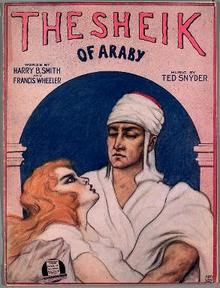
"The Sheik of Araby" was a Tin Pan Alley hit, and was also adopted by early jazz bands, especially in New Orleans, making it a jazz standard. It was a well recognized part of popular culture. A verse also appears in the novel The Great Gatsby (1925) by F. Scott Fitzgerald. In 1926, Benny Goodman playing-https://www.youtube.com/watch?v=bLFz-X8cpTw--close to flapper style...

It was in November 1922 that King Tut's tomb was discovered and the world went bonkers over that!  Egyptian stuff was sheik, and they all were singing about the Sheik of Araby....it was a love fest--over Egypt.    

During the year of 1955, the USSR (Russia) had been supplying military equipment to Egypt and Syria to use against Israel. Strange, because they had voted for Israel's existence in the UN. The Russian Federation had joined the UN on October 24, 1945.   Israel's application was renewed in 1949 after the Israeli elections. The Security Council by UN Security Council Resolution 69 on 4 March 1949 voted 9 to 1 in favour of membership, with Egypt voting no and Great Britain abstaining.  Those voting in favour were: China (ROC), France, United States, Soviet Union, Argentina, Canada, Cuba, Norway, and Ukrainian SSR.


 Egypt had banned the Suez Canal and the Gulf of Eilat from Israel for navigation to and from Israel.  The Egyptian; Fidayun or Fedayeen) units were attacking Israelis sent by Egypt from Sinai, the Gaza Strip and elsewhere.  Egypt was creating military bases in Sinai in its frontier.  1955 was a year when Egypt had Arab military pacts against Israel with Egypt in the center.  In October 1956, Jordan joined the Egyptian-Syrian pact.  In 7 days, Israel's army occupied the Sinai peninsula and the Gaza Strip.  This opened the Suez Canal for transit of goods to and from Israel.  Israel was promised that the Canal would be open for such transit, but the promise was never honored.   


Egypt–Israel relations are foreign relations between Egypt and Israel. The state of war between both countries which dated back to the 1948 Arab–Israeli War culminated in the Yom Kippur War in 1973, and was followed by the 1979 Egypt–Israel Peace Treaty a year after the Camp David Accords, mediated by U.S. president Jimmy Carter. Full diplomatic relations were established on January 26, 1980, and the formal exchange of ambassadors took place one month later, on February 26, 1980, with Eliyahu Ben-Elissar serving as the first Israeli Ambassador to Egypt, and Saad Mortada as the first Egyptian Ambassador to Israel. Egypt has an embassy in Tel Aviv and a consulate in Eilat. Israel has an embassy in Cairo and a consulate in Alexandria. Their shared border has two official crossings, one at Taba and one at Nitzana. The crossing at Nitzana is for commercial and tourist traffic only. The two countries' borders also meet at the shoreline of the Gulf of Aqaba in the Red Sea.

Peace between Egypt and Israel has lasted for more than thirty years and Egypt has become an important strategic partner of Israel. In January 2011, Binyamin Ben-Eliezer, a former defense minister known for his close ties to Egyptian officials, stated that "Egypt is not only our closest friend in the region, the co-operation between us goes beyond the strategic." Nevertheless, the relationship is sometimes described as a "cold peace", with many in Egypt skeptical about its effectiveness. According to the 2019-2020 survey, 13% of Egyptians support diplomatic recognition of Israel while 85% oppose. The Arab-Israeli conflict kept relations cool and anti-Israeli incitement is prevalent in the Egyptian media. 

While in Israel 1980-1985, we used to watch TV movies from Egypt.  It is a great way to see a country.  While there, my friends were able to visit Egypt on our Ulan's Spring Semester break, and my friend did.  We were too busy going over our Hebrew in order to pass the coming test, so we didn't take the advantage.  I wish we had been able to do it.  


The President of Egypt today is Abdel Fattah Saeed Hussein Khalil el-Sisi.

Abdel Fattah Saeed Hussein Khalil el-Sisi is an Egyptian politician who is the sixth and current President of Egypt, former Director of Military Intelligence, former Minister of Defense, and former General.  He rules with an iron hand.  Relations with Israel have improved significantly following Mohamed Morsi's removal, with Sisi saying he talks to Israel's prime minister, Binyamin Netanyahu, "a lot." Sisi has been described by The Economist as "the most pro-Israeli Egyptian leader ever."

 With continuous support for Palestine, the Sisi administration supports the two-state solution establishing a Palestinian state on lands that were occupied in 1967  with Eastern Jerusalem as its capital for the Israeli–Palestinian conflict achieving the Palestinians needs and granting Israel the security it wants. 

The first months of Sisi's presidency witnessed the 2014 Israel–Gaza conflict. Egypt also criticized the IDF operation in the Gaza Strip as "oppressive policies of mass punishment rejecting 'the irresponsible Israeli escalation' in the occupied Palestinian territory, which comes in the form of 'excessive' and unnecessary use of military force leading to the death of innocent civilians." It also demanded Israel adopt self-restraint and to keep in mind that being an "occupation force", it has a legal and moral duty to protect civilian lives.

Egypt has been the 5th largest Muslim majority Middle East country with 95,000,000 population.  It has from 90 to 94.7% Muslims.  


                           Shopping in Egypt

Sisi doesn't know the half of it, as he continues to support the Arabs, but their peace has been a peaceful one.  May it continue to be so.  It must be hard on the Arab countries to play on 2 sides of the coin, but he does so in keeping everyone happy.  The longer peace continues, the less death there is and everyone can become aware of how nice a peaceful environment can be.                   

    Moshe Dayan, Anawar Sadat (1918-1981) and Menacham Begin

President Sadat had made peace with Israel and was assassinated for doing so.  Everyone in Israel loved that man.  He came personally to Israel to see for himself what it was like.  He had been Egypt's President from 1970 to 1981, and had succeeded Nasser.  It was Sadat who launched the Yom Kippur War of 1973!  By 1977 he initiated a peace process with Israel when he made his visit to Israel.  In 1979 he signed a peace treaty through the Camp David Agreements.  A Moslem extremist assassinated him while he was reviewing a military parade in Cairo.  Watch "Valley of Tears" on  https://www.youtube.com/watch?v=ltSvPE8xw3A  story of Yom Kippur War -HBO Max orginal


Resource:

https://en.wikipedia.org/wiki/Egypt_Eyalet#:~:text=The%20Eyalet%20of%20Egypt%20operated,into%20the%20Empire%20in%201516.

https://www.britannica.com/place/Egypt/The-Ottomans-1517-1798

https://encyclopedia.1914-1918-online.net/article/occupation_during_and_after_the_war_middle_east#:~:text=Upon%20Ottoman%20entry%20into%20the,%2D1917)%20was%20appointed%20sultan.

https://mfa.gov.il/MFA/ForeignPolicy/Issues/Pages/94th-anniversary-of-the-League-of-Nations-affirmation-of-Jewish-self-determination-24-July-2016.aspx#:~:text=%E2%80%A2-,On%20July%2024%2C%201922%2C%20the%20League%20of%20Nations%2C%20the,the%20historical%20Land%20of%20Israel.

https://en.wikipedia.org/wiki/Member_states_of_the_United_Nations

https://en.wikipedia.org/wiki/Abdel_Fattah_el-Sisi