Showing posts with label 12 Tribes of Israel. Show all posts

Friday, June 27, 2025

The Jewish Homeland and the Jewish State: One In The Same and Why

 Nadene Goldfoot                                                 

      Israel and its neighbors

Zohran Mamdani, contender for NY City mayor,  wants to know what the Jewish Homeland is, and also what the Jewish State is,  so here's what they are all about:  

"According to Jewish tradition and sources, the Jewish homeland is the Land of Israel (Eretz Israel), encompassing the territory "historically"  known as Palestine, renamed to Palestine by the Romans after 135 CE in a 3 year battle with the Jewish general, Bar Kokhba.  They named it thus after Israel's worst  and longest enemy, the Philistines.  

                   The 12 tribes of Israel (Jacob) 3,500 years ago, documented in the Torah, our written history done by the Egyptian scribe and leader, Moses

 This land is considered sacred and central to Jewish identity, history, and religion. Jewish sources highlight a continuous historical and religious connection to this land, dating back thousands of years; at least 4,000 years."

The Land of Israel is central to Jewish belief in the Torah, written, as believed, by Moses himself, with the Hebrew Bible (Tanakh) depicting God's promise of the land to Abraham, Isaac, and Jacob. Jewish history is deeply intertwined with the Land of Israel, with periods of self-rule and sovereignty, including the reigns of King David and King Solomon. 

Many Jewish laws and rituals are tied to the Land of Israel, and some religious authorities consider it a religious obligation for Jews to live there, according to JewFAQ. 

The Zionist movement, which emerged in the late 19th century, advocated for the establishment of a Jewish state in the Land of Israel, fulfilling a long-held aspiration for self-determination and refuge. The Jewish aspiration to return to Zion, generally associated with divine redemption, has suffused Jewish religious thought since the destruction of the First Temple and the Babylonian exile

In the 1920s, the 30 year British Mandate for Palestine encompassed the territory that is now Israel, the West Bank, and Jordan. It was formally established in 1922 and came into effect in September 1923. The Mandate was a consequence of the defeat of the Ottoman Empire in World War I, and it incorporated the principles of the Balfour Declaration, which expressed support for the establishment of a "national home for the Jewish people" in Palestine. 

  • Transjordan: In 1921, the British divided the Mandate region in two, with the area east of the Jordan River becoming the Emirate of Transjordan, governed separately by Abdullah bin Hussein under British supervision. The Jewish National Home provisions of the Mandate were not to apply to Transjordan.
  • Jewish Land Acquisition: The Zionist movement actively pursued land purchases in Mandatory Palestine throughout the 1920s, primarily to establish Jewish settlements. A significant instance was the Sursock Purchase, where a large tract of land in the Jezreel Valley and Haifa Bay was acquired from absentee landlords.
  • Mounting Tensions: The influx of Jewish immigrants and land purchases led to increasing tensions and conflicts with the Arab population. Arabs feared displacement and the loss of their land and rights. This period saw violent clashes and riots.  The worst happened when Samuels of Britain appointed Husseini as Grand Mufti of Jerusalem, and he, of course, did not want to lose his newly found authority, so got the Arabs to riot against the arrival of Jews.  They were bloody riots.  

Golda Meir announcing the creation of the Jewish State after waiting  2,000 years , 

The modern State of Israel, established in 1948, is widely considered by Jews worldwide as the fulfillment of this aspiration and a central place for Jewish identity and culture. While the Land of Israel is widely considered the Jewish homeland, there are diverse views within Judaism regarding the extent of its borders, the relationship with the Palestinian population, and the role of religious law in the modern state.   We have a Chief Rabbi who helps to decide such things as a government.  During the 1920s and 1930s, the Chief Rabbis of Mandatory Palestine were:Ashkenazi Chief Rabbi: Abraham Isaac haCohen Kook; 

Sephardi Chief Rabbi (also known as Rishon leZion): Yaacov Meir 

They both began their terms in 1921. Rabbi Kook served until 1935, and Rabbi Meir served until 1939.                             


The current Chief Rabbis of Israel are Rabbi David Yosef (Sephardic) and 
Rabbi Kalman Ber (Ashkenazi), who both began their terms in 2024. 

Israel is the only Jewish state in the world and holds about 9.757 million of which 20%
are not Jews but Arabs and others in 2023.  There are over 48  countries with more than
50 % Islamic religion, and according to various sources, approximately 15-22 countries have
 Christianity as their official state religion in various forms, such as Catholicism,
 Lutheranism, Anglicanism, or specific national branches.

The Jewish state today does not include all the land of its original state.  Judea and Samaria had been taken by Trans-Jordan, and renamed as The West Bank.  Since the Oslo Accords, the land was
divided into areas A,B, and C with C belonging to Israel, A belonging
to Palestinians and B to both.  
Israel also gave-free in the name of PEACE, Gaza.  Palestinians
use it as a platform from which to shoot at Israelis ever since.  There
has been NO PEACE for Israel ever since.  


Resource:

https://en.wikipedia.org/wiki/Homeland_for_the_Jewish_people  

Tuesday, November 22, 2022

Jeroboam, Solomon's Superintendent of Temple Builders-An Ephraimite Who Led The Rebellion

 Nadene Goldfoot                                              

    Jacob was the father of 12 sons.  One of them was Ephraim. 
Jeroboam was an Ephraimite of the tribe of Ephraim.  He became king of Israel, the most northerly kingdom,  from 933 to 912 BCE. He was not from the tribe of Moses and his brother, Aaron, who were tribal members of Levi.  He was the head superintendent working for Solomon, and he led the rebellion against Solomon's son, causing a Civil War.    
 
Who were the Ephraimites?  Here's their genealogy:  Jacob with his 12 sons, (Reuben, Simeon, Levi, Judah, Issachar, Zebulun, Dan, Naphtali, Gad, Asher,  Joseph-1st son of Rachel, and his sons-EphraimManasseh and later, Benjamin, son of Rachel who died in labor, of which Joseph, the youngest, was his favorite.  The others, of course, became jealous of Joseph.  They probably knew that Rachel had been his true and first love.   Later, Joseph became the father of Ephraim and Manasseh who became heads of 2 of the 12 tribes of Jacob who were Jacob's grandsons, not his sons.  
Jacob gives Joseph's sons a double portion being Joseph was found living in Egypt.  They both maintained their own "flags," and when the land of Israel was divided amongst the Israelites, they both received independent portions.

Ephraim's land included the hill-country in the central region of the land and was noted for its fertility.  Mt. Ephraim was the area occupied by the tribe of Ephraim in the hill regions from Bethel northward.  At the time of Solomon, the entire region was occupied by Ephraim and Manasseh right in the center of what was later called Palestine.  Their later religious center was situated at Shiloh, 25 miles north of Jerusalem in the mountains of Ephraim in its territory.  

Manasseh had been the first son of Joseph and Asenath (Gen.41:50).  When Jacob blessed Joseph's 2 sons, Jacob conferred on them an equal portion with his own sons in the division of Canaan.  Manasseh's tribe was divided into 7 families;  one called Machir and the other six called claiming kinship with Gilead.  Half the tribe with those of Reuben and Gad requested land in Transjordania, which was granted by Moses on condition that they ago with the other tribes in the conquest of the land as scouts going ahead of the main body.                                 
The 10 tribes ceded from the king Rehoboam, Solomon's son who was from the tribe of Judah, because mainly from the tax issue and the forced labor on the temple and other places.  Because the Temple was in Jerusalem, Jeroboam and the others found it uncomfortable to face Rehoboam and go to Judah 3 times a year.  To compensate, Jeroboam set up new shrines at Bethel and Dan  with a similar cult but centering around the symbols of golden calves.  The bible and talmudic sources were violently hostile to Jeroboam who "sinned and caused Israel to sin."

Detail of 
Jeroboam Sacrificing to Idols an unforgivable act, as painted in 1752  by Fragonard, as by doing this, he was committing heresy.  Orthodox Judaism considers views on the part of Jews who depart from traditional Jewish principles of faith heretical. In addition, the more right-wing groups within Orthodox Judaism hold that all Jews who reject the simple meaning of Maimonides's 13 principles of Jewish faith are heretics. As such, most of Orthodox Judaism considers Reform and Reconstructionist Judaism heretical movements, and regards most of Conservative Judaism as heretical. The liberal wing of Modern Orthodoxy is more tolerant of Conservative Judaism, particularly its right wing, as there is some theological and practical overlap between these groups.

Jeroboam was born into the tribe of Ephraim and had become Solomon's superintendent of the Temple builders.  His distant ancestor no doubt was then Ephraim, the younger son of Joseph which had grown to become the tribe of the Israelite tribe of 9 others in the Northern part of the nation of Israel.  Joseph had been Jacob's favorite son.  Ephraim had arrived with 32,500 population after their 40 year trek, but had started off from Egypt with 40,500.  They suffered a loss of 8,000.  Manasseh, on the other hand, had arrived with 52,700 population, having left Egypt with 32,200.  They had a gain of 20,500. 
In the Torah’s account of the end of Jacob’s life, we read that Joseph, upon learning that his father is on his deathbed, brings his two sons to visit him (Gen 48:1) and that when Jacob sees them he proceeds to bless them (48:9). Although Joseph positions the elder son, Manasseh, on Jacob’s right (48:13), Jacob crosses his hands (שִׂכֵּל אֶת־יָדָיו), placing his right hand upon the head of the younger son, Ephraim (48:14). Joseph attempts to correct his father (48:18), but Jacob insists that he is acting deliberately and that Ephraim will be the greater of the two (48:19). The Torah then relates:
 Why did Ephraim lose so many on the Exodus?  This troubling midrash relates a tradition that some or all of the tribe of Ephraim died in the wilderness. Having miscalculated the end of the 400 years of slavery which God prophesied to Abraham, they left Egypt on their own, 30 years ahead of schedule, and were slaughtered by the Philistines. God circumvents the scene of this tragedy, believing that the rest of the Israelites, having just emerged from their long period of oppression and violence, are not ready to encounter the sheer horror of these skeletons. As the midrash states, “Therefore the Holy Blessed One reasoned: If Israel behold the bones of the Ephraimites strewn in the path, they will return to Egypt.”  Only when the right conditions are joined by the right spirit can such a process succeed in helping a developing society to heal and move forward, thus fulfilling the words of Ezekiel’s prophecy: “Thus said the Lord God to these bones: I will cause breath to enter you and you shall live again.”

Jeroboam was the son of Nebat, a member of the Tribe of Ephraim of Zereda. His mother, named Zeruah (צרוע "leprous") was a widow. He had at least two sons, Abijah and Nadab, who succeeded him on the throne.

A massive stepped podium for the Canaanite-Jebusite palace/fortress that was also used as David’s palace. Eilat Mazar dates the building of this structure from the period of 1200-1000 BC. This Stepped Stone Structure was the work of the Jebusites during the days of the Judges, and the work of David around 1000 BC

While still a young man, King Solomon made Jeroboam superintendent over his tribesmen in the building of the fortress Millo in Jerusalem and of other public works, and he naturally became conversant with the widespread discontent caused by the extravagances which marked the reign of Solomon.

Influenced by the words of the prophet Ahijah, he began to form conspiracies with the view of becoming king of the ten northern tribes; but these were discovered, and he fled to Egypt, where he remained under the protection of Pharaoh Shishak (925 BCE) Egyptian king of Libyan origin until the death of Solomon.  Jeroboam fled from Solomon and found refuge with Shishak.  In the 5th year of Rehoboam's rule, Shishak overran Judah and plundered the Temple treasure in Jerusalem.  His conquests also included the kingdom of Israel.   After this event, he returned and participated in a delegation sent to ask the new king Rehoboam to reduce taxes.

 After Rehoboam rejected their petition, ten of the tribes withdrew their allegiance to the house of David and proclaimed Jeroboam their king, forming the northern kingdom of Israel (Samaria). Thus, the Civil War.  Initially,  only the tribes of Judah and Benjamin remained to form the new kingdom of Judah, loyal to Rehoboam.

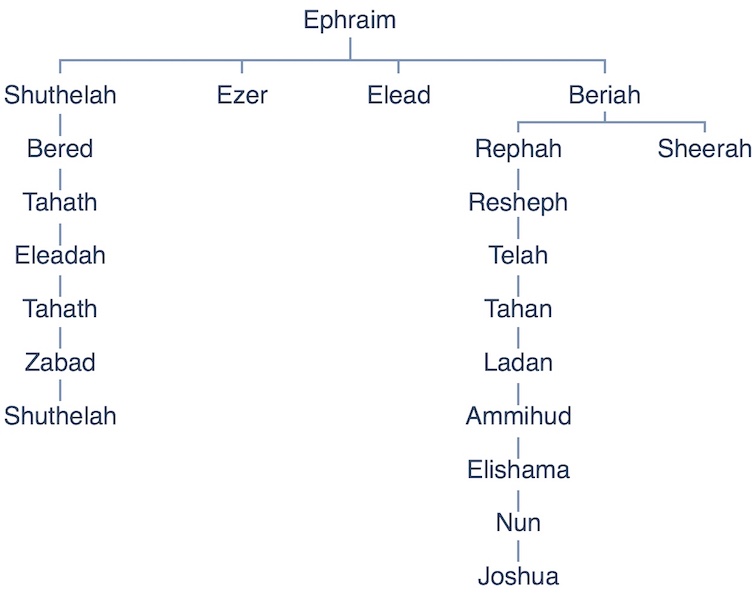
The Ephraimites who entered the land with Joshua were the descendants of Ephraim, hardly Ephraim himself with his children. This is clear, first of all, because Joshua, son of Nun, who led the conquest, was a distant descendant of Ephraim (cf. 1 Chron. 7:25—27). Second, the notice in Numbers 26:35 cited above concerning the Ephraimites who entered the land speaks of the families of the Shuthalhites, Bachrites and Tahanites. The reference is to fully developed clans, not individuals.

7:20 And the sons of Ephraim; Shuthelah, and Bered his son, and Tahath his son, and Eladah his son, and Tahath his son, 7:21 And Zabad his son, and Shuthelah his son, and Ezer, and Elead. Now the men of Gath, who were born in the land, killed them, for they (=the sons of Ephraim) came down to raid their cattle. 7:22 Their father Ephraim mourned for them for many days, and his brothers came to comfort him. 7:23 He (Ephraim) came unto his wife and she conceived and had a son. And he named him Beriah, because disaster (ברעה) had befallen his house. 7:24 His daughter was Sheera. She built Lower and Upper Beit Horon and Uzzen-Sheera.   Beit Horon is one of the Levitical cities within the territory of Mount Ephraim in Joshua 21:20-22 (cf. also Josh. 16:3, 5). The entire family is thus living and building new settlements in the land.

Joshua was proud to be from this tribe.  He had been the commander of defenders in their war with the Amalekites who had attacked them (Exod.17:14).  Later, he was the representative of Ephraim's tribe among the 12 spies, sent to reconnoiter the land of Canaan.  He and Caleb were the only ones to return to Moses with a favorable report.  It could be that Joshua was Jeroboam's ancestor. 

After crossing the Jordan River, Joshua defeated the alliance of southern kings headed by the king of Jerusalem, and then the northern kings led by the king of Hazor, capturing most of what became the Land of Israel (except the valley areas and the coast). He then brought the Tabernacle to Shiloh and divided the territory among the 12 tribes by Lot.   Joshua died at age 110, buried in Ephraim. 

Gilead was the region of Transjordania, settle by the tribes of Reuben, Gad, and half the tribe of Manasseh (Num.32:Josh.22:9, 15l.  After Solomon's reign, Gilead was part of the northern kingdom and, in 732 BCE, was captured by Assyria, its inhabitants being sent into exile.  Its boundaries were not stable, and the area has not been precisely determined.  

When Moses had died before he arrived in Canaan, dying just outside of it's gates, it was then up of Joshua, his 2nd in command, to issue the sites of land for each of the 12 tribes.  10 tribes were given the northern sites and 2-3 were given the southern sites with  Benjamin being in both northern and southern sites.  

Jeroboam's distant ancestor no doubt was then Ephraim, the younger son of Joseph which had grown to become the tribe of the Israelite tribe of 9 others in the Northern part of the nation of Israel.  Joseph had been Jacob's favorite son.  Ephraim's tribe had arrived with 32,500 population after their 40 year trek, but had started off from Egypt with 40,500.  They suffered a loss of 8,000.  Manasseh, on the other hand, had arrived with 52,700 population, having left Egypt with 32,200.  They had a gain of 20,500.  

In order to accomplish the building of the temple, his palace, and the other government buildings, Solomon established twelve administrative districts throughout Israel. The purpose of these districts was to provide for the needs the royal court (4:1-19), to raise taxes, and to coordinate the labor force needed to complete the building projects of his kingdom (5:13-18).

According to 1 Kings 9:15, Solomon established a system of forced labor in Israel in order to build “the house of the LORD and his own house, the Millo and the wall of Jerusalem, Hazor, Megiddo, Gezer.” At the beginning of his building projects, forced labor was only imposed on the remnant of the Canaanite population:

“All the people left from the Amorites, Hittites, Perizzites, Hivites and Jebusites (these peoples were not Israelites), that is, their descendants remaining in the land, whom the Israelites could not exterminate–these Solomon conscripted for his slave labor force, as it is to this day” (1 Kings 9:20-21).

According to Deuteronomy 20:11, when the people of Israel entered the land of Canaan, they were supposed to conquer the Canaanites and submit them to forced labor: “If [a Canaanite city] accepts your terms of peace and surrenders to you, then all the people in it shall serve you at forced labor.”

In the period of the Judges, before king Saul, Ephraim claimed priority among the other Israelite tribes, partly because their religious center was situated at Shiloh in its territory.  

The secession of the northern tribes after Solomon's death in 920 BCE, centered on the tribe of Ephraim,  to which Jeroboam, the first king of the northern kingdom of Israel, belonged.

It's hard to accept that Jeroboam, from such enlightened ancestors, could have ignored his Jewish upbringing and had ignored the principals of it when developing Samaria.  Did he do it out of  anger?  Golden calves?  How could he?  Is this what seeking power does to a person?  Giving up your beliefs?  

The Genealogy of Ephraim in 1 Chronicles 7:20-27  Joshua is the 10th generation from Ephraim. Again, Jeroboam was the son of Nebat, a member of the Tribe of Ephraim of Zereda. His mother, named Zeruah (צרוע "leprous") was a widow. He had at least two sons, Abijah and Nadab, who succeeded him on the throne.  
ZEREDAH (Heb. צְרֵדָה), home town of the Ephraimite Jeroboam the son of Nebat (i Kings 11:26). The reference to Zeredah in ii Chronicles 4:17 is a corruption of Zarethan, according to the parallel verse in i Kings 7:46.  The accepted identification of Zeredah is with Deir Ghassāna in the district of Thamna, 16 mi. (c. 25½ km.) northeast of Lydda (Lod, Israel). The ancient name is preserved by the village spring, ʿAyn Ṣarīda, This area was originally part of Ephraim but was transferred to Judea, together with the rest of the district, in the time of Jonathan the Hasmonean. 

Resource:

The New Standard Jewish Encyclopedia

https://www.thetorah.com/article/when-moses-placed-ephraim-before-manasseh

https://en.wikipedia.org/wiki/Jeroboam

https://en.wikipedia.org/wiki/Heresy

https://claudemariottini.com/2014/02/18/forced-labor-under-solomon-part-6/

https://www.thetorah.com/article/the-book-of-chronicles-and-the-ephraimites-that-never-went-to-egypt

https://www.generationword.com/jerusalem101/17-millo-jebusite-wall.html

https://www.chabad.org/library/article_cdo/aid/520258/jewish/Why-do-we-bless-our-sons-to-be-like-Ephraim-and-Manasseh.htm

https://biblicalhistoricalcontext.com/quirks-in-chronicles/ezer-elead-and-exodus/

Thursday, June 16, 2022

Moving From Mt Sinai to Canaan; Like a Marching Army

Twelve sons of Jacob, who fathered Levi, who fathered Kohath, who fathered Amram, who fathered Moses.  From Jacob to Moses, a direct descendant, was 4 generations.  Moses was the gggrandson of Jacob.                                     

  Jacob was the father of the 12 Tribes of Israel (Jacob's new name-granted to reflect a new state of mind) who were the slaves of the Egyptians. Jacob took 4 wives,, Leah, daughter of Laban-brother of Rebekah-wife of Isaac; Rachel, daughter of Laban-brother of Rebekah-wife of Isaac, then their handmaids, Bilhah and Zilpah.  Remember that Abraham, son of Terah-husband of Sarah, daughter of Haran, sister of Lot, niece of Abraham and wife,  begat Isaac and Isaac begat Jacob.  

The following is how Moses arranged the manner in which they would all leave Egypt when he received the word that he was getting the release of the Israelites from Egyptian bondage. They took 40 years to reach their destination, giving Moses time to create a new fighting force of people from their descendants with the proper education.  

                      
  According to the Torah, Kehath (Hebrew: קְהָת, Qəhāṯ) or Kohath was one of the sons of Levi and the patriarchal founder of the Kehathites, one of the four main divisions of the Levites in biblical times.  They were the direct descendants of Aaron, brother of Moses.  It was Aaron and his sister, Mirium, who had approached Moses, telling him that they were his long lost sibling from when just a baby.  On the Exodus, they were the ones who carried the Ark of the Covenant and the other holy vessels.  When reaching their destination, they would find the Tabernacle already properly set up for them, and they would be able to put their load down.  This happened in 1310 BCE,  3,332 years ago.  

The details found in "Numbers" is astounding. People were named and the order that the Israelites marched was given. These slaves, who had started off as a free people of 70 that had increased to 601,730 over 400 years, as according to the 2nd census that Moses had taken at the end of their exodus of 40 years from Egypt. 

                                        Heading for Moab

They had followed Moses in a manner that generals would be proud; marked by knowing where each tribe was and by banners held high as markers.  It was 10 months and19 days after the group had arrived at Mt. Sinai, they started their journey towards Moab and their destiny, the Holy Land of Canaan.  They were guided by a mysterious cloud.                     

    Romans would copy this way of marching in 70 CE, 1,400 years in the future.  Our Israelites would be fighting people that were not going to let them pass on their land.  They found the land to be populated after 400 years.  
                

1. First in line was the tribe of Judah of 74,600 people, which was the most populated tribe.    Nahshon, son of Amminadab was their leader.  We Jews are the descendants of this tribe today, as we lost the 10 northern tribes much later in 721 BCE.  Judah's mother was Leah. Judah gained 1,900 people by last census.

2. Next was the tribe of Issachar of 54,400 people.  Nethanel, son of Zuar was their leader. Mother of Issachar was Leah. Issachar gained 9,900 people.

3. Next was the tribe of Zebulun of 57,400 people.   Eliab, the son of Elon was their leader. Mother of Zebulun was Leah.  Had a gain of 3,100.

The sons of Gershon and the sons of Merari, who carried the Tabernacle which had been taken down, as it was in a portable state, started their walk.  The main source describing the tabernacle is the biblical Book of Exodus, specifically Exodus 25–31 and 35–40. Those passages describe an inner sanctuary, the Holy of Holies, created by the veil suspended by four pillars. This sanctuary contained the Ark of the Covenant, with its cherubim-covered mercy seat.

According to the TorahGershon (Hebrewגֵּרְשׁוֹן Gērǝšôn) was the eldest of the sons of Levi, and the patriarchal founder of the Gershonites, one of the four main divisions among the Levites in biblical times. The Gershonites were charged with the care of the outer tabernacle including components such as the tent and its covering, screens, doors, and hangings. Biblical scholars regard the name as being essentially the same as "Gershom" (גֵּרְשֹׁם‎ Gēršōm), which appears to mean "a sojourner there" (גר שם), and it is Gershom rather than Gershon who is sometimes listed in the Book of Chronicles as a founder of one of the principal Levite factions. The Torah names Gershon's sons as Libni and Shimei.

4. Next was the tribe of Reuben of 46,500 people.  Elizur, the son of Shedeur, was their leader. Mother of Reuben was Leah. Reuben suffered a loss of 2,770 people.  

5. Next was the tribe of Simeon of 59,300 people.  Shelumiel, the son of Zurishaddai, was their leader. Mother of Simeon was Leah. Suffered a loss of 37,000.   

6. Next was the tribe of Gad of 45,650 people. Eliasaph, the son of Deuiel, was their leader. Mother was Zilpah.  Suffered a loss of 5,150 people.  

Then came the Koathites, who were the carriers of the sanctuary, came next.  A sanctuary is a holy place or a place of safety. The Lord wanted the children of Israel to build a tabernacle (or sanctuary). In our day, a temple is considered a sanctuary.  The Kohathites were one of the four main divisions among the Levites in biblical times, the other three being the Gershonites, the Merarites, and the Aaronites (more commonly known as Kohen). The Bible claims that the Kohathites were all descended from the eponymous Kohath, a son of Levi.

7. Next was the tribe of Ephraim of 40,500 people.  Elishama, the son of Ammihud, was their leader.  Grandmother of Ephraim was Rachel, sister of Leah.  Suffered a loss of 8,000 people.  

8. Next was the tribe of Manasseh of 32,200 people.  Gamaliel, the son of  Pedahzur, was their leader.  Grandmother of Manasseh was Rachel, sister of Leah. Gained 20,500 people.    

9.  Next was the tribe of Benjamin of 35,400 people.  Abidan, the son of Gideoni, was their leader.  Mother of Benjamin was Rachel. Gained 10,200 people.   

10. Next was the tribe of Dan of 62,700 people, who took the rear position in all the camps.  Ahiezer, the son of Ammishaddai, was their leader.  Mother of Dan was Bilhah. Gained 1,700 people.  

11. Next was the tribe of Asher of 41,500 people.  Pagiel, the son of Ochran was their leader.  Mother of Asher was Zilpah.  Gained 11,900 people.  

12. Last was the tribe of Naphtali of 53,400 people.  Ahira, the son of Enon, was their leader.   Mother of Naphtali was Bilhah. Suffered a loss of 8,000. 

https://jewishbubba.blogspot.com/2022/06/the-importance-of-gilgal-in-israel.html 

Update: 6/17/22.  

Why this article?  It's not about any controversy.  As a genealogist, I was so excited to find actual names of each of the 12 tribes!  It is my chance to honor them by remembering them in an article, part of our important ancient history that is most likely glossed over when reading being it is only names.   It's to realize the authenticity of our Torah, recording real-life, not imaginary tales.  Moses was trying his hardest to record history, not make-believe stories.  


References:

Tanakh, Stone edition of ArtScroll series, appendix B, p2035

Pentateuch and Haftorah II, Numbers 10, p. 612, 613

The New Standard Jewish Encyclopedia

https://en.wikipedia.org/wiki/Kohathites#:~:text=The%20Kohathites%20were%20one%20of,Kohath%2C%20a%20son%20of%20Levi.

https://bible365podcast.com/numbers-weekly/?utm_source=facebook&utm_medium=paid&utm_campaign=Torah%20Weekly&utm_content=authors_balaamtwo&fbclid=IwAR2vHFenUINbbL2Js-O1Ie_cDAeAhGcy21jAY3NKLOIBKMzW-o3bSmnj-XA


.