Showing posts with label Levi. Show all posts

Monday, June 8, 2026

Rape In Bible Days: Simeon and Levi, Two of Twelve Sons Of Jacob

 Nadene Goldfoot                                               


Jacob had one daughter that was listed in our Torah.  It was Dinah.According to biblical chronology, the patriarch Jacob lived from roughly 1836 to 1689 BCE, or alternatively 1652 to 1505 BCE depending on the exact calculation used for the Hebrew calendar. Modern historical scholarship views him as a legendary figure rather than a historically confirmed individual as most of them must not Jewish.     

                 A must to read about our Jewish feelings about G-d
              
     Leah                                  Rachel             Zilpah           Bilhah

                                         The Abduction: 

Dinah, the daughter of Jacob and Leah, went to visit the local women in the city of Shechem. She was abducted and raped by the local prince, also named Shechem.  Ref: Genesis, Bereishis 34:2ff; birth 30:2ff.  Shechem was the son of Hamor the Hivvite, prince of the region who took her away and raped her, then fell in love with her.  He then appealed to Dinah's emotions and asked his father if he could marry her.  SO....Shechem's father, Hamor, proposed peace and intermarriage between their two peoples. The brothers pretended to agree, but on the condition that all the men of the city be circumcised.  The Hivites were an ancient group of Canaanite people described in the Old Testament as one of the indigenous nations inhabiting the land of Canaan prior to the Israelite conquest. Their name is widely believed to derive from a Hebrew word meaning "villagers" or "tent-dwellers," implying they were primarily nomadic or rural.  But Hamor had a gate.......

Shechem even  had all the people who departed through the gate of his city listened to Hamor and his son Shechem, and all the males----all those who depart through the gate of his city----were circumcised.  The city had to meet the standards of Jacob and marriage of his people to their people by being circumcized, they thought, though there is a lot more to being of their belief than that.


Jacob heard that Shechem had defiled his only daughter when his sons were with his cattle in the field;  and kept silent until their arrival at home.  He had been hoping to find tranquility in Eretz Yisrael, but now his family had to experience a moral outrage upon its own flesh and blood from its beginning.  His reaction was to not tolerate what others might consider commonplace.

The brothers of Dinah intended to rescue Dinah while the Shechemites were weak and ill, but Simeon and Levi, full brothers, acted on their own, and carried out a death sentence on all the males of Hamor.  On the 3rd day, when all were in pain, Simeon and Levi took their sword and they went to Hamor City and killed every Then they took Dinah from Shechem's house and left.  

Then they plundered the city;  their flocks, their cattle, their donkeys, whatever was in the city and in the field, they took;  all their wealth, all their children and wives they took captive and they plundered, as well as everything in the house.  

Jacob said to Simeon and Levi, "You have discomposed me, making me odious among the people of the land, among the Canaanite and among the Perizzite;  I am few in number and should they band together and attack me, I will be annihilated----I and my household. (It's admirable that he accepts the blame as the father of these boys, something rarely seen today.) The 2 boys then said, "Should we treat our sister like a harlot?  

Jacob had to make amends to G-d. He must have now inherited all the female family left of Hamor.   He was told to go to Beth-el and live now, make an altar there so he told all those living with him to get rid of all their clothing, get rid of any alien gods you have with you ,  and they did so, including rings in their ears, and Jacob buried them underneath the terebinth near Shechem.  No one chased after them as they were afraid of Jacob's tribe.  After that episode, Jacob's name was changed to Israel by G-d.  It was at Beth-el that G-d had spoken to him.   

By what right they did so halachically is discussed by the major commentators.  Whatever the interpretation of the legal statue of the attack on the city, the other nine brothers apparently refused to take part in the attack, and Jacob was sharply critical of Simeon and Levi.             

Genesis 49: The Blessing of Jacob’s Sons…

In his deathbed blessing recorded in ⁠Genesis 49 NIV, Jacob pronounces a harsh rebuke rather than a traditional blessing upon his second and third sons, Simeon and Levi. He condemns their violent massacre of the Shechemites and prophesies that their descendants will be scattered throughout Israel.   Jacob distances himself from their ruthless actions, famously declaring:

"Simeon and Levi are brothers—their swords are weapons of violence. Let me not enter their council, let me not join their assembly... Cursed be their anger, so fierce, and their fury, so cruel! I will scatter them in Jacob and disperse them in Israel."Genesis 49:5-7 NIV  Instead of cursing the men themselves, Jacob curses their unchecked rage and declares that their tribes will be stripped of the concentrated influence they would have had as dominant groups.

Notice, it was not Simeon and Levi that ever raped anyone but the story tells of them punishing those who possibly made it acceptable in their culture;    one of the reasons the Israelites did not want to marry outside their tribal people.   

Going forward from Jacob we have Judah***, Perez, Hezron, Ram and Caleb, Amminadab, Salma, Boaz, Obed, Jesse and King David!!!

Moses was the leader of the Exodus.  He was the son of Amram, a Levite, and Jochebed.  Jews follow the teaching of Moses.  To besmirch Moses as a bad guy is besmirching our religion and is highly anti-Semitic.  

Resource:

Tanach, (old Testament)  the Stone Edition


Sunday, April 16, 2023

Romans and The Infamous High Priest Caiaphas of Judaea, and His Father in Law, Annas

Nadene Goldfoot                                          

                           High Priest Annus with son in law-next high priest, Caiaphas
Aaron, brother of Moses, became the 1st high priest of the Israelites, chosen by Moses himself.  Aaron never lived to see the Promised Land. He died on Mount Hor, near the southern end of the Dead Sea when he was 123 years old. The Israelites mourned him for 30 days, the same number of days that they mourned when, some time later, Moses died. Aaron was succeeded as High Priest by his son Eleazar.  It was an inherited position from the family of Levi.  To be a high priest is to be a direct descendant. They were the Cohens.    Other Levites became Levites in the conduct of Jews praying.  Today our Y haplogroup  of DNA can show who is a Cohen, who is a Levi, etc.  Cohen is one of the most common Jewish surnames. 

The high priests belonged to the Jewish priestly families that trace their paternal line back to Aaron—the first high priest of Israel in the Hebrew Bible and elder brother of Moses—through Zadok, a leading priest at the time of the reigns of David and Solomon over the United Kingdom of Israel. This tradition came to an end in the 2nd century BCE during the rule of the Hasmoneans, when the position was occupied by other priestly families unrelated to Zadok.

High Priest (Hebrewכהן גדולromanizedKohen Gadol or הַכֹּהֵן הַגָּדוֹלha'kohen ha'gadol, ]was the title of the chief religious official of Judaism from the early post-Exilic times until the destruction of the Second Temple in Jerusalem by the Romans in 70 CE. 

Here's the sad part.  In 6 CE, Judaea became a newly formed Roman province.  The Romans had deposed Archaelaus, the Ethnarch of Judaea, which put Judaea directly under Roman rule. Herod Archelaus  23 BCE – c. CE 18) was the ethnarch of Samaria, Judea, and Idumea, including the cities Caesarea and Jaffa, for nine years ( c. 4 BCE to 6 CE ).                  
                                     Annas the High Priest

Annas was appointed by the Roman legate, Quirinius, as the 1st High Priest. Publius Sulpicius Quirinius (c. 51 BC – AD 21), also translated as Cyrenius, was a Roman aristocratAnanus, took the high priesthood, who was a bold man in his temper, and very insolent; he was also of the sect of the Sadducees, who are very rigid in judging offenders, above all the rest of the Jews,

After the banishment of the ethnarch Herod Archelaus from the tetrarchy of Judea in AD 6, Quirinius was appointed legate governor of Syria, to which the province of Judaea had been added for the purpose of a census.

 Annas's son-in-law was Joseph Caiaphas.  Ananus was one of the main leaders of the Great Revolt of Judea, which erupted in 66 CE. He was appointed as one of the heads of the Judean provisional government together with Joseph ben Gurion in late 66. In 68, Ananus was killed during the inter-rebel civil war in Jerusalem. Josephus in The Jewish War considered Ananus "unique in his love for liberty and an enthusiast for democracy" and as an "effective speaker, whose words carried weight with the people."  After Ananus was deposed as high priest, he continued to exercise leadership. "Under the guidance of former high priest Ananus ben Ananus, they (the Sanhedrin) exhorted the populace for support against the radical priestly Zealots, as these 'persuaded those who officiated in the Temple sacrifices to accept no gift or services from a foreigner' (BJ II, 409-414)." Later, he marshaled recruits to fight the Zealots, resulting in the Zealot Temple Siege. While commanding the Jews during the siege, Ananus was killed by the Idumeans.
                           Caiaphas


According to Josephus, Caiaphas was appointed in CE 18 by the Roman prefect Valerius Gratus who preceded Pontius Pilate. He famously presided over the Sanhedrin trial of Jesus. The primary sources for Caiaphas' life are the New Testament, and the writings of Josephus. Josephus records that he was made high priest by the Roman procurator Valerius Gratus after Simon ben Camithus had been deposed.  Simon ben Camithus was a 1st-century High Priest of Israel, who was given the office by the Roman procurator Valerius Gratus and held the office from 17AD to 18AD. Very little is known of him, however he is briefly mentioned in the Talmud as one of the seven sons of Kimchit to serve as high priest, and according to Josephus was succeeded as High Priest by Joseph Caiaphas.

Valerius Gratus was the 4th Roman Prefect of Judaea province under Tiberius from 15 to 26 CE. He succeeded Annius Rufus in 15 and was replaced by Pontius Pilate in 26. The government of Gratus is chiefly remarkable for the frequent changes he made in the appointment of the high-priesthood. He deposed Ananus, and substituted Ishmael ben Fabus, then Eleazar, son of Arianus, then Simon, son of Camith, and lastly Joseph Caiaphas, the son-in-law of Ananus. 

 Pontius Pilate was the fifth governor of the Roman province of Judaea, serving under Emperor Tiberius from 26/27 to 36/37 CE. He is best known for being the official who presided over the trial of Jesus and ultimately ordered his crucifixion.                                                       

It seems clear that the primary cause of the trial and execution of Jesus was his role in an incident at the Temple in Jerusalem. The incident occurred in April, 30 C.E. (or possibly in 33 C.E.) during Festival time, the period including the Day of Passover leading into the week of the Unleavened Bread.  In the New Testament, the Sanhedrin trial of Jesus refers to the trial of Jesus before the Sanhedrin (a Jewish judicial body) following his arrest in Jerusalem and prior to the trial before Pontius Pilate. It is an incident reported by all three Synoptic Gospels of the New Testament, while the Gospel of John refers to a preliminary inquiry before Annas. The gospel accounts vary on a number of details. Jesus was taken to the house of Caiaphas the High Priest of Israel, where the scribes and the elders were gathered together. Mark 14 (Mark 14:53) states that Jesus was taken that night "to the high priest" (without naming the priest), where all the chief priests and the elders gathered.

According to John's gospel, Jesus was taken not to Caiaphas but to Annas, who questioned him only privately. A former high priest and father-in-law of Caiaphas, Annas remained very influential. The fact that Jesus was taken not to Caiaphas but to Annas is explained on the ground that the latter's palace was nearer the place of arrest than that of the former. Peter and other disciples, however, being ignorant of the state of affairs, went to Caiaphas' house in the night.

The gospels report that Jesus was brought before high priest Joseph Caiaphas and the Sanhedrin, the Jewish supreme governing council and court.  Mark and Matthew report a trial at night in the house of Caiaphas, whereas Luke explicitly states that Jesus was tried in the morning before the Sanhedrin. Some scholars doubt the accuracy of of the gospel accounts.  They note that Jewish law prohibits both capital trials on the eves of a festival and trials by night.  

The 1st-century Jewish historian Josephus is considered the most reliable extra-biblical literary source for Caiaphas. His works contain information on the dates for Caiaphas' tenure of the high priesthood, along with reports on other high priests, and also help to establish a coherent description of the responsibilities of the high-priestly office. Josephus (Antiquitates Judaicae 18.33–35) relates that Caiaphas became a high priest during a turbulent period. He also states that the Legate of Syria Lucius Vitellius the Elder deposed Caiaphas (Antiquitates Judaicae 18.95–97). Josephus' account is based on an older source, in which incumbents of the high priesthood were listed chronologically.

The Sadducees were the party of high priests, aristocratic families, and merchants—the wealthier elements of the population. They came under the influence of Hellenism, tended to have good relations with the Roman rulers of Palestine, and generally represented the conservative view within Judaism.  They knew that good intensions of Romans was just a pretense and that they could also be on a cross, so they had to be careful.  Just like Josephus, the general who because a historian for the Romans.  He knew he was writing for a Roman audience and could easily be killed according to how he worded his history.  The Jews were not dealing with reasonable men who thought first before taking lives. In years ago, a life was worth very little except for work.  The Roman culture was one that enjoyed watching people died in a stadium from horrible deaths.  The more gory it was, the better !      

According to John, Caiaphas was the son-in-law of the high priest Annas, who is widely identified with Ananus the son of Seth, mentioned by Josephus. Annas was deposed after the death of Emperor Augustus, but had five sons who served as high priest after him. Augustus, also called Augustus Caesar or (until 27 BCEOctavian, original name Gaius Octavius, adopted name Gaius Julius Caesar Octavianus, (born September 23, 63 BCE—died August 19, 14 CENola, near Naples [Italy]), first Roman emperor, following the republic, which had been finally destroyed by the dictatorship of Julius Caesar, his great-uncle and adoptive father.  Caiaphas was the son-in-law of Annas by marriage to his daughter and ruled longer than any high priest in New Testament times. For Jewish leaders of the time, there were serious concerns about Roman rule and an insurgent Zealot movement to eject the Romans from Israel.

 The terms of Annas, Caiaphas, and the five brothers are:

  • Ananus (or Annas) the son of Seth (6–15)
  • 1.Eleazar the son of Ananus (16–17)
  • Caiaphas, properly called Joseph son of Caiaphas (18–36/37), who had married the daughter of Annas (John 18:13)
  • 2. Jonathan the son of Ananus (spring 37)
  • 3. Theophilus ben Ananus (37–41)
  • 4. Matthias ben Ananus (43)
  • 5. Ananus ben Ananus (63)

Previously, in the Israelite religion, including during the time of the kingdoms of Israel and Judah, other terms were used to designate the leading priests; however, as long as a king was in place, the supreme ecclesiastical authority lay with him. The official introduction of the term "high priest" went hand-in-hand with a greatly enhanced ritual and political significance bestowed upon the chief priest of the Israelites in the post-Exilic period, especially from 411 BCE onward due to the religious transformations brought about during the time of the Babylonian captivity and due to the lack of a Jewish king and kingdom.

According to Helen Bond, there may be some references to Caiaphas in the rabbinic literature. 

Reference: 

https://en.wikipedia.org/wiki/High_Priest_of_Israel

https://en.wikipedia.org/wiki/Caiaphas

https://en.wikipedia.org/wiki/Pontius_Pilate

https://www.britannica.com/topic/prefect-ancient-Roman-official

https://en.wikipedia.org/wiki/Valerius_Gratus

https://en.wikipedia.org/wiki/Ananus_ben_Ananus

https://en.wikipedia.org/wiki/Herod_Archelaus#:~:text=Herod%20Archelaus%20(Ancient%20Greek%3A%20%E1%BC%A9%CF%81%E1%BF%B4%CE%B4%CE%B7%CF%82,4%20BC%20to%20AD%206).

https://www.jewishencyclopedia.com/articles/3903-caiaphas

https://www.britannica.com/biography/Augustus-Roman-emperor

https://en.wikipedia.org/wiki/Pontius_Pilate

https://en.wikipedia.org/wiki/Simon_ben_Camithus

https://en.wikipedia.org/wiki/Quirinius

https://en.wikipedia.org/wiki/Sanhedrin_trial_of_Jesus

April 17, youtube: From Jesus to Christ, The First Christians, Part I=(informative), mentioning Caliphas on Pilate)

Sunday, February 26, 2023

The Day Four Rabbis Were Slaughtered By Terrorists in Jerusalem

 Nadene Goldfoot                                             

Rabbi Goldberg on left   and Rabbi Twersky on right, I believe...

November 18, 2014 was a day that the newspapers told of 4 rabbis praying in a synagogue in Jerusalem, evidently the Kehillat Yaakov Synagogue,  were slaughtered by terrorists.  One of them, the British born Abraham Shmuel Goldberg, was my newly-found cousin who had been helping me with my genealogy long-distance from Jerusalem to Oregon.  

Avraham Shmuel Goldberg was one of four people killed when two people attacked worshippers with knives, axes and guns. The attackers were shot dead by police. The other rabbis murdered were Rabbi Moshe Twersksy, Rabbi Arieh Kiepansky, and Rabbi Kalman Levi.

Prayer book full of blood, prayer shawl was under it.   

Avraham was born in 1946, right after WWII in London.  Rabbi  Goldberg worked as a chemical engineer in London and Israel, specializing in the pharmaceutical industry.  He was also involved in setting up educational facilities in Jerusalem to allow religious students to learn more about the secular world, a man after my own heart. His wife was Bryna and he was the father of 5 girls and a boy.  He died far too soon at 68.  

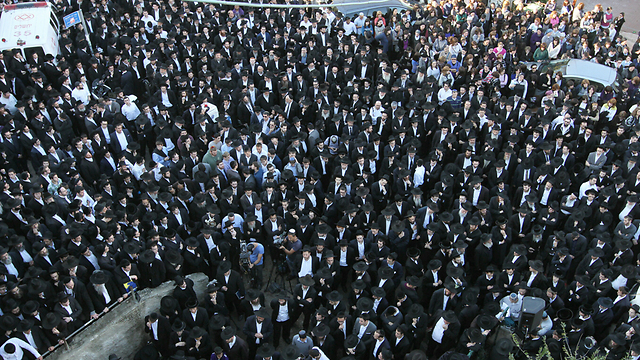
  Rabbi Twersky's funeral

Rabbi Rubin told the participants not to seek revenge for the deaths of the four Jews who were killed by two terrorists from East Jerusalem who raided their morning prayers with guns and meat cleavers.  (Twersky is a Hasidic dynasty of rabbis.  They were from Chernobyl, Russia, founded by Rabbi Menahem Nahum of 1730-1797, who was a pupil of the Baal Shem Tov, known as the maggid of Chernobyl.) 


The funeral procession of people who came to pay their last respects to terror victim Rabbi Moshe Twersky. (Photo: Ido Erez) (Photo: Ido Erez)
The funeral procession of people who came to pay their 

last respects to terror victim Rabbi Moshe Twersky, 

Kupiensky, Goldberg and Levi.  

(Photo: Ido Erez)  
Rabbi Moshe Twersky, a victim of the Jerusalem synagogue terror attack, was laid to rest on Tuesday.  Rabbi Moshe Twersky, a 59-year-old immigrant from the US, b:1955,  and prominent Jewish figure in the Jewish community of Agassi Street in Jerusalem, was one of the four Jews killed during the terror attack on Tuesday morning. 

"He was a big and righteous man during his life – not just after his death," Rabbi Shmuel Aurbach, a leader of the Lithuanian community, said in his eulogy at Twersky's funeral.


"He was so close to God during his holy life and was murdered in the middle of his prayers, while T'filin was laid on his head," said Rabbi Aurbach.  

                             Rabbi Goldberg

A cousin of Rabbi Goldberg, Michelle Hirschfield from north-west London, said he was a peaceful man with no political involvement. She said: "My cousin, Rabbi Abraham Goldberg, [was] born and brought up in Liverpool and then lived and worked in London before going with his family to live in Israel.                      

The two Palestinians who carried out the attack, Jerusalem's deadliest in six years, were shot dead.

Israel's PM Benjamin Netanyahu has vowed a harsh response.

He ordered the homes of the attackers to be destroyed and called for the people of Israel to stand together in the face of a "wave of terror".

Jerusalem has seen weeks of unrest, partly fuelled by tension over a disputed holy site.  Muslims call the site al-Haram al-Sharif and believe it is the place where the Prophet Muhammad ascended into heaven - to Jews it is Temple Mount and marks the place where the sacred temples of their faith stood in ancient times.'    


There was no justification for such an attack.  Three of the victims were dual Israeli-US nationals, the US state department has confirmed, while the fourth was a dual Israeli-UK citizen. The funerals of the four men - all rabbis - have been held in Jerusalem, with thousands in attendance.

PM Netanyahu said this was a "terrible attack at a time of prayer" and condemned what he termed the "shouts of joy" from the Palestinian-controlled Gaza Strip after the attacks.

He said he was strengthening security on the streets of Jerusalem, without giving details.

PM Netanyahu called on the people of Israel to "stand together as one" but added that it was "forbidden for anybody to take the law into their own hands, even if their blood is boiling".

Earlier, the office of Palestinian President Mahmoud Abbas issued a statement saying: "The presidency condemns the attack on Jewish worshippers in their place of prayer and condemns the killing of civilians no matter who is doing it."

US President Barack Obama also condemned the attack, saying: "There is and can be no justification for such attacks against innocent civilians."

The Abu Ali Mustafa Brigades, the military wing of the Popular Front for the Liberation of Palestine, said it had carried out the attack.


This happened 9 years ago.  Israel is still facing the same problems.  The many unforgotten murders of innocent and good people are not forgotten, but affect the citizens.  Can anyone understand this?  


Research:

https://www.bbc.com/news/world-middle-east-30092720

https://www.ynetnews.com/articles/0,7340,L-4593478,00.html

https://www.findagrave.com/memorial/138941253/avraham-shmuel-goldberg