Showing posts with label Israel and Judah. Show all posts

Sunday, July 2, 2023

The Importance of The Prophet, Samuel As a Historian Of Biblical Facts

 Nadene Goldfoot                                    


Samuel lived in the the 11th Century BCE which comprises all years from 1100 BC to 1001 BC. Although many human societies were literate in this period, some of the individuals of the individuals mentioned may be apocryphal rather than historically accurate. 

He was a prophet and the last Israelite judge, a position that was a chosen one that came before Israelite kings.  

The Exodus of Moses leading the Israelites and others out of Egypt to the land of Canaan took place, experts figure, between  1579 to 1476 BCE or about 3,800 years ago. Others say it took place 480 years before the 1st Temple of Solomon.                                                   

                        Elkanah and Hannah want a child

Samuel was born to a family of the tribe of Levi.  Jacob had had 12 sons by 4 women and Levi was one.  Twelve tribes sprouted from these 12 sons of Reuben, Simeon, Levi, Judah, Issachar, Zebulun, Joseph, Benjamin,and Gad, Asher, Dan and Naphtali. Samuel's family lived on Mt. Ephraim and at Ramah that was then in the land of Zuph.  

His mother, Hannah, and most likely his father, Elkanah, a Levite,  had wanted a baby so bad and had a hard time getting pregnant and bringing it to full term.  She had had such a bad experience that she more more than grateful to give birth finally and had consecrated him even before he was born to be a Nazirite; men who would serve the sanctuary at Shiloh. According to the Hebrew Bible, Shiloh was the central sanctuary of the Israelites during the pre-monarchic period, before the First Temple in Jerusalem was built. After the Israelite conquest of Canaan, the Tabernacle was moved to Shiloh, and remained there during the period of the biblical judges.  


Elkanah's genealogy was that he was from the sons of Levi's son, Kohath: Izhar or Assir, Korahand Elkanah was his son   (Chronicles I-6 the Levite families.   If you're looking for the source of Samuel's gene of prophecy, it must be in the tribe of Levi early on--and remember, Moses and his brother Aaron were of the tribe of Levi.  In fact, they were the Cohens who were part of the tribe of Levi.                            

      Little Samuel meeting Eli, the high Priest, a Cohen of the Tribe of Levi in Shilo.  

 Evidently she gave him up to the group as a small child, nursing and weaning him first (most likely till the age of 2)  because he received the Divine call as a child and could prophesize, later foretold the destruction of the House of ELI, a priest and a judge of the Israelites in the city of Shilohancient Israel. When Hannah came to Shiloh to pray for a son, Eli initially accused her of drunkenness, but when she protested her innocence, Eli wished her well. Hannah's eventual child, Samuel, was raised by Eli in the tabernacle

When Eli's sons took what did not belong to them and took it before they should have, they were robbing God of His offering and cheating the people. Notice that because of Eli's sons' actions, the people disliked offering sacrifices (see 1 Samuel 2:17). "The sins of the attendants was very great before HaShem (G-d) for the men had disgraced HaShem's offering.)"

When Eli failed to rein in the abusive behavior of his own sons, God promised to punish his family, which resulted in the death of Eli and his sons. Later biblical passages mention the fortunes of several of Eli's descendants, and he figures prominently in Samaritan religious tradition. 

After the death of Eli and his sons, when the Israelites were defeated by the Philistines in battle at Aphek, Samuel tried to restore traditional religious worship.  

He was living in Ramah as a judge of the Israelites in the sacred towns of Bethel, Gilgal, and Mizpeh, actually getting them ready for national unity.  He organized groups of other prophets to be able to guide the people. 

              King Saul calmed by David's singing with harp.
                                Saul failed as a leader.  
 

In his senior years, he gave in to the popular demand for a king, and so selected Saul, who he later had problems with of tension and so Saul broke off the relationship.  The result was that Saul went to Bethlehem where he found, liked and anointed David as Saul's successor. David became the epitome of royal greatness.  Most of Samuel is about David:  man of faith, unselfish leader, great warrior, loyal friend, compassionate in victory, humble in defeat, and model of repentance.                           

                     King David, king of Israel from about 1000 to 960 BCE, youngest son of Jesse, born in Bethlehem;, armor bearer at 25 of King Saul, friend of his son Jonathan, husband of Saul's daughter, Michal.  Saul became overly jealous causing David to leave and find refuge with king of Gath, Achish.  David returned to Israel after Saul and 3 of his sons had been defeated and killed in battle at Mt. Gilboa.  David settled in Hebron and declared himself king of Judah, one of the original 12 tribes.  Saul's general, Abner, sided with Saul's son Eshbaal who wanted the throne,  and who he had crowned king at Mahanaim, but when the new king was murdered, all the tribes accepted David as king.  After reigning for 8 years, David captured Jerusalem, a Jebusite stronghold, and he proclaimed his capital there and so moved the Ark to this site.   
            Brave David and the Philistine giant, Goliath from Gath

He is studied in the light of the Talmudic and Rabbinic commentaries where we can begin to imagine his stature.  Even reading superficially about Bathsheba, we see David's humility and powerful conscience.  When the prophet, Nathan criticized David harshly, David did not become defensive, and didn't try to defend himself at all, even though, as the Talmud explains, he was technically in the right.  His remorse was so great that it became the textbook for repentance.  I'm sure we can all name presidents that need to learn this lesson to be forever remembered for 3,000 years!  Nathan had told David that his royal house would be perpetually established, but also prevented him from building a permanent Temple in Jerusalem.                                                 


Later, he comes to David to reprimand him for committing adultery with Bathsheba while she was the wife of Uriah the Hittite, whose death the King had also arranged to hide his previous transgression .Later, he comes to David to reprimand him for committing adultery with Bathsheba while she was the wife of Uriah the Hittite, whose death the King had also arranged to hide his previous transgression (2 Samuel 12:7–14).                       

      David accused of moral wrongs by prophet Nathan.  

He was a protagonist of moral values, and charged David with responsibility for the death of Uriah the Hittite.  Later, he was all for Solomon becoming king over his brothers.  Nathan even wrote a chronicle of David's reign (Chron 29:29) which was probably one of the main sources for the Book of Samuel. 

David, of the tribe of Judah, was able to consolidate the 12 competitive tribes into a single nation.  He defeated external enemies and left his successor, his son Solomon, with a united, secure and prosperous kingdom.  To the rest of us in all generations, he bequeathed legacies of pure faith, the seeds of the Messiah concept, and the Book of Psalms that he is said to have written.  Solomon was king from 961 to 920 BCE over Israel.  His son, Rehoboam, became king from 933 to 917 BCE, quite unsuccessfully.  Judah's line continued on till King Zedekiah who reigned from 597 to 586 BCE.

Judah was broken away from the body of Israel after Solomon had died, their CIVIL WAR.E  Jeroboam, the superintendent of workers for Solomon took power and was king from 933 to 912 BCE.  Their last king was Hoshea who ruled from 730 to 721 BCE when the Assyrians attacked and took the best of the population away as slaves.  All 10 tribes were taken away, leaving Judah with a few Benjamin and Simeon with Judah as they were neighbors.  

This book of Samuel marks a historic transition in Jewish history in more ways than one, because the change from judges to kings also led to a change in the role of the prophets.  The judges were said to be chosen by G0d because they were such righteous men.  There was no danger that they would defy Him or falsify His message; rare men indeed!  

The monarchy was a hereditary position, like royalty of today, and, as seen in the sad history of the Books of Kings and Chronicles and Royalty, many of the kings sinned grievously and ultimately brought the nation down.  The kings could not be the moral leaders of the nation, as the judges had been.  that role had to be assumed by prophets, and today, they no longer exist.  Evidently that gene had been used up long ago.  

Thus, after the Book of Samuel, we find the prophets assuming a new king of authority and prominence;  as the succeeding Books will show.  Samuel I and II are followed by Kings.  

 I'd say that Samuel was highly respected and his opinion ruled.  He had the Power.  

Resource:

The new Standard Jewish Encyclopedia

Tanakh, the Stone Edition on Samuel...


Sunday, March 19, 2023

Beware Of Israel's First Civil War of North and South and It's Consequences

 Nadene Goldfoot                                                

When at present, it was announced on the news today that Israel is close to a Civil War, but the president, Hertzog, said he would not allow that to happen.  People have been rioting for the past 11 weeks and it looks like it will continue until Passover over the new governmental policies in the judicial area.  

Israel and the kingdom of Judah allowed things to get out of hand and had their First and Only Civil War with dire consequences.  King Solomon died in 920 BCE, and that was the start of it.  A divided kingdom falls, and in this case, Assyria was just waiting for this to happen as they stepped in and took the land AND the people.  

Solomon, born in 961 BCE,  had taken on the task of building the Temple that Moses had planned for.  He got rid of his brother, Adonijah, and other potentially dangerous individuals and put his money and his laborers with architects and builders sent to him by King Hiram of Tyre.  The work was completed in the 11th year of Solomon's reign and ensured the central position of Jerusalem in the kingdom.                              

                     Abiathar, son of Ahimelech, chief priest at Nob, a priestly city probably situated near Jerusalem on Mt. Scopus.  After the destruction of the tabernacle  or temporary Temple (According to the Hebrew Bible, the tabernacle, also known as the Tent of the Congregation, was the portable earthly dwelling place of Yahweh used by the Israelites from the Exodus until the conquest of Canaan.) at Shiloh, the priests of the sons of Eli built a high-place in Nob where they officiated.  As a punishment for the assistance given to the fugitive David, Saul slew all the priests of the place because they were like false priests.                          
            Eli with Samuel

Eli became the high priest at age 58 at the shrine of Shiloh and one of the last Judges in the 11th century BCE.  He was the mentor of Samuel.  He had died 40 years after becoming high priest by falling from his chair on hearing of the Philistine capture of the Ark. 

Zadok was a Cohen, a priest, not a high one, though.  He may have officiated at the altar in Gibeon but after Saul's death, went to David at Hebron and--together with Abiathar---was David's chief priest.  He remained loyal during Absalom's rebellion and on David's command, anointed Solomon as king.  Solomon appointed Zadok's son a high priest in the Temple and from that time the high priesthood remained in the Zadokite family until the period of the Hasmonean rising. 
Adonijah buttering up David as he lay dying.  Adonijah was the 4th son of David.  After  his brother, Absalom's death, who was the 3rd son, he claimed the succession to the throne, with the support of Joab and Abiathar, but was unsuccessful.  Adonijah later sought to marry Abishag, David's young concubine, but Solomon regarded this as an adct of rebellion and had him killed.  (Kings 1-2).    

Supporting Adonijah were the "old guard"--General Joab and the priest, Abiathar;  and supporting Solomon were the priest Zadok, the prophet Nathan, and the captain of David's bodyguard, Benaiah. 

Solomon ruled his country.  The Sanhedrin wasn't born until much later.  The earliest record of a Sanhedrin of the 71 male rabbinical judges is by Josephus who wrote of a olitical Sanhedrin convened by the Romans in 57 BCE.  Hellenistic sources generally depict the Sanhedrin as a political and judicial council headed by the country's ruler.  

The biggest problem with Solomon's unwise governmental decisions were taxing the people too much to complete the Temple and not paying his laborers.  Solomon must have paid his superintendant, though, Jeroboam I, of the tribe of Ephraim, who supervised forced laborers' work.  It was he who later led the revolt after Solomon had died because his son, Rehoboam, did not revise these problematic areas that the people were rebelling against.  He kept taxes that high, and kept forcing the laborers to work which was too much like slave standards.  

Jeroboam's revolutionary movement was at first suppressed, and he had to take refuge in Egypt.  Later, he led a delegation to speak with King Rehoboam representing the fated northern Israelite tribes which met him at Shechem, demanding changes in the system of taxation and forced labor.  

When that request was refused, the northern tribes declared their independence and anointed Jeroboam as their king.  Jeroboam's capital was first at Shechem, but was later removed to Penuiel in Transjordan and finally to Tirzah.  

Five years after his accession, 60 towns of his territory were ravaged by an Egyptian invasion.  


To combat the influence of the Jerusalem Temple (for he's now going against Moses's plan and making this more of an economical competition of businesses, he had the audacity to set up new shrines at Bethel and Dan with a similar cult but centering around the symbols of golden calves--a horrid idea since Moses had gone up the mountain to receive the 10 Commandments and when he was out of sight, the Israelites threw a Rave;  a party of dancing and drinking around a golden calf they had made. 


 Golden Calf: (Exodus 32:4Exodus 32:8Deuteronomy 9:16Nehemiah 9:18). This was a molten image of a calf which the idolatrous Israelites formed at Sinai. This symbol was borrowed from the custom of the Egyptians. It was destroyed at the command of Moses (Exodus 32:20).

The Bible and talmudic sources are violently hostile to Jeroboam I who "sinned and caused Israel to sin."  Jeroboam was not a student of Moses' writings but a great worker and leader of men.  He had missed the whole idea of what Solomon had in mind with the Temple and where Judaism was going to be.  That was the beginning of their end.

By being divided, they were like chickens out of the coop about to be plucked by the lion nearby.  The Assyrians saw their weakness and attacked, taking most of the best of the people away with them to be used in another land in 721 BCE.  Shalmaneser V's had laid siege of Samaria and its capture by Sargon, his successor who annexed the country and then deported 27,290 of the Israelites to Assyria and Media, and then replaced them with people they wanted to rid themselves of, Syrian and Babylonian prisoners.  Judah itself was taken by them by 700 BCE.  

The only thing that stopped Sennacherib was a plague in his army and they returned home.  King Manasseh of Judah was exiled to Assyria in 652 BCE as a result of complicity in a plot against Ashurbanipal  (669-626 BCE). He was the king of the Neo-Assyrian Empire from 669 BCE to his death in 631.  He is generally remembered as the last great king of Assyria.  

After this time, Assyria declined rapidly and was succeeded by Babylon.  

Resource: 

The New Standard Jewish Encyclopedia

Tanakh, Stone Edition

ILTV on riots today in Israel


Tuesday, November 22, 2022

Jeroboam, Solomon's Superintendent of Temple Builders-An Ephraimite Who Led The Rebellion

 Nadene Goldfoot                                              

    Jacob was the father of 12 sons.  One of them was Ephraim. 
Jeroboam was an Ephraimite of the tribe of Ephraim.  He became king of Israel, the most northerly kingdom,  from 933 to 912 BCE. He was not from the tribe of Moses and his brother, Aaron, who were tribal members of Levi.  He was the head superintendent working for Solomon, and he led the rebellion against Solomon's son, causing a Civil War.    
 
Who were the Ephraimites?  Here's their genealogy:  Jacob with his 12 sons, (Reuben, Simeon, Levi, Judah, Issachar, Zebulun, Dan, Naphtali, Gad, Asher,  Joseph-1st son of Rachel, and his sons-EphraimManasseh and later, Benjamin, son of Rachel who died in labor, of which Joseph, the youngest, was his favorite.  The others, of course, became jealous of Joseph.  They probably knew that Rachel had been his true and first love.   Later, Joseph became the father of Ephraim and Manasseh who became heads of 2 of the 12 tribes of Jacob who were Jacob's grandsons, not his sons.  
Jacob gives Joseph's sons a double portion being Joseph was found living in Egypt.  They both maintained their own "flags," and when the land of Israel was divided amongst the Israelites, they both received independent portions.

Ephraim's land included the hill-country in the central region of the land and was noted for its fertility.  Mt. Ephraim was the area occupied by the tribe of Ephraim in the hill regions from Bethel northward.  At the time of Solomon, the entire region was occupied by Ephraim and Manasseh right in the center of what was later called Palestine.  Their later religious center was situated at Shiloh, 25 miles north of Jerusalem in the mountains of Ephraim in its territory.  

Manasseh had been the first son of Joseph and Asenath (Gen.41:50).  When Jacob blessed Joseph's 2 sons, Jacob conferred on them an equal portion with his own sons in the division of Canaan.  Manasseh's tribe was divided into 7 families;  one called Machir and the other six called claiming kinship with Gilead.  Half the tribe with those of Reuben and Gad requested land in Transjordania, which was granted by Moses on condition that they ago with the other tribes in the conquest of the land as scouts going ahead of the main body.                                 
The 10 tribes ceded from the king Rehoboam, Solomon's son who was from the tribe of Judah, because mainly from the tax issue and the forced labor on the temple and other places.  Because the Temple was in Jerusalem, Jeroboam and the others found it uncomfortable to face Rehoboam and go to Judah 3 times a year.  To compensate, Jeroboam set up new shrines at Bethel and Dan  with a similar cult but centering around the symbols of golden calves.  The bible and talmudic sources were violently hostile to Jeroboam who "sinned and caused Israel to sin."

Detail of 
Jeroboam Sacrificing to Idols an unforgivable act, as painted in 1752  by Fragonard, as by doing this, he was committing heresy.  Orthodox Judaism considers views on the part of Jews who depart from traditional Jewish principles of faith heretical. In addition, the more right-wing groups within Orthodox Judaism hold that all Jews who reject the simple meaning of Maimonides's 13 principles of Jewish faith are heretics. As such, most of Orthodox Judaism considers Reform and Reconstructionist Judaism heretical movements, and regards most of Conservative Judaism as heretical. The liberal wing of Modern Orthodoxy is more tolerant of Conservative Judaism, particularly its right wing, as there is some theological and practical overlap between these groups.

Jeroboam was born into the tribe of Ephraim and had become Solomon's superintendent of the Temple builders.  His distant ancestor no doubt was then Ephraim, the younger son of Joseph which had grown to become the tribe of the Israelite tribe of 9 others in the Northern part of the nation of Israel.  Joseph had been Jacob's favorite son.  Ephraim had arrived with 32,500 population after their 40 year trek, but had started off from Egypt with 40,500.  They suffered a loss of 8,000.  Manasseh, on the other hand, had arrived with 52,700 population, having left Egypt with 32,200.  They had a gain of 20,500. 
In the Torah’s account of the end of Jacob’s life, we read that Joseph, upon learning that his father is on his deathbed, brings his two sons to visit him (Gen 48:1) and that when Jacob sees them he proceeds to bless them (48:9). Although Joseph positions the elder son, Manasseh, on Jacob’s right (48:13), Jacob crosses his hands (שִׂכֵּל אֶת־יָדָיו), placing his right hand upon the head of the younger son, Ephraim (48:14). Joseph attempts to correct his father (48:18), but Jacob insists that he is acting deliberately and that Ephraim will be the greater of the two (48:19). The Torah then relates:
 Why did Ephraim lose so many on the Exodus?  This troubling midrash relates a tradition that some or all of the tribe of Ephraim died in the wilderness. Having miscalculated the end of the 400 years of slavery which God prophesied to Abraham, they left Egypt on their own, 30 years ahead of schedule, and were slaughtered by the Philistines. God circumvents the scene of this tragedy, believing that the rest of the Israelites, having just emerged from their long period of oppression and violence, are not ready to encounter the sheer horror of these skeletons. As the midrash states, “Therefore the Holy Blessed One reasoned: If Israel behold the bones of the Ephraimites strewn in the path, they will return to Egypt.”  Only when the right conditions are joined by the right spirit can such a process succeed in helping a developing society to heal and move forward, thus fulfilling the words of Ezekiel’s prophecy: “Thus said the Lord God to these bones: I will cause breath to enter you and you shall live again.”

Jeroboam was the son of Nebat, a member of the Tribe of Ephraim of Zereda. His mother, named Zeruah (צרוע "leprous") was a widow. He had at least two sons, Abijah and Nadab, who succeeded him on the throne.

A massive stepped podium for the Canaanite-Jebusite palace/fortress that was also used as David’s palace. Eilat Mazar dates the building of this structure from the period of 1200-1000 BC. This Stepped Stone Structure was the work of the Jebusites during the days of the Judges, and the work of David around 1000 BC

While still a young man, King Solomon made Jeroboam superintendent over his tribesmen in the building of the fortress Millo in Jerusalem and of other public works, and he naturally became conversant with the widespread discontent caused by the extravagances which marked the reign of Solomon.

Influenced by the words of the prophet Ahijah, he began to form conspiracies with the view of becoming king of the ten northern tribes; but these were discovered, and he fled to Egypt, where he remained under the protection of Pharaoh Shishak (925 BCE) Egyptian king of Libyan origin until the death of Solomon.  Jeroboam fled from Solomon and found refuge with Shishak.  In the 5th year of Rehoboam's rule, Shishak overran Judah and plundered the Temple treasure in Jerusalem.  His conquests also included the kingdom of Israel.   After this event, he returned and participated in a delegation sent to ask the new king Rehoboam to reduce taxes.

 After Rehoboam rejected their petition, ten of the tribes withdrew their allegiance to the house of David and proclaimed Jeroboam their king, forming the northern kingdom of Israel (Samaria). Thus, the Civil War.  Initially,  only the tribes of Judah and Benjamin remained to form the new kingdom of Judah, loyal to Rehoboam.

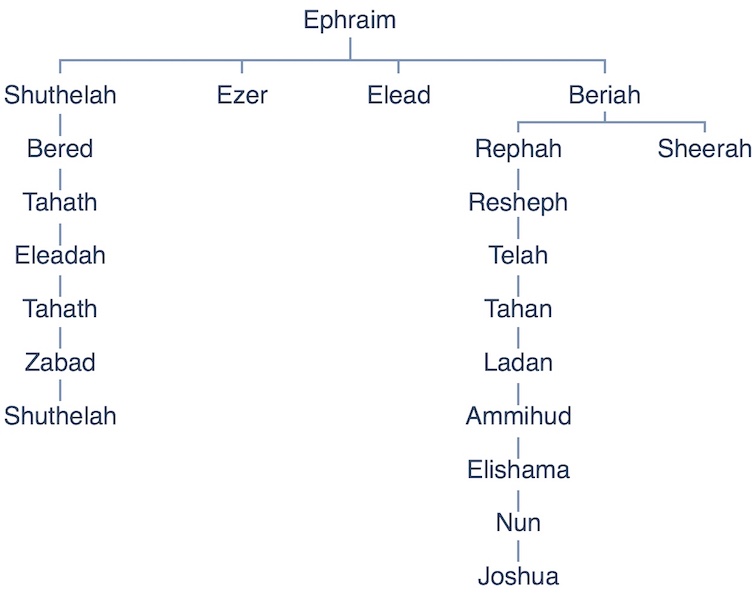
The Ephraimites who entered the land with Joshua were the descendants of Ephraim, hardly Ephraim himself with his children. This is clear, first of all, because Joshua, son of Nun, who led the conquest, was a distant descendant of Ephraim (cf. 1 Chron. 7:25—27). Second, the notice in Numbers 26:35 cited above concerning the Ephraimites who entered the land speaks of the families of the Shuthalhites, Bachrites and Tahanites. The reference is to fully developed clans, not individuals.

7:20 And the sons of Ephraim; Shuthelah, and Bered his son, and Tahath his son, and Eladah his son, and Tahath his son, 7:21 And Zabad his son, and Shuthelah his son, and Ezer, and Elead. Now the men of Gath, who were born in the land, killed them, for they (=the sons of Ephraim) came down to raid their cattle. 7:22 Their father Ephraim mourned for them for many days, and his brothers came to comfort him. 7:23 He (Ephraim) came unto his wife and she conceived and had a son. And he named him Beriah, because disaster (ברעה) had befallen his house. 7:24 His daughter was Sheera. She built Lower and Upper Beit Horon and Uzzen-Sheera.   Beit Horon is one of the Levitical cities within the territory of Mount Ephraim in Joshua 21:20-22 (cf. also Josh. 16:3, 5). The entire family is thus living and building new settlements in the land.

Joshua was proud to be from this tribe.  He had been the commander of defenders in their war with the Amalekites who had attacked them (Exod.17:14).  Later, he was the representative of Ephraim's tribe among the 12 spies, sent to reconnoiter the land of Canaan.  He and Caleb were the only ones to return to Moses with a favorable report.  It could be that Joshua was Jeroboam's ancestor. 

After crossing the Jordan River, Joshua defeated the alliance of southern kings headed by the king of Jerusalem, and then the northern kings led by the king of Hazor, capturing most of what became the Land of Israel (except the valley areas and the coast). He then brought the Tabernacle to Shiloh and divided the territory among the 12 tribes by Lot.   Joshua died at age 110, buried in Ephraim. 

Gilead was the region of Transjordania, settle by the tribes of Reuben, Gad, and half the tribe of Manasseh (Num.32:Josh.22:9, 15l.  After Solomon's reign, Gilead was part of the northern kingdom and, in 732 BCE, was captured by Assyria, its inhabitants being sent into exile.  Its boundaries were not stable, and the area has not been precisely determined.  

When Moses had died before he arrived in Canaan, dying just outside of it's gates, it was then up of Joshua, his 2nd in command, to issue the sites of land for each of the 12 tribes.  10 tribes were given the northern sites and 2-3 were given the southern sites with  Benjamin being in both northern and southern sites.  

Jeroboam's distant ancestor no doubt was then Ephraim, the younger son of Joseph which had grown to become the tribe of the Israelite tribe of 9 others in the Northern part of the nation of Israel.  Joseph had been Jacob's favorite son.  Ephraim's tribe had arrived with 32,500 population after their 40 year trek, but had started off from Egypt with 40,500.  They suffered a loss of 8,000.  Manasseh, on the other hand, had arrived with 52,700 population, having left Egypt with 32,200.  They had a gain of 20,500.  

In order to accomplish the building of the temple, his palace, and the other government buildings, Solomon established twelve administrative districts throughout Israel. The purpose of these districts was to provide for the needs the royal court (4:1-19), to raise taxes, and to coordinate the labor force needed to complete the building projects of his kingdom (5:13-18).

According to 1 Kings 9:15, Solomon established a system of forced labor in Israel in order to build “the house of the LORD and his own house, the Millo and the wall of Jerusalem, Hazor, Megiddo, Gezer.” At the beginning of his building projects, forced labor was only imposed on the remnant of the Canaanite population:

“All the people left from the Amorites, Hittites, Perizzites, Hivites and Jebusites (these peoples were not Israelites), that is, their descendants remaining in the land, whom the Israelites could not exterminate–these Solomon conscripted for his slave labor force, as it is to this day” (1 Kings 9:20-21).

According to Deuteronomy 20:11, when the people of Israel entered the land of Canaan, they were supposed to conquer the Canaanites and submit them to forced labor: “If [a Canaanite city] accepts your terms of peace and surrenders to you, then all the people in it shall serve you at forced labor.”

In the period of the Judges, before king Saul, Ephraim claimed priority among the other Israelite tribes, partly because their religious center was situated at Shiloh in its territory.  

The secession of the northern tribes after Solomon's death in 920 BCE, centered on the tribe of Ephraim,  to which Jeroboam, the first king of the northern kingdom of Israel, belonged.

It's hard to accept that Jeroboam, from such enlightened ancestors, could have ignored his Jewish upbringing and had ignored the principals of it when developing Samaria.  Did he do it out of  anger?  Golden calves?  How could he?  Is this what seeking power does to a person?  Giving up your beliefs?  

The Genealogy of Ephraim in 1 Chronicles 7:20-27  Joshua is the 10th generation from Ephraim. Again, Jeroboam was the son of Nebat, a member of the Tribe of Ephraim of Zereda. His mother, named Zeruah (צרוע "leprous") was a widow. He had at least two sons, Abijah and Nadab, who succeeded him on the throne.  
ZEREDAH (Heb. צְרֵדָה), home town of the Ephraimite Jeroboam the son of Nebat (i Kings 11:26). The reference to Zeredah in ii Chronicles 4:17 is a corruption of Zarethan, according to the parallel verse in i Kings 7:46.  The accepted identification of Zeredah is with Deir Ghassāna in the district of Thamna, 16 mi. (c. 25½ km.) northeast of Lydda (Lod, Israel). The ancient name is preserved by the village spring, ʿAyn Ṣarīda, This area was originally part of Ephraim but was transferred to Judea, together with the rest of the district, in the time of Jonathan the Hasmonean. 

Resource:

The New Standard Jewish Encyclopedia

https://www.thetorah.com/article/when-moses-placed-ephraim-before-manasseh

https://en.wikipedia.org/wiki/Jeroboam

https://en.wikipedia.org/wiki/Heresy

https://claudemariottini.com/2014/02/18/forced-labor-under-solomon-part-6/

https://www.thetorah.com/article/the-book-of-chronicles-and-the-ephraimites-that-never-went-to-egypt

https://www.generationword.com/jerusalem101/17-millo-jebusite-wall.html

https://www.chabad.org/library/article_cdo/aid/520258/jewish/Why-do-we-bless-our-sons-to-be-like-Ephraim-and-Manasseh.htm

https://biblicalhistoricalcontext.com/quirks-in-chronicles/ezer-elead-and-exodus/