Showing posts with label British mandate. Show all posts

Monday, January 26, 2026

Jews Living In Germany At Start Of Holocaust

 Nadene Goldfoot                                                

First day of school
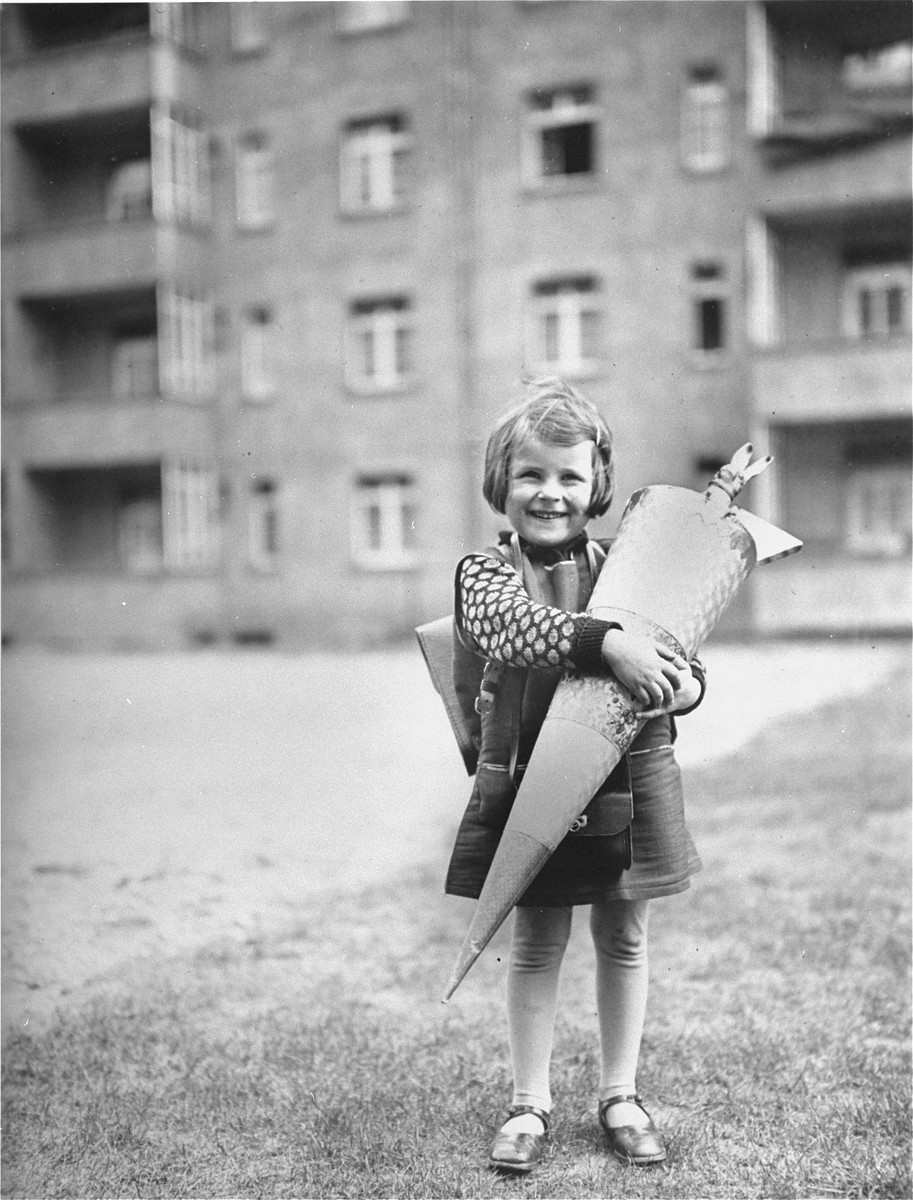
Berta Rosenheim poses with a large cone, traditionally filled with sweets and stationery, on her first day of school. [LCID: 12479]

Berta Rosenheim, Jewish,  poses with a large cone, traditionally filled with sweets and stationery, on her first day of school. Leipzig, Germany, April 1929.

Item View 

Approximately 500,000 to 530,000 Jews lived in Germany around 1930–1933, comprising less than 1% of the total population. While precise yearly census data for 1930-31 is less common than 1933 figures, estimations confirm the population remained around 525,000 just before the Nazis took power.  (We Jews continue to be only less than 1% of world population.)

In the 1930s, prominent German ships like the SS Europa and SS Bremen dominated transatlantic routes from Germany to the United States, representing a peak in maritime luxury and speed. These, along with other vessels, frequently transported passengers and mail, often sailing from major ports like Hamburg or Bremen to New York, often featuring distinctive, sleek designs.                                               
      MS St Louis ship:  
In 1939, the St. Louis carried more than 900 Jewish refugees from Nazi Germany intending to escape antisemitic persecution. The refugees first tried to disembark in Cuba but were denied permission to land. After Cuba, the captain, Gustav Schröder, went to the United States and Canada, trying to find a nation to take the Jews in, but both nations refused. He finally returned the ship to Europe, where various countries, including the United Kingdom, Belgium, the Netherlands, and France, accepted some refugees.

Following the German occupation of France, Belgium and the Netherlands during World War II, refugees were persecuted during the Holocaust, and some historians have estimated that approximately a quarter of them were killed in death camps. These events, also known as the "Voyage of the Damned", have inspired film, opera, and fiction.

   Jewish refugees arrive at Haifa's Port on November 1, 1945. 

 In 1945, it was illegal for Jews to immigrate to Palestine primarily due to the British Mandatory authority’s strict enforcement of the 1939 White Paper. This policy, aimed at preventing further Arab revolts and securing British strategic interests, aimed to limit Jewish immigration to 75,000 over five years, after which further immigration was disallowed without Arab consent. (Giving the mandate to Britainwas political as they had kept out Jews from their country for365 years!!!)

Of 75,000 Jewish refugees of 1933, 1934 and 1935, the largest singlegroup, 30,000 in all, had gone to Palestine.   9,000 had gone to the USA.

About 2,000 had gone to Britain and others to South Africa, Canada, andAustralia, which were English speaking countries.  Thousands more went toFrance, Holland, Belgium, Austria and Czechoslovakia.  

Those German Jews who, like Richard Frankel, were under pressure, left Germany .  More than 75,000 German Jews had emigrated or fled by theend of August 1935.  Of these, several thousand were Jewish according toNazis, known to them as "Christian non-Aryans".  They were condemnedwith being non-Aryan;  meaning Jewish.

Who was Richard Frankel?  Take your pick.  

  • Dr. Richard E. Frankel (Modern Historian): A contemporary American professor of modern German history at the University of Louisiana at Lafayette, who specializes in antisemitism, nationalism, and the Holocaust. He is the author of Bismarck's Shadow: The Cult of Leadership and the Transformation of the German Right, 1898-1945 and Antisemitism Before the Holocaust. He is not a person from the 1930s himself, but a scholar of that era.
  • Richard Frenkel (Holocaust Victim): A two-year-old child born in 1940 who was deported from France to Auschwitz in 1942.
  • Richard Frenkel (Berlin/New York): A man born around 1884 in Germany who lived in Berlin in 1935 and emigrated to New York by 1940. 
  • What happened to the Jews who remained in Germany like my Uncle Werner Oster's parents?  They were Ferdinand Oster and Rosa  Ullmann.  They  died August 1, 1942 in Krasniczyn concentration camp, Poland Camp; Holocaust KZ.  Based on available records, there is no evidence of a major concentrationor extermination camp in Krasniczyn, Poland. It appears there may be confusion with the nearby Budzyń concentration camp, where hundreds to thousands of Jews were imprisoned and many perished between 1942 and 1944. 
  • These camps were as follows:
  • Auschwitz-Birkenau (Oswiecim, near Kraków) 
  • Belzec (near the current Ukrainian border north-west of L'viv) 
  • Kulmhof (Chelmno, between Warsaw and Poznan) 
  • Majdanek (near Lublin) 
  • Sobibór (south of Brest-Litovsk) 
  • Treblinka (north-east of Warsaw) 
  • Warschau (in Warsaw) 
  • A quarter (1/4) of the remaining Jews had been kept from their professional liveli-
  • hood by boycott, decree, or local pressure.  More than 10,000 public health and
  • social workers had been driven out of their posts.  4,000 lawyers were without the
  • right to practice, 2,000 doctors had been expelled from hospitals and clinics;  
  • 2,000 actors, singers and musicians had been driven from their orchestras, clubs
  • and cafes.  1200 editors and journalists had been dismissed, and 800 university
  • professors and leturers, and 800 elementary and secondary school-teachers.
The search for Jews, and for converted Jews, to be driven out of their jobs was con-
tinuous.  On September 5, 1935, the SS newspaper published the names of 8 half
-Jews and converted Jews, all of the Evangelical-Lutheran faith at the time, who had
been dismissed without notice" and deprived of opportunity 'of acting as organists in
Christian churches".  The Reich Chamber of Music is taking steps to protect the
church from pernicious influence." 

Reference:
Holocaust by Martin Gilbert

Saturday, September 27, 2025

1880 Job-Seeking Arabs Entering Palestine

 Nadene Goldfoot                                          

In 1880, the land called Palestine by the Romans way back in 132-135  CE experienced a return of the Israelites, now called Jews, from Eastern European lands where anti-Semitism had become so intolerable that it reminded them of their ancient home called Judah as a refuge and sailed or walked there.  

The Ottoman Empire had taken over all of Palestine by 1516.  Turks were not considered Arabs.  Syria was part of the Ottoman Empire in the 1880s.  In fact, By 1880, the Ottoman Empire's territorial control was declining but still included parts of over 30 modern nations, encompassing the Balkans, North Africa, and the Middle East, though the extent of its actual governance varied, ranging from direct rule to nominal or vassal status. It ruled all or parts of countries like Turkey, Greece, Egypt, and Syria, with its territories extending from southeastern Europe to the Arabian Peninsula.                           

Israel in purple with Judea-Samaria in Yellow, neighbors around the Mediterranean Sea such as Lebanon, Jordan, Egypt;  they came from far
 and near...   This period was written about by Joan Peters extensively.  From Time Immemorial: The Origins of the Arab-Jewish Conflict over Palestine: Peters, Joan: 9780060152659: Amazon.com: Books.  She traced the countries from which they came;  it's in the book.  Joan Peters found that many Palestinian Arabs were recent, unrecorded migrants who were drawn to the land by the economic opportunities created by Jewish settlement, rather than being indigenous to the area "from time immemorial". She argued that significant numbers of Arabs, including Egyptians, Syrians, and others from neighboring countries and regions, moved to Palestine for work in agriculture and construction, making them comparative newcomers to the region. 


      Ottoman Empire Extent :  
By 1880, the Ottoman Empire's territorial control was declining but still included parts of over 30 modern nations, encompassing the Balkans, North Africa, and the Middle East, though the extent of its actual governance varied, ranging from direct rule to nominal or vassal status. It ruled all or parts of countries like Turkey, Greece, Egypt, and Syria, with its territories extending from southeastern Europe to the Arabian Peninsula.  
European Territories:
  • Balkans: Bulgaria, Greece, Albania, Bosnia and Herzegovina, Serbia, Macedonia, and Kosovo. Other: Hungary, Cyprus, and parts of modern-day Romania and Ukraine. Also the Caucasus and beyond: Parts of Armenia and Georgia .  
  •  Middle Eastern Territories:
  •  Levant: Iraq, Syria, Jordan, Palestine, and Lebanon. Arabian Peninsula: Saudi Arabia and other parts.
  • North African Territories: Eastern: Egypt, Sudan, and Eritrea. Western: Libya, Algeria, and Tunisia.
No wonder jobs were hard to get with the Ottoman Empire  in charge of 
half the world.                          


Palestinian men's Y-chromosome DNA, or paternal haplogroups, are predominantly Haplogroup J1 and E1b1b, with some Haplogroup J2 and T also present. These haplogroups indicate deep roots in the ancient Canaanite and Israelite populations of the Levant. J1 is linked to both ancient presence and later Arabian influences, while E1b1b is connected to Neolithic Levantine farmers, and J2 is associated with ancient Phoenician and other Levantine populations. 
  • Genetic studies show that Palestinians, both Muslim and Christian, retain a strong Canaanite and Israelite genetic core in their paternal lineages.
  • Following the 7th-century Muslim conquests, Arabian ancestry, particularly in the paternal line, became an additional influence on the gene pool.
This is much like the Jewish men.  Jewish Israeli men, like other Jewish men globally, are not defined by a single Y-chromosome haplogroup but rather a diverse set of paternal lineages, with Haplogroup J (especially J1 and J2) and E1b1b being particularly common. Studies show significant genetic sharing among different Jewish communities, indicating a common paternal ancestry within the Middle Eastern region, though not a single ancestral founder for all Jewish men. Specific communities also show unique patterns, such as a high frequency of Haplogroup R in Ashkenazi Levites and some evidence of regional genetic contributions from places like Iran and North Africa.

Estimates vary, but by 1880, there were approximately 400,000 to 500,000 Arabs living in Palestine. These figures are based on the total population estimates of the region during the late 19th century under Ottoman rule, with Arabs making up the vast majority of the inhabitants. Peters tells us what countries they came from in the 1880s.  Many were from Syria, referred to as Syrian Arabs.   A few owned land and had to pay taxes to the Ottomans.  The region was still part of the Ottoman Empire, and the movement of people within the empire was common.

         About the Jews of Europe moving to Palestine, historic novel, excellent.  

The first Aliyah took place of the return of Jews from 1880 to 1903.  They bought land from the few Arab owners at high prices, happy to pay to be on their own land. The Arabs were happy as clams in finding buyers as now they could live unrestrained in larger and better cities such as Damascus.  The First Aliyah (first wave of Jewish immigration to Palestine) took place following pogroms and anti-Semitic violence in Russia that prompted Jews to seek a homeland in Palestine. Actually many Jews still were living in Palestine ever since the destruction of Jerusalem by the Romans in the year 70.  Now the Euro-pean Jews joined them.  

Jews commenced to build, for the land under the Ottomans had become so neglected after almost 2,000 years that it had turned into nothing but swamps and mosquitoes, desert sands and wind.  

Tel Aviv was built in 1909s with the help of these Syrian Palestinian Arabs who had followed them, seeking work. It was meant to be  garden suburb of JAFFA named for Herzl's novel Altneuland. Arab riots had forced most Jews to abandon living in Jaffa.  Petah Tikva in 1883, and Rishon LeZion in 1882 were also created then.

Tel Aviv became a separate town by 1921.  Palestine was under the British Mandate by then since the Ottomans lost this country in World War I.  The Allies then had it in their hands with the Brits holding a 30 year mandate over it.  The Jewish National Home was to be born again.  

Thursday, September 25, 2025

Jews Living in Palestine During The British Mandate period (1917-1948) of 30 Years

 Nadene Goldfoot                                   

             General Sir Edmund Allenby, Viscount (1861-1936)  entering Jerusalem, 1917; commander of Egyptian Expeditionary Force from June to October 1917 launching an attack on Turkish forces in the Gaza-Beersheba sector and on Dec. 9 entered Jerusalem.  Allenby won a victory over Turks near Megiddo on Sept 19.  He with allies conquered Palestine.  Although cool toward Zionist aspirations, later favored them while traveling to Jerusalem in April 1925 to attend the official opening by Lord Balfour of the Hebrew University.                     
                   
The man of this British Mandate over Palestine was:  The British High Commissioner for Palestine being  Sir Herbert Louis Samuel [1870-1963] from (1920–1925), the only Jew in office in this liberal government, and leader of the Liberal Party.
        

                                 British Mandate (1917–1948)
  He was not informed about Husseini and his activities, it seems, keeping very busy with other more important matters such as leader of House of Commons from 1931-1935, and House of Lords starting in 1944.  From 1936-height of German atrocities on Jews of Germany, he  as president of Council for German Jews and in 1939, founded the Children's Movement to bring lone refugee children out of Germany to Britain; president of Royal Institute of Philosophy from 1931 to 1956 and author of philosophy, ethics, belief and action and physics.   
  • World War I: During World War I, the British occupied Palestine from the Ottomans because the Ottomans had sided with the Axis, the Germans, and they lost.  Many Jews fought in this war from Palestine.  
  • League of Nations Mandate: After the war, the League of Nations granted the United Kingdom a 30 year mandate to administer Palestine. During that time the British aided and abetted more Arabs into Palestine while curtailing Jews.  They had agreed to help the Jews create the Jewish Homeland ! 
                             As soon as the British left, the Jewish leadership announced the birth of their nation:  ISRAEL.  May 14, 1948 was the birth, and then the Jews were attacked.  
     
     They went against The Balfour Doctrine which Lord Balfour hadwritten. 
     
         Faisal I was the king of both Syria and Iraq in the early 20th century; he was crowned king of the Arab Kingdom of Syria in 1918 but was forced out by the French and later became king of the Kingdom of Iraq in 1921, leading the country to independence in 1932.   
  • In 1920, Britain assumed responsibility for Palestine under a League of Nations Mandate. Mandatory Palestine had a majority Arab population, although more than 100,000 Jews entered the country over the next two decades.

    The British Army's operations in Palestine during this period were mainly directed against militant Arab groups who were opposed to this mass Jewish immigration. Violence reached a height with the Arab Revolt of 1936-39.


  •  Faisal  met with Chaim  Weizmann in Paris in conferences over Palestine and was in favor of the Jews, and hoped they could teach the Arabs some skills.  He lost his power with the Arabs as Husseini had gotten to them, leading them, instead.                                          
  •         In 1921 Transjordan was detached from the area covered by the British Mandate for Palestine and made a separate Emirate under ABDULLAH who renamed it the Hashemite Kingdom of Jordan in 1946.   In 1948 he took over the Arab areas of Palestine but these were lost to Israel by hiss grandson, HUSSEIN , in the 6 Day War.                                                                                                                                    
  • At the Paris Peace Conference, Chaim Weizmann met and signed the Faisal-Weizmann agreement with Emir Faisal (later King Faisal I of Iraq), not with a King of Iraq at the time, as Iraq was not yet its own kingdom. Signed in January 1919, the agreement proposed mutual respect and cooperation between Arab and Jewish peoples, with Faisal supporting the implementation of the Balfour Declaration and a Jewish homeland in Palestine.  
      
                                            Prince Abdullah
     I(Abdullah bin Hussein;  February 1882 – 20 July 1951) was the ruler of Jordan from 11 April 1921 until his assassination in 1951. He was the Emir of Transjordan, a British protectorate, until 25 May 1946, after which he was king of an independent Jordan.  
  • Within 2 years they had given away almost 80% of the Jewish Homeland to Prince Abdullah of Arabia who needed land and people to make him feel like a prince/king.  
  •                                       1947 UN Partition Plan
    The initial vision for Israel's statehood came from United Nations Resolution 181, passed in November 1947. This plan proposed partitioning the British Mandate of Palestine into three parts:  The resolution recommended the creation of independent but economically linked Arab and Jewish States and an extraterritorial "Special International Regime" for the city of Jerusalem and its surroundings.
  • They were dreaming of pie in the sky!  It was an impossibility then just as it is today.  Arabs had been instigated by Husseini, the Arab Grand Mufti of Jerusalem who would not stand to lose his title-had been selected by the only Jew in England's parliament, yet,  who knew nothing of what had been going on with all the riots Husseini and led, etc. 
  • A typical special Jewish man to me was my 3rd cousin, Stanley Goldfoot who I met in Israel in 1980 in Jerusalem.   Stanley was born  May 1914 in Johannesburg South Africa to Sarah, a descendant of the Mayor of Liverpool, and Shimon, born in Vilnius and a direct descendant of Rabbi Eliahu, the Gaon of Vilna. Stanley has a sister, Rachel. He studied at King Edward School. In 1933 he made aliya illegally. He felt the genetic legacy to realize  Zionism, inherited from the Gaon of Vilna, pushing him to come to Eretz Yisrael. Stanley joined Kibbutz Degania. After two years the authorities discovered his illegal presence, and sent him back to South Africa. He worked in various professions, and was sent to the US on behalf of the South African Government. Stanley did not relinquish his dream of Aliya. In 1945 he returned to Eretz Yisrael. He settled in Jerusalem and worked chiefly as a foreign correspondent for the London Daily Express, Johannesburg Sunday Times, France Soir, and the New York Times. During this period he joined Lehi, and became Chief of Intelligence.   His connections  with journalism and foreign correspondent sources, yielded precious news, invaluable for the underground. After the UN Decision of November 29th, he helped establish a Lehi base at ‘Camp Dror’ Talbiyeh. He participated in the force which attempted a breakthrough of the Old City Walls on July 17,1948. He helped prepare the underground broadcasts in English, meant for the British Army. He participated in the conquest of Deir-Yassin. Later, using funds he raised, he established in that neighborhood the ‘Dvar Yerushalayim’ Yeshiva, in memory of his parents.
          Stanley Goldfoot and his first wife and two daughters in Tel Aviv.  When I met him, he was still as slender.  We met at the King David Hotel which held many memories for him. 
        Avraham Stern "Yair" (1907-1942) In 1939-1940 he left the group, Irgun Tzevai Leumi where he was the leader because they refused to take risks to continue anti-British acts in Palestine during WWII.  he formed the underground later known as Lohame Herut Israel which carried out acts of sabotage, etc.  He was killed by British police while being arrested.  
  • LEHI;also called The Stern Group;   Lehi (Hebrew pronunciation: [ˈleχi]; Hebrew: לח״י, sometimes abbreviated "LHI"), officially the Fighters for the Freedom of Israel (Hebrew: לוחמי חרות ישראל, romanized: Lohamei Herut Israel) and often known pejoratively as the Stern Gang by the British,  was a Zionist paramilitary militant organization founded by Avraham ("Yair") Stern in Mandatory Palestine. Its avowed aim was to evict the British authorities from Palestine by use of violence, allowing unrestricted immigration of Jews and the formation of a Jewish state. It was initially called the National Military Organization in Israel, upon being founded in August 1940, but was renamed Lehi one month later. The group referred to its members as terrorists and admitted to having carried out acts of terrorism.
  •  Stanley played an important part in the assassination of Bernadotte, an operation planned in his apartment.  After the assassination he was arrested with other Lehi members and imprisoned in the Jaffa, Akko, and then Jalameh Prisons. After over five months, he was released during the general amnesty. 
  • He worked in journalism afterwards, and did business in the US two years. For seven years he co-operated with Dr. Yisrael Eldad  publishing  the Times of Israel, with a circulation of about 50,000 copies in the US and Israel. He published the international edition of Dr. Eldad’s book, The Jewish Revolution. Stanley wrote the fabulous 'Letter to the World"  that has been set to music and pictures as well.  
  •  Stanley lives in Jerusalem with his wife Helen, née Milner. He is the father of three daughters and two sons (including those from previous marriages) and grandfather to seven. Little had I first guessed that this Portland, Oregon me had such a cousin in South Africa and Israel.  I'm so very glad we met !!!! We had so much in common, especially that urge to move to Israel and help our people.  
  • From 1917 to 1948, the Jews in Palestine, often called Palestinian Jews, were a growing population primarily driven by Zionism and fleeing antisemitism. These immigrants, alongside a smaller number of established Jewish communities, settled in Palestine under the British Mandate, aiming to create a "national home" as promised by the Balfour Declaration. This period saw the organized acquisition of land by Jewish entities and a significant increase in Jewish immigration, fundamentally changing the region's demographics and contributing to the subsequent conflict.  Approximately 110,000 Jewish immigrants arrived in Palestine between May and the end of 1948, adding to the existing Jewish population of about 600,000, contributing to a significant doubling of the country's Jewish population in the years that followed.  

  •               The refugee ship SS ‘Exodus’ 1947 at Haifa Docks, 1947. They had almost made it !   It carried 4,554 Jewish refugees to Palestine under Haganah auspices in 1947.  It was seized by the British in the Mediterranean after a battle in which 3 Jews were killed.  The refugees, returned forcibly from Haifa to Port de Bouc, France, refused to land there;  in spite of their resistance the were disembarked at Hamburg by British soldiers.  The incident did much to swing world opinion against Britain's Palestine policy. 
  • The Outcome: 
    British forces rammed the ship, and after refusing to disembark in France, the passengers were forcibly returned to Germany, where they were placed in displacement camps. 
    They were interned in displaced persons camps in Germany until the United Nations voted to partition Palestine. Most of the passengers eventually immigrated to the newly established state of Israel in 1948. I'm surprised they were not gassed or shot.  

  • The 1960 Hollywood movie Exodus,1947 based on Leon Uris's 1958 novel of the same name, dramatically fictionalizes the real 1947 refugee ship SS Exodus. The actual ship carried about 4,500 Holocaust survivors attempting to enter British Mandate Palestine, not 4,000 as stated in the user request, but the core details of the user request match the actual events involving the SS Exodus. 

  • The 1960 Hollywood movie Exodus, directed by Otto Preminger, featured a large ensemble cast. The main actors included: 
    • Paul Newman as Ari Ben Canaan
    • Eva Marie Saint as Kitty Fremont
    • Ralph Richardson as General Sutherland
    • Lee J. Cobb as Barak Ben Canaan
    • Sal Mineo as Dov Landau 
    Resource: