Showing posts with label Ephraim. Show all posts

Saturday, March 4, 2023

Land of Each Tribe of Our 12 Tribes of Israel

 Nadene Goldfoot                                                                                                              

The Promised Land was 17,500 sq miles of which 45% was Transjordan reaching from the arm of the Nile Delta , the Gulf of Elath, and the Euphrates River opposite Aleppo in the East.  It included most of Syria, covering 58,000 sq. miles.  This entire area was occupied by the Israelites under kings David and his son, Solomon.  There were generally gentile enclaves within Jewish territory.  By 1949 in today's world, the armistice agreements left Israel with 8,000 sq miles with complicated borders.  

    1967 War of Egypt attacking Israel led to Israel's win (a repeat) By beating the odds and winning, they won land that was eluded to be theirs in the first place.  
          1973 and Yom Kippur War with Sadat trying again

The 12 tribes of (Jacob/Israel) left Egypt after living there for 400 years. That's 16 generations of families that had lived in Egypt.  Mostly, they were Egyptians after living there for all these years but a special group that had been isolated in slave quarters.  They were a people breaking away from their "mother" country who had used them, such as Ukraine has done with Russia. 

Parting of the sea for Israelites being chased by Egyptian soldiers

 They left a life of slavery and had to learn to adjust to depending on themselves. They were a people deprived of education; only Moses, raised as a prince of Egypt, was educated and could read and write. They followed the teachings of Moses, which have remained with the Jewish people for the past 4,000 years.   They must have been bilingual, speaking Egyptian and Hebrew.   

Moses leading the way, over 80 years old and walking.  That's why he's so capable.  Sandals are horrible for walking. However did they manage without hiking boots?   Sand can be so hot!  

 Moses, son of Amram and Jochebed of the tribe of Levi,  led the way with Hoshea/Joshua of the tribe of Ephraim.  Joshua was the commander and successor of Moses.  

Joshua and Caleb were the only ones out of the 12 that brought back an encouraging report when on a scouting mission in Canaan. 

    Joshua and Caleb saw huge grapes, luscious fruit being carried 

They tried to convince the Israelites that they could conquer the land: Then Caleb silenced the people before Moses and said, "We should go up and take possession of the land, for we can certainly do it." Caleb was a member of the Kenizzite family (possibly a  central Syrian people mentioned in Egyptian and Hittite inscriptions.  ;  one of the leaders of the tribe of Judah. He must have married into the Kenizzites, an ancient nation in Canaan. Caleb would have been a slave in Egypt as well.   

Joshua was the leader in the war against the Amaleks, nomads who attacked the Israelites in the desert near Rephidim, preying on the weak and weary of the 603,550.  Amaleks became their eternal foe, perhaps a sign that there would always be someone who resents their presence. Haman was an Amalek.  Hitler was an Amalek.  

 Joshua's father was Nun of the tribe of Ephraim.  Nun /ˈnʊn/ (Hebrew: נוּן Nūn, 'Perpetuity'), in the Hebrew Bible, was a man from the Tribe of Ephraim, grandson of Ammihud, son of Elishama, and father of Joshua (1 Chronicles 7:26–27). 

We know very little about Joshua’s early life, except that he was born in Goshen, in the land of Egypt; he was the son of Nun, an Ephraimite; he was in the twelfth generation from Joseph; and he was about forty years old at the time of the Exodus. He is styled as the ‘servant of Moses’, and following Moses’ death is appointed by God to lead the children of Israel into the Promised Land. In the call and commission of Joshua, God gives him two promises: (1) that he would possess the land of Canaan, and (2) that God would be with him and would never forsake him. The Lord directs him (Josh. 1:8) to the secret of success—meditation in the Word of God. It was this more than any other single thing that made Joshua the great leader he proved to be.

It was Joshua who divided the land for the 12 tribes by lot, not by the size of the tribe.    Moses had asked Joshua, laying his hands on him,  to lead the Israelites in the Conquest of Canaan.  He was successful, capturing most of the land except for the valley areas and the coast.  Joshua had all the responsibility of leading, winning in battles to get there, and in selecting land for them to live in.  

                       Egyptian army on the march after Israelites
 7.Gad        8.Asher,     9.Issachar, Zebulun, 11.Joseph   12.Benjamin   

Judah , (4th son of Jacob and Leah), was the largest most populous tribe to enter Canaan with Joshua.  This tribe started in Egypt with 74,600.  By the time they arrived, they had 76,500, a gain of 1,900.  In 933BCE after the death of King Solomon, they were left alone except for most of Benjamin and  it presumably absorbed the tribe of Simeon as well.  They are the remaining tribe to this day, now called the Jewish people.  

The tribe of Dan* (5th son of Jacob, and Bilhah, handmaid of Rachel), was 2nd largest starting with 62,700.  They ended with 64,400, a gain of 1,700.  They were allotted a portion south of Jaffa. The Amorites forced them into hill country so only part of the tribe remained along the coast.  Most were forced north  and took land from the Phoenicians around Laish.  Then the Philistines arrived, causing them to lose land.  Their northern land was the site of a Temple, a chief cult center for tribe of Ephraim.  By 900 BCE, Syria had taken their land.  The great hero of the Danites was Samson, who, until his betrayal by Delilah, used his mighty strength against the Philistine invaders.

The 3rd largest tribe was Simeon, (2nd son of Jacob and Leah),  with 59,300 members.  By the time they arrived, they were almost wiped out having lost 37,100.  They were left with 22,200.  Their lot was 2 areas within Judah in the Negev Desert.  During Hezekiah's reign, they took land from Arabs of Seir.  Some settled in the mountains of Ephraim.  It had been Simeon and Levi attacked Shechem for sister Dinah's name, overly zealous young men.  

The 4th largest tribe was Zebulun,(6th son of Jacob and Leah)    with 57,400. They had 60, 500 when they arrived, having gained 3,100.   They had a central but  small northern piece from the lot, the Valley of Jezreel.  Their descendants were into trade.  The tribe supported the scholars of Issachar.  

The 5th largest tribe was Issachar, (5th son of Jacob and Leah)  with 54,400.   By the time they arrived, they had 64,309 and were the 3rd largest tribe.  Their lot was land between Mt. Tabor and the Jordan River including much of the fertile Valley of Jezreel.  Evidently some of the tribe was saved from the Assyrian exile in 721 BCE and the men answered Hezekiah's summons to celebrate Passover in Jerusalem.  

The 6th largest tribe was Naphtali*, (6th son of Jacob with Bilhah) with 53,400.  When they arrived, they had lost 8,000 leaving them with 45,400.  Their lot was in the northern section of Canaan including the entire East Coast of the Sea of Galilee.  The tribe fought in the war with Sisera and Gideon's campaign against the Midianites.  The land was overrun by the Arameans during the time of Baasha.  Many were exiled by Tiglath-Pileser in 721 BCE.  The survivors lived in the Galilee during 2nd Temple Times 597-538 BCE.  

The 7th largest tribe was Reuben (1st son of Jacob and Leah)  with 46,500 .  They had lost 2,770 by the time they arrived with 43,730.  Reuben had opposed all his brothers in the plot against Joseph.  Another sign of leadership was that he volunteered as surety for Benjamin during the latter's visit to Egypt.  Reuben's tribe had requested and received  land in Moab (Transjordan) which was fertile but came with political problems, eventually in Moabite and Ammoniate hands.  They were one of 10 tribes exiled to Assyria in 721 BCE.  Because of their isolate position, Reuben played little part in the history of the Israelite tribes after the settlement in Canaan.  

The 8th largest tribe was Gad* (son of Jacob and Zilpah) with 45,650 who lost 5,150 and arrived with 40,500.  Their lot was to settle in Gilead and Central Transjordan where they gained a warlike reputation.  They flourished during the rule of Saul , and their position was consolidated under David.  Gad then belonged to Samaria, the northern kingdom and suffered severely from Syrian attacks.  In 732 BCE, the region was devastated by the Assyrians and most of its inhabitants were exiled, later was occupied by the Ammonites.  

The 9th largest tribe was Asher* (8th son of Jacob and Zilpah's 2nd) with 41,500 and  gained 11,900 in the 40 year trek, arriving with a whopping 53,400.  Their lot was fertile territory extending from Western Galilee to the Southern part of Carmel.                                       

       Joseph and Asenath, daughter of Poti-phera, priest of On. 
Jacob couldn't marry Rachel until 14 years had passed after marrying Leah as he had to wait for 7 years to gain Leah when he thought he was marrying Rachel, then had to work another 7 years for Rachel.  By the time Joseph's older brothers sold him to the passing camel caravan, the brothers were older teenagers, jealous teenagers to have done such a horrible thing to Joseph, their father's pride and joy.     

The 3rd smallest tribe was Ephraim (2nd son of Joseph and Asenath) with 40,500 but they lost 8,000 and arrived with only 32,500, and their lot was for  the more northern of the 2 Israelite kingdoms of Ephraim and Israel.  Ephraim included the hill-country in central Eretz and was noted for its fertility.  In the period of the Judges, Ephraim claimed priority among the Israelite tribes, partly because their religious center was situated at Shiloh in its territory. 

The prophets later spoke of the House of Judah and the House of Ephraim, as representing the two branches of the Hebrew people.  What happened to such an important historical group?  The Samaritans claim that some of their adherents are descended from this tribe, and many Persian Jews claim to be descendants of Ephraim.Further afield, in India the Telugu Jews claim descent from Ephraim, and call themselves Bene Ephraim, relating similar traditions to those of the Mizo Jews, whom the modern state of Israel regards as descendants of Manasseh.

The Pashtuns have a proud oral history that talks of descending from the Israelites. Their tribal groupings have similar names, including Yusufzai, which means sons of Joseph; and Afridi, thought by some to come from Ephraim. Some customs and practices are said to be similar to Jewish traditions: lighting candles on the sabbath, refraining from eating certain foods, using a canopy during a wedding ceremony and some similarities in garments.

In 930 BCE,  the tribe of Ephraim led the 10 northern tribes in a successful revolt against the south and established the Kingdom of Israel in (933-912), with Jeroboam I, an Ephraimite, as king. He was Solomon's superintendent, no relation to Solomon.  He had led the revolt, so became their king.   Actually, Solomon died 10 years later.  At the same time,  Rehoboam (son of Solomon of the tribe of Judah  and his Ammonite wife, Naamah) was crowned king of Judah (933-917) which was now on its own in this split from Israel. Judah and Israel even fought against each other at times.  The split was all over high taxes and being forced to labor on the Temple without pay. These reasons were real, but Solomon  was frantic to finish the Temple before he died and this was his only way.  Rehoboam had kept these unreasonable demands on the people.  

The 2nd smallest tribe was Benjamin (the 12th son of Jacob and Rachel's 2nd and last) with 35,400 and arrived with 45,600, a gain of 10,200.  There was a strong connection between Jacob and Benjamin which ended with Jacob's migration to Egypt.  The tribe of Benjamin occupied territory between Ephraim and Judah which included Jerusalem.  On one occasion, it was almost exterminated in a war with the other tribes.  Saul, 1st king of Israel was  Benjamite.  The territory was a bone of contention between the kingdoms of Israel and Judah after the division of the kingdom and eventually, was partitioned between the two.  The land was so small.                                       

                       Joseph, Viceroy of Egypt, son of Jacob all due to understanding others' dreams 

The very smallest tribe was Manasseh (1st son of Joseph and Asenath) with 32,200 and arrived with 52,700, a gain of a whopping 20,500.  The trek agreed with them!  The tribe was divided into 7 families.  One was Machir and the other 6 claimed kinship with Gilead.  Half the tribe with Reuben and Gad asked for territory in Transjordania, which was granted by Moses on condition that they go with the remaining tribes in the conquest of the land as scouts preceding the main body.  This half-tribe received Gilead, Gashan, and Argob.  After the conquest of Canaan, the other half received land in the west of the country around the Valley of Jezreel.  Both these areas were highly fertile.  The Assyrians exiled much of the population from both sections but part remained.  A Jewish population (partly descended from the tribe of Simeon) still existed in the West Manasseh region in the earlier 2nd Temple Period.  

Resource:

Tanakh, Stone Edition

The New Standard Jewish Encyclopedia

https://en.wikipedia.org/wiki/Kingdom_of_Israel_(Samaria)

Tuesday, November 22, 2022

Jeroboam, Solomon's Superintendent of Temple Builders-An Ephraimite Who Led The Rebellion

 Nadene Goldfoot                                              

    Jacob was the father of 12 sons.  One of them was Ephraim. 
Jeroboam was an Ephraimite of the tribe of Ephraim.  He became king of Israel, the most northerly kingdom,  from 933 to 912 BCE. He was not from the tribe of Moses and his brother, Aaron, who were tribal members of Levi.  He was the head superintendent working for Solomon, and he led the rebellion against Solomon's son, causing a Civil War.    
 
Who were the Ephraimites?  Here's their genealogy:  Jacob with his 12 sons, (Reuben, Simeon, Levi, Judah, Issachar, Zebulun, Dan, Naphtali, Gad, Asher,  Joseph-1st son of Rachel, and his sons-Ephraim, Manasseh and later, Benjamin, son of Rachel who died in labor, of which Joseph, the youngest, was his favorite.  The others, of course, became jealous of Joseph.  They probably knew that Rachel had been his true and first love.   Later, Joseph became the father of Ephraim and Manasseh who became heads of 2 of the 12 tribes of Jacob who were Jacob's grandsons, not his sons.  
Jacob gives Joseph's sons a double portion being Joseph was found living in Egypt.  They both maintained their own "flags," and when the land of Israel was divided amongst the Israelites, they both received independent portions.

Ephraim's land included the hill-country in the central region of the land and was noted for its fertility.  Mt. Ephraim was the area occupied by the tribe of Ephraim in the hill regions from Bethel northward.  At the time of Solomon, the entire region was occupied by Ephraim and Manasseh right in the center of what was later called Palestine.  Their later religious center was situated at Shiloh, 25 miles north of Jerusalem in the mountains of Ephraim in its territory.  

Manasseh had been the first son of Joseph and Asenath (Gen.41:50).  When Jacob blessed Joseph's 2 sons, Jacob conferred on them an equal portion with his own sons in the division of Canaan.  Manasseh's tribe was divided into 7 families;  one called Machir and the other six called claiming kinship with Gilead.  Half the tribe with those of Reuben and Gad requested land in Transjordania, which was granted by Moses on condition that they ago with the other tribes in the conquest of the land as scouts going ahead of the main body.                                 
The 10 tribes ceded from the king Rehoboam, Solomon's son who was from the tribe of Judah, because mainly from the tax issue and the forced labor on the temple and other places.  Because the Temple was in Jerusalem, Jeroboam and the others found it uncomfortable to face Rehoboam and go to Judah 3 times a year.  To compensate, Jeroboam set up new shrines at Bethel and Dan  with a similar cult but centering around the symbols of golden calves.  The bible and talmudic sources were violently hostile to Jeroboam who "sinned and caused Israel to sin."

Detail of 
Jeroboam Sacrificing to Idols an unforgivable act, as painted in 1752  by Fragonard, as by doing this, he was committing heresy.  Orthodox Judaism considers views on the part of Jews who depart from traditional Jewish principles of faith heretical. In addition, the more right-wing groups within Orthodox Judaism hold that all Jews who reject the simple meaning of Maimonides's 13 principles of Jewish faith are heretics. As such, most of Orthodox Judaism considers Reform and Reconstructionist Judaism heretical movements, and regards most of Conservative Judaism as heretical. The liberal wing of Modern Orthodoxy is more tolerant of Conservative Judaism, particularly its right wing, as there is some theological and practical overlap between these groups.

Jeroboam was born into the tribe of Ephraim and had become Solomon's superintendent of the Temple builders.  His distant ancestor no doubt was then Ephraim, the younger son of Joseph which had grown to become the tribe of the Israelite tribe of 9 others in the Northern part of the nation of Israel.  Joseph had been Jacob's favorite son.  Ephraim had arrived with 32,500 population after their 40 year trek, but had started off from Egypt with 40,500.  They suffered a loss of 8,000.  Manasseh, on the other hand, had arrived with 52,700 population, having left Egypt with 32,200.  They had a gain of 20,500. 
In the Torah’s account of the end of Jacob’s life, we read that Joseph, upon learning that his father is on his deathbed, brings his two sons to visit him (Gen 48:1) and that when Jacob sees them he proceeds to bless them (48:9). Although Joseph positions the elder son, Manasseh, on Jacob’s right (48:13), Jacob crosses his hands (שִׂכֵּל אֶת־יָדָיו), placing his right hand upon the head of the younger son, Ephraim (48:14). Joseph attempts to correct his father (48:18), but Jacob insists that he is acting deliberately and that Ephraim will be the greater of the two (48:19). The Torah then relates:
 Why did Ephraim lose so many on the Exodus?  This troubling midrash relates a tradition that some or all of the tribe of Ephraim died in the wilderness. Having miscalculated the end of the 400 years of slavery which God prophesied to Abraham, they left Egypt on their own, 30 years ahead of schedule, and were slaughtered by the Philistines. God circumvents the scene of this tragedy, believing that the rest of the Israelites, having just emerged from their long period of oppression and violence, are not ready to encounter the sheer horror of these skeletons. As the midrash states, “Therefore the Holy Blessed One reasoned: If Israel behold the bones of the Ephraimites strewn in the path, they will return to Egypt.”  Only when the right conditions are joined by the right spirit can such a process succeed in helping a developing society to heal and move forward, thus fulfilling the words of Ezekiel’s prophecy: “Thus said the Lord God to these bones: I will cause breath to enter you and you shall live again.”

Jeroboam was the son of Nebat, a member of the Tribe of Ephraim of Zereda. His mother, named Zeruah (צרוע "leprous") was a widow. He had at least two sons, Abijah and Nadab, who succeeded him on the throne.

A massive stepped podium for the Canaanite-Jebusite palace/fortress that was also used as David’s palace. Eilat Mazar dates the building of this structure from the period of 1200-1000 BC. This Stepped Stone Structure was the work of the Jebusites during the days of the Judges, and the work of David around 1000 BC

While still a young man, King Solomon made Jeroboam superintendent over his tribesmen in the building of the fortress Millo in Jerusalem and of other public works, and he naturally became conversant with the widespread discontent caused by the extravagances which marked the reign of Solomon.

Influenced by the words of the prophet Ahijah, he began to form conspiracies with the view of becoming king of the ten northern tribes; but these were discovered, and he fled to Egypt, where he remained under the protection of Pharaoh Shishak (925 BCE) Egyptian king of Libyan origin until the death of Solomon.  Jeroboam fled from Solomon and found refuge with Shishak.  In the 5th year of Rehoboam's rule, Shishak overran Judah and plundered the Temple treasure in Jerusalem.  His conquests also included the kingdom of Israel.   After this event, he returned and participated in a delegation sent to ask the new king Rehoboam to reduce taxes.

 After Rehoboam rejected their petition, ten of the tribes withdrew their allegiance to the house of David and proclaimed Jeroboam their king, forming the northern kingdom of Israel (Samaria). Thus, the Civil War.  Initially,  only the tribes of Judah and Benjamin remained to form the new kingdom of Judah, loyal to Rehoboam.

The Ephraimites who entered the land with Joshua were the descendants of Ephraim, hardly Ephraim himself with his children. This is clear, first of all, because Joshua, son of Nun, who led the conquest, was a distant descendant of Ephraim (cf. 1 Chron. 7:25—27). Second, the notice in Numbers 26:35 cited above concerning the Ephraimites who entered the land speaks of the families of the Shuthalhites, Bachrites and Tahanites. The reference is to fully developed clans, not individuals.

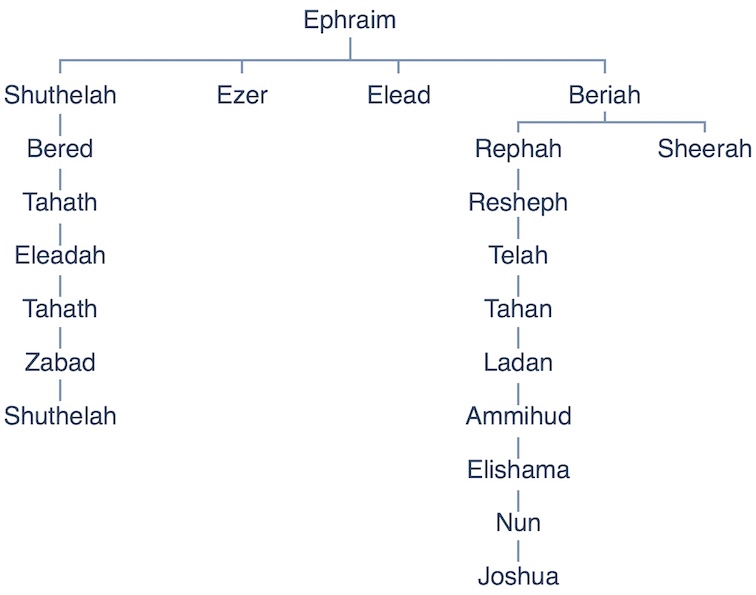
7:20 And the sons of Ephraim; Shuthelah, and Bered his son, and Tahath his son, and Eladah his son, and Tahath his son, 7:21 And Zabad his son, and Shuthelah his son, and Ezer, and Elead. Now the men of Gath, who were born in the land, killed them, for they (=the sons of Ephraim) came down to raid their cattle. 7:22 Their father Ephraim mourned for them for many days, and his brothers came to comfort him. 7:23 He (Ephraim) came unto his wife and she conceived and had a son. And he named him Beriah, because disaster (ברעה) had befallen his house. 7:24 His daughter was Sheera. She built Lower and Upper Beit Horon and Uzzen-Sheera.   Beit Horon is one of the Levitical cities within the territory of Mount Ephraim in Joshua 21:20-22 (cf. also Josh. 16:3, 5). The entire family is thus living and building new settlements in the land.

Joshua was proud to be from this tribe.  He had been the commander of defenders in their war with the Amalekites who had attacked them (Exod.17:14).  Later, he was the representative of Ephraim's tribe among the 12 spies, sent to reconnoiter the land of Canaan.  He and Caleb were the only ones to return to Moses with a favorable report.  It could be that Joshua was Jeroboam's ancestor. 

After crossing the Jordan River, Joshua defeated the alliance of southern kings headed by the king of Jerusalem, and then the northern kings led by the king of Hazor, capturing most of what became the Land of Israel (except the valley areas and the coast). He then brought the Tabernacle to Shiloh and divided the territory among the 12 tribes by Lot.   Joshua died at age 110, buried in Ephraim. 

Gilead was the region of Transjordania, settle by the tribes of Reuben, Gad, and half the tribe of Manasseh (Num.32:Josh.22:9, 15l.  After Solomon's reign, Gilead was part of the northern kingdom and, in 732 BCE, was captured by Assyria, its inhabitants being sent into exile.  Its boundaries were not stable, and the area has not been precisely determined.  

When Moses had died before he arrived in Canaan, dying just outside of it's gates, it was then up of Joshua, his 2nd in command, to issue the sites of land for each of the 12 tribes.  10 tribes were given the northern sites and 2-3 were given the southern sites with  Benjamin being in both northern and southern sites.  

Jeroboam's distant ancestor no doubt was then Ephraim, the younger son of Joseph which had grown to become the tribe of the Israelite tribe of 9 others in the Northern part of the nation of Israel.  Joseph had been Jacob's favorite son.  Ephraim's tribe had arrived with 32,500 population after their 40 year trek, but had started off from Egypt with 40,500.  They suffered a loss of 8,000.  Manasseh, on the other hand, had arrived with 52,700 population, having left Egypt with 32,200.  They had a gain of 20,500.  

In order to accomplish the building of the temple, his palace, and the other government buildings, Solomon established twelve administrative districts throughout Israel. The purpose of these districts was to provide for the needs the royal court (4:1-19), to raise taxes, and to coordinate the labor force needed to complete the building projects of his kingdom (5:13-18).

According to 1 Kings 9:15, Solomon established a system of forced labor in Israel in order to build “the house of the LORD and his own house, the Millo and the wall of Jerusalem, Hazor, Megiddo, Gezer.” At the beginning of his building projects, forced labor was only imposed on the remnant of the Canaanite population:

“All the people left from the Amorites, Hittites, Perizzites, Hivites and Jebusites (these peoples were not Israelites), that is, their descendants remaining in the land, whom the Israelites could not exterminate–these Solomon conscripted for his slave labor force, as it is to this day” (1 Kings 9:20-21).

According to Deuteronomy 20:11, when the people of Israel entered the land of Canaan, they were supposed to conquer the Canaanites and submit them to forced labor: “If [a Canaanite city] accepts your terms of peace and surrenders to you, then all the people in it shall serve you at forced labor.”

In the period of the Judges, before king Saul, Ephraim claimed priority among the other Israelite tribes, partly because their religious center was situated at Shiloh in its territory.  

The secession of the northern tribes after Solomon's death in 920 BCE, centered on the tribe of Ephraim,  to which Jeroboam, the first king of the northern kingdom of Israel, belonged.

It's hard to accept that Jeroboam, from such enlightened ancestors, could have ignored his Jewish upbringing and had ignored the principals of it when developing Samaria.  Did he do it out of  anger?  Golden calves?  How could he?  Is this what seeking power does to a person?  Giving up your beliefs?  

The Genealogy of Ephraim in 1 Chronicles 7:20-27  Joshua is the 10th generation from Ephraim. Again, Jeroboam was the son of Nebat, a member of the Tribe of Ephraim of Zereda. His mother, named Zeruah (צרוע "leprous") was a widow. He had at least two sons, Abijah and Nadab, who succeeded him on the throne.  
ZEREDAH (Heb. צְרֵדָה), home town of the Ephraimite Jeroboam the son of Nebat (i Kings 11:26). The reference to Zeredah in ii Chronicles 4:17 is a corruption of Zarethan, according to the parallel verse in i Kings 7:46.  The accepted identification of Zeredah is with Deir Ghassāna in the district of Thamna, 16 mi. (c. 25½ km.) northeast of Lydda (Lod, Israel). The ancient name is preserved by the village spring, ʿAyn Ṣarīda, This area was originally part of Ephraim but was transferred to Judea, together with the rest of the district, in the time of Jonathan the Hasmonean. 

Resource:

The New Standard Jewish Encyclopedia

https://www.thetorah.com/article/when-moses-placed-ephraim-before-manasseh

https://en.wikipedia.org/wiki/Jeroboam

https://en.wikipedia.org/wiki/Heresy

https://claudemariottini.com/2014/02/18/forced-labor-under-solomon-part-6/

https://www.thetorah.com/article/the-book-of-chronicles-and-the-ephraimites-that-never-went-to-egypt

https://www.generationword.com/jerusalem101/17-millo-jebusite-wall.html

https://www.chabad.org/library/article_cdo/aid/520258/jewish/Why-do-we-bless-our-sons-to-be-like-Ephraim-and-Manasseh.htm

https://biblicalhistoricalcontext.com/quirks-in-chronicles/ezer-elead-and-exodus/

Friday, July 15, 2022

Ebla of Ancient History and Its Clay Tablets

 Nadene Goldfoot                                         

     Ruins of the outer wall and the "Damascus Gate" of Ebla

In Syria, we find the ancient city of Ebla, a place where 20,000  clay tablets with writing have been found telling us about the ancient history of that place.               

Tell Mardikh — Ebla, written by Faja Haj Muhammad that gives a short presentation of the history and remains of the kingdom of ancient Ebla. I will share a couple of photos with some brief info from that book.  The first photo shows the reconstruction of the Palace of the Crown Prince (Palace Q or Western Palace). This palace, built of mud brick, is “located in the lower town, west of the Acropolis.” In the portion of the palace shown here you will see “a well preserved room, used for the grinding of cereals, in order to prepare bread for hundreds of persons.”  

Also, the city that Abram came from UR, also had clay tablets.  "About 1,100 of the tablets date from the period of the Third Dynasty of Ur, (ca. 2112–2004 BCE). They were discovered in the administrative archives of 2 towns in southern Mesopotamia, Umma and Puzrish-Dagan.

      Ebla is on this map.  

Syria (Aram)  originally was vastly huge.  Aram, Ancient country, Middle East, southwestern Asia. It extended eastward from the Anti-Lebanon Mountains to beyond the Euphrates River. It was named for the Aramaeans, who emerged from the Syrian desert to invade Syria and Upper Mesopotamia (c. 11th century BCE) and who built numerous city-kingdoms, including Damascus. It lends its name to the Aramaic language.                          

First Kingdoms: The Forgotten Mesopotamian Kingdom of Ebla

Ebla, modern Tall Mardīkh, also spelled Tell Mardikh, ancient city 33 miles (53 km) southwest of Aleppo in northwestern Syria. During the height of its power (c. 2600–2240 BCE), Ebla dominated northern Syria, Lebanon, and parts of northern Mesopotamia (modern Iraq) and enjoyed trade and diplomatic relations with states as far away as Egypt, Iran, and Sumer. 

Isaiah 7:2 (CJB) It was told to the house of David that Aram (Syria) and Efrayim (Ephraim, younger son of Joseph, the hill country in central Eretz Yisrael noted for its fertility with Solomon's son,, Jeroboam, from there-1st king after Solomon's death) (had become allies with Aram, an enemy. Achaz's heart began to tremble, as did the hearts of his people, like forest trees shaken by the wind.  In (Gen.10:22) we learn that Aram and Israel had a common ancestry and the Israelite patriarch were of Aramaic origin and maintained ties of marriage with the tribes of Aram.  

Jewish comments: "Ebla is a site in northern Syria (Tel Mardikh) where an ancient royal archive was discovered, consisting of over 15,000 tablets written in Sumerian and a language similar to ancient Akkadian.  They date back from the mid-third millennium BCE.  while only a few texts have been published, it is apparent that they are of great value for biblical texts and throw new light on the early history of the Land of Israel."

Ebla maintained its prosperity through a vast trading network. Artifacts from Sumer, Cyprus, Egypt and as far as Afghanistan were recovered from the city's palaces. The kingdom had its own language, Eblaite, and the political organization of Ebla had features different from the Sumerian model.

 Women enjoyed a special status, and the queen had major influence in the state and religious affairs. The pantheon of gods was mainly north Semitic and included deities exclusive to Ebla. The city was excavated starting in 1964 and became famous for the Ebla tablets, an archive of about 20,000 cuneiform tablets found there, dated to around 2350 bcE. Written in both Sumerian and Eblaite and using the cuneiform, the archive has allowed a better understanding of the Sumerian language and provided important information over the political organization and social customs of the mid-3rd millennium bcE's Levant.

At the beginning of the process of deciphering the tablets, Giovanni Pettinato made claims about a possible connections between Ebla and the Bible, citing an alleged references in the tablets to the existence of Yahweh, the Patriarchs, Sodom and Gomorrah and other Biblical references. However, much of the initial media excitement about a supposed Eblaite connections with the Bible, based on preliminary guesses and speculations by Pettinato and others, is now widely discredited and the academic consensus is that Ebla "has no bearing on the Minor Prophets, the historical accuracy of the Biblical Patriarchs, Yahweh worship, or Sodom and Gomorrah". 

 In Ebla studies, the focus has shifted away from comparisons with the Bible; Ebla is now studied as a civilization in its own right. The claims led to a bitter personal and academic conflict between the scholars involved, as well as what so described as political interference by the Syrian authorities.  I'm not surprised that that the non-religious element refuses to 

see any connection.  If there is at least a 51% possibility, it 

should be considered.  DNA below,  shows a  connection that 

Jews have to Ebla.  

According to ancient DNA analyses conducted by Skourtanioti et al. (2020) on 10 human remains from Tel Mardikh from Early and Middle Bronze age, the inhabitants of the kingdom of Ebla were a mixture of Copper age Levantines and Mesopotamians, and were genetically similar to contemporary Levantines from Alalakh and Sidon. 


One Early Bronze Age (2700-2500 BC) individual carried haplogroup E1b1b1b2a-M123, a lineage likely linked to the diffusion of Afroasiatic languages.  This is pretty exciting because many Jews tested carry E-L117.   the YDNA haplogroup E-L117 (if that has not also changed) has undergone several name changes, and is still often referred to as 'E1b1b1' or even 'E-3b'. Google those 'E codes' and all becomes clear, as there are numerous references to the Jewish link to the haplogroup including http://e1b1b1-m35.blogspot.co.uk/2011/02/e1b1b1-jewish-haplogroup.html .

In a nutshell, the group's origins had previously been assumed to have arose in East Africa and the haplogroup was often incorrectly described as African, leaving a misimpression regarding the origin and complex history of this haplogroup. According to the International Society of Genetic Genealogy (ISOGG) and National Geographic's Genographic Project, E1b1b1 may have arisen instead in the Near East or the Middle East, and then expanded into the Mediterranean with the spread of agriculture.

 Another Early Bronze age (2572-2470 cal BCE) individual belonged to J1a2a1a2-P58, while four Middle Bronze Age (2000-1800 BC) individuals carried haplogroups G2a, J1a2a1a2-P58, and the West Asian T1a1-L162 which was present since the middle PPNB Levant. Jews have been found to carry J1 (Cohen gene), and G.  

Resource:

https://www.britannica.com/place/Ebla

https://ferrelljenkins.blog/2011/05/25/the-golden-age-of-ebla-%E2%80%94-before-the-biblical-patriarchs/

https://groups.jewishgen.org/g/main/topic/70311032

https://www.biblestudytools.com/isaiah/7-2-compare.html