Showing posts with label Justinian. Show all posts

Wednesday, August 20, 2025

Roman Imperial Laws, Protecting and Against Jewish Belief From 329-553 In Byzantine Empire

 Nadene Goldfoot                                        

                         Romans outlawed reading the Mishnah, the Oral Law

What they call Mishnah, on the other hand, we prohibit entirely, for it is not included among the Holy Books, nor was it handed down from above by the prophets, but it is an invention of men in their chatter, exclusively of earthly origin and having in it nothing of the divine. Let them read the holy words themselves, therefore, in unfolding these Holy Books for reading, but without hiding what is said in them, on the one hand, and without accepting extraneous and unwritten nonsense they themselves had contrived to the perdition of the more simple minded, on the other hand. In consequence of this permission granted by us, those who adopt the Greek language and the other languages shall not be subjected to any penalty at all, neither shall they be hindered by any person, nor shall those who are called among them Archipherekitae [office now of uncertain authority], or possibly Presbyters [elders] or Didascaloi [teachers], have the license to hinder them from this by any deceits or excommunications, unless they would wish to be chastened for these deeds by corporal punishments as well as by loss of property, and obey us-who desire and command deeds better and more pleasing to God-against their will.

There were so many instances of another law coming up that I'll just list the devastating ones.  After Constantine, emperors continued to issue laws affecting the Jewish population, gradually restricting their rights and freedoms within the Byzantine Empire. Constantine had not stopped.

  • Constantine (306-337 CE): Forbade Jews from proselytizing and punished those who molested converts to Christianity.
  • Constantius II (337-361 CE): Outlawed intermarriage between Jews and Christians and prohibited Jews from owning or dealing in slaves.
  • Theodosius II (408-450 CE): Published the Theodosian Code in 439 CE which systematically curtailed Jewish rights. It barred Jews from building new synagogues, holding public office, and imposed burdensome civic obligations.
  • Justinian I (527-565 CE): Issued the Code of Justinian which further restricted Jewish rights, including denying them full citizenship, disqualifying them from holding public office, prohibiting them from testifying against Christians in court, and banning Hebrew prayer, according to Jewish Currents. 
  • These laws became entrenched in Europe and influenced the status of Jews for over a thousand years under the power of the Church. 

Resource:
https://www.jewishvirtuallibrary.org/byzantine-empire#:~:text=The%20temporary
%20expulsion%20of%20the,Empire%20in%20the%20fourth%20century.
https://www.ccjr.us/dialogika-resources/primary-texts-from-the-history-of-the-relation
ship/roman-laws


Thursday, June 1, 2023

Why Jews Settled in Lithuania In The First Place and When


 Nadene Goldfoot                                          ,

                        Grand Duke Gediminas of Lithuania from 1315 or 1316 until his death in 1341. the Grand Dukes Gediminas and then Vytautas (Witold) had sent out an invitation to the Jewish merchants and craftspeople in 1323-1324 to come and live there for its economic opportunities. Why?  What was going on there? He is considered the founder of Lithuania's capital Vilnius (see: Iron Wolf legend). During his reign, he brought under his rule lands from the Baltic Sea to the Black Sea. The Gediminids dynasty he founded and which is named after him came to rule over Poland, Hungary and Bohemia. 
                              
 Grand Duke Vytautas of Lithuania the Great,Lithuanian Vytautus Didysis, Polish Witold Wielki, (born 1350, Lithuania—died Oct. 27, 1430, Trakai, Lith.)
                                    Jews of 13th Century
  
The Middle Ages, as Dark as they were, lightened up in the 14th century for Jews.  The Great Lithuanian Princedom, also called Magnus Ducatus Lithuaniae was settled by Jews in the 14th Century.  It was because of the invitations to live there by the Grand Dukes.  Jews had had it in Germany, having lived there since the destruction of Jerusalem in 70 CE and Jews were taken as slaves and dispersed. Jewish merchants had been in Rome before 70CE.   

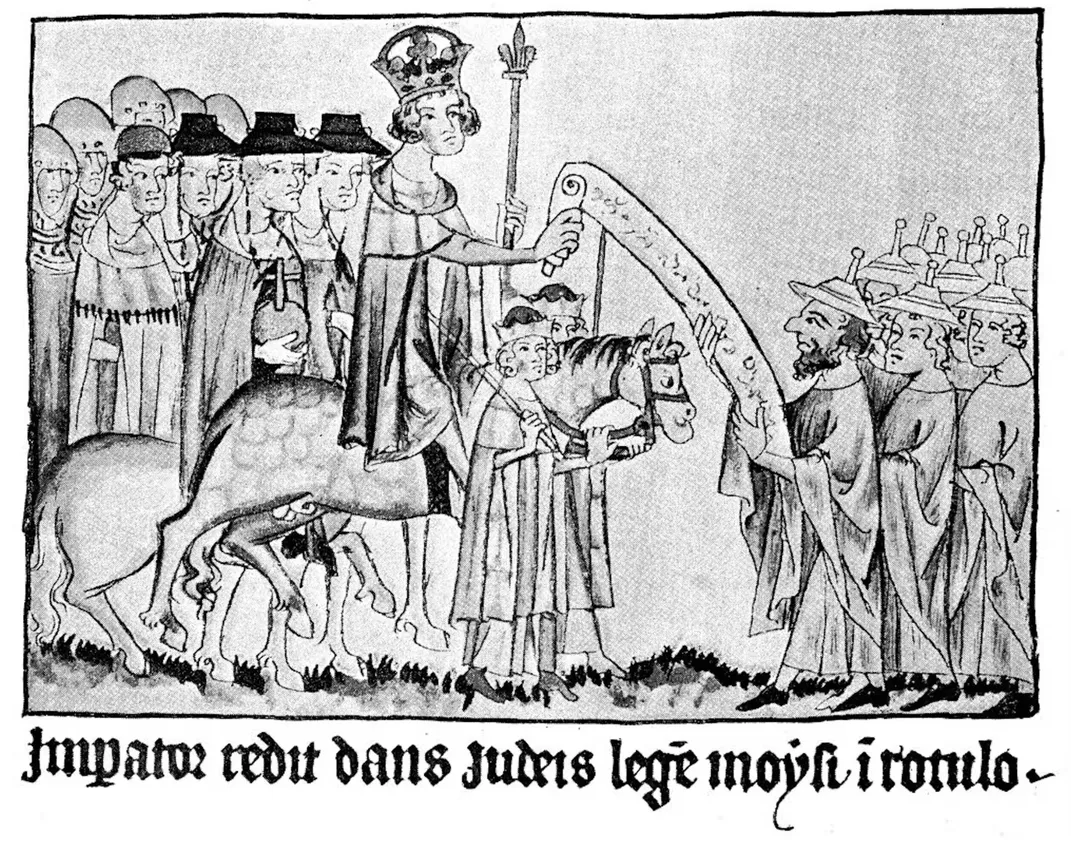
Emperor Constantine in 321 CE issued regulations which shows us that Jews had a community with rabbis and elders at Cologne, Germany and that they had already settled on the Rhineland at the time.  Jewish soldiers were in Roman garrisons as well.  The Carolingian royal house of the 8th -9th century adopted a pro-Jewish policy and encouraged the settlement of Jews in its German dominions with the object of developing trade. By 9th century, Jews lived in Augsburg and Metz;  by the 10th, they lived in Worms, Mainz, Magdeburg and Ratisbon.  On the Rhineland was Mainz, Speyer, Worms, Cologne, etc. where intellectual life developed by the 11th century.   Jews in pointed hats receive confirmation of their privileges from Holy Roman Emperor Henry VII in the Codex Trevirensis, circa 1340
Jews in pointed hats receive confirmation of their privileges from Holy Roman Emperor Henry VII in the Codex Trevirensis, circa 1340 Bildagentur-online / Universal Images Group via Getty Images     

Then in 1348, Germany was hit with the Black Death and Jews were blamed.  200 Jewish communities were wiped out by angry mobs.  By the 14th century, Jews were kept perpetually impoverished by the imperial authorities' cancellation of the debts  due to them. In fact, the Black Death was present in the Holy Roman Empire between 1348 and 1351. The Holy Roman Empire, composed of today's Germany, Switzerland, Austria, Belgium and the Netherlands, was, geographically, the largest country in Europe at the time, and the pandemic lasted several years due to the size of the Empire. .   

– At the time, Lithuania had no cities in the western sense of the word, no Magdeburg Rights or closed guilds. In the 14th century, the Grand Duchy of Lithuania expanded into Galicia–Volhynia (see Galicia–Volhynia Wars) and the Principality of Kiev (see Battle on the Irpin River and Battle of Blue Waters), territories already inhabited by Jews. After the death of Casimir III (1370), the condition of the Polish Jews changed for the worse. The influence of the Roman Catholic clergy at the Polish court grew; Louis of Anjou was indifferent to the welfare of his subjects, and his eagerness to convert the Jews to Christianity, together with the increased Jewish immigration from Germany, caused the Polish Jews to become apprehensive for their future.

In 1387, The Christian-Catholic religion was introduced all over Lithuania.  The Christian-Roman decisions about Jews reached Lithuania in a much slower manner.  


Vytautas and KÄ™stutis imprisoned by Jogaila. Painting by Wojciech Gerson

Jogaila:   In 1387, he converted Lithuania to Catholicism. His own reign in Poland started in 1399, upon the death of Queen Jadwiga, lasted a further thirty-five years, and laid the foundation for the centuries-long Polish–Lithuanian union.

One year later, in 1388, Lithuania granted the Jews a preferred civil status and incomparable bills of rights in many different spheres, such as protecting their bodies and property;  freedom to maintain their religious rituals;  significant alleviation in the field of commerce, and money lending---this being permitted in relation to Christians.  there was even a particular regulation to protect Jews against blood libels!  This after a history of anti-Semitism?

Most of the privileges from the time of Vytautas were left intact, even after this event, and for a long period they were of some importance in preserving the legal, civil and economic status of the Jews.  He was also known as Vytautas the Great    from the late 14th century onwards, was a ruler of the Grand Duchy of Lithuania. He was also the Prince of Grodno (1370–1382), Prince of Lutsk (1387–1389), and the postulated king of the Hussites.  


Treatment of Jews was a topic of discussion when Christianity was first introduced to a world of pagan polytheistic religions.  The Roman Emperor, Constantine (27 February 272 – 22 May 337)), had a lot to say about it.  Actually, he preferred to keep his Roman gods and was a polytheist, but he mother, Helena, was quick to convert to Christianity and even journeyed to Jerusalem looking for souveniers.  

  "The Middle Ages, for the Jew at least, begins with the advent to power of Constantine, the Great Roman emperor from 306 to 337 CE.  He was the 1st emperor to convert to Christianity from the years 306 to 337.  He was also the 1st Roman emperor to issue laws which radically limited the rights of Jews as citizens of the Roman Empire, a privilege conferred upon them by Caracalla in the year of 212. 

As Christianity grew in power in the Roman Empire, it influenced the emperors to limit further the civil and political rights of the Jews.  Most of the imperial laws that deal with the Jews since the days of Constantine are found in the Latin Codex Theodosianius of 438 CE and in the Latin and Greek code of Emperor Justinian of 534CE.  Both of these monumental works are therefore very important, for they enable us to trace the history of the progressive deterioration of Jewish rights.

The real significance of Roman law for the Jew and his history 

is that it exerted a profound influence on subsequent Christian 

and even Muslim legislation. The second-class status of 

citizenship of the Jew, as crystallized in the Justinian code, 

was thus entrenched in the medieval world, and under the 

influence of the Church the disabilities imposed upon him 

received religious sanction and relegated him even to lower 

levels.

In our first selection - laws of Constantine the Great - Judaism 

is denied the opportunity of remaining a missionary religion 

because of the prohibition to make proselytes.


The laws of Constantius (337-361), the second selection, 

forbid intermarriage between Jewish men and Christian 

women. A generation later, in 388, all marriages between 

Jews and Christians were forbidden. Constantius also did 

away with the right of Jews to possess slaves. This prohibition 

to trade in and to keep slaves at a time when slave labor was 

common was not merely an attempt to arrest conversion to 

Judaism; it was also a blow at the economic life of the Jew. It 

put him at a disadvantage with his Christian competitor to 

whom this economic privilege was assured.


The third selection, a law of Theodosius II (408-410), prohibits 

Jews from holding any advantageous office of honor in the 

Roman state. They were compelled, however, to assume 

those public offices which entailed huge financial losses and 

almost certain ruin, and they were not even granted the hope 

of an ultimate exemption. This Novella (New Law) III of 

Theodosius II also makes a direct attack on the Jewish 

religion by reenacting a law which forbade the building of new 

Jewish synagogues. This prohibition was known a generation 

before this. It was reenacted now, probably to pacify the 

aroused Christian mob in the Eastern Empire which desired to 

crush the religious spirit of the Jews who were massing at 

Jerusalem and confidently looking forward to the coming of a 

Messianic redeemer in 440. This disability, later taken over by 

some Muslim states, was reenunciated by the Church which 

sought to arrest the progress of Judaism, its old rival.

A Latin law of Justinian (527-565), the final selection, does not allow a Jew to bear witness in court against an orthodox Christian. Thus as early as the sixth century the Jews were already laboring under social, economic, civil, political, and religious disabilities." 

Jews were being expelled in many countries.  It happened in England by 1290 and they weren't allowed to enter again until 1655.  Jews in France were then expelled by 1306.  In 1355, 12,000 Jews were massacred by the mob in Toledo, Spain.  Starting in 1349, Jews were being expelled from Hungary and this went on until 1360.   Back in France  by 1420, the Jewish community in Toulouse was annihilated. Austrian Jews were then expelled in 1421.   

In 1478 Pope Sixtus IV issued a papal bull, or decree, authorizing the Catholic Monarchs to name inquisitors in order to enforce religious uniformity and to expel Jews from Spain. Ferdinand and Isabella sought to use the Inquisition to increase their absolute power over the centralized regime.

Then in 1492-Columbus sailed the ocean blue, and the Roman-Christian rules about Jews had been dragged along after its introduction of Christianity.  Jews were forced to leave Spain if they wanted to remain Jewish. 180,000 Jews were expelled.  50,000 remained but had to convert to Christianity to do so.   Only Christians were allowed to inhabit Spain.  So the Jews went over to Portugal, where the same treatment greeted them after a few years.  

By 1495, the Grand Duke Alexander Jagiellon, 5 August 1461 – 19 August 1506) of the House of Jagiellon was the Grand Duke of Lithuania and later also King of Poland. He was the fourth son of Casimir IV Jagiellon. He was elected grand duke of Lithuania on the death of his father (1492) and king of Poland on the death of his brother John I Albert (1501)

He expelled all Jews in 1495, as soon as he took power--who numbered more than 6,000 people---from Lithuania and confiscated their property!  This must have given him political power as he was elected King of Poland 8 years later by the joint rule of 2 countries ruling Poland then.  

Surprisingly, with this power on the throne, he allowed Lithuanian Jews to return to their homes and gave them back part of their property.                                      


By 1566 and lasting until 1572, the Jewish badge was introduced and Jews were also disqualified from giving evidence in court. Muslim caliphs, medieval bishops, and, eventually, Nazi leaders used an identifying badge to mark Jews.  Here's one from Nazi days.  

I traced my Goldfus/Goldfoot family back to 1730 in Telsiai (Telz), Lithuania.  Why hadn't they left ages ago?  There were no better countries that would take in Jews.  That's why.  When South Africa and the USA opened up, many Jews immigrated to both places.                  

Resource:

https://sourcebooks.fordham.edu/jewish/jews-romanlaw.asp

https://en.wikipedia.org/wiki/Constantine_the_Great

https://en.wikipedia.org/wiki/History_of_the_Jews_in_Lithuania

https://www.myjewishlearning.com/article/jewish-clothing-in-the-middle-ages/

Facts about Israel, published by he Division of Information, Ministry for Foreign Affairs, Jerusalem

The New Standard Jewish Encyclopedia

Friday, April 26, 2019

The First Christian Empire and the Nicene Creed Against Jews

Nadene Goldfoot                                               
Constantine I the Great, also known as Constantine I, born February 27, 272, was a Roman Emperor who ruled between 306 and 337 AD. Born in Naissus, in Dacia Ripensis, town now known as NiÅ¡ now in Serbia, he was the son of Flavius Valerius Constantius Chlorus, a Roman Army officer. His mother was his father's consort, Helena.  Constantine was the first Roman emperor to convert to Christianity. 


He called the First Council of Nicaea in 325, which produced the statement of Christian belief known as the Nicene Creed and  wrongly, the so-called Edict of Toleration issued at Milan in 312 which established the supremacy of Christianity.  Although Constantine  lived much of his life as a pagan, and later as a catechumen (student of Christianity) , he joined the Christian faith on his deathbed, being baptised by Eusebius of Nicomedia.  His mother, Helena, had converted earlier and was influential in his becoming a Christian.  


Commonly surnamed Theodosius the Younger, or Theodosius the Calligrapher, was the Eastern Roman Emperor for most of his life, taking the throne as an infant in 402 and ruling as the Eastern Empire's sole emperor after the death of his father Arcadius in 408. He is mostly known for promulgating the Theodosian law code, and for the construction of the Theodosian Walls of Constantinople. He also presided over the outbreak of two great Christological controversies, Nestorianism and Eutychianism.
The Edict of Milan gave Christianity a legal status, but did not make Christianity the State church of the Roman Empire; this took place under Emperor Theodosius I in 380 with the Edict of Thessalonica.  

Note below that the purple land belongs to empire of Constantinople.
Green belongs to Venice
Pink belongs to Greek successor states of Byzantine Empire                                                             
 Nicaea was an ancient Greek city in Anatolia. Emperor Constantine the Great convened the First Ecumenical Council there, and the city gave its name to the Nicene Creed. The city remained important in the 4th century, seeing the proclamation of Emperor Valens (364) and the failed rebellion of Procopius (365). During the same period, the See of Nicaea became independent of Nicomedia and was raised to the status of a metropolitan bishopric. However, the city was hit by two major earthquakes in 363 and 368, and coupled with competition from the newly established capital of the Eastern Empire, Constantinople, it began to decline thereafter. 
                                                 

Many of its grand civic buildings began to fall into ruin, and had to be restored in the 6th century by Emperor Justinian I. 

 What became of Milan?  After the city was besieged by the Visigoths in 402, the imperial residence was moved to Ravenna. An age of decadence began which worsened when Attila, King of the Huns, sacked and devastated the city in 452 AD. In 539, the Ostrogoths conquered and destroyed Milan during the Gothic War against Byzantine Emperor Justinian I.


"The Nicene Creed was adopted to resolve the Arian controversy, whose leader, Arius, a clergyman of Alexandria, "objected to Alexander's (the bishop of the time) apparent carelessness in blurring the distinction of nature between the Father and the Son by his emphasis on eternal generation". In reply, Alexander accused Arius of denying the divinity of the Son and also of being too "Jewish" and "Greek" in his thought. Alexander and his supporters created the Nicene Creed to clarify the key tenets of the Christian faith in response to the widespread adoption of Arius' doctrine, which was henceforth marked as heresy."

In 315, Constantine I's decrees took an anti-Jewish turn, canceling Jewish exemptions from municipal office and prohibiting proselytization or interference with Jewish converts to Christianity.  Constantine's legislation initiated the legal degradation of Jews characteristic of the Middle Ages and set the pattern of emperors that followed him.  


 NiÅ¡ has long been a crossroads between East and West. Founded by the Celtic Scordisci in 279 BC, the city would serve as the birthplace of three Roman emperors: Constantine the Great, the first Christian emperor and the founder of Constantinople; Constantius III; and Justin I. Later playing a prominent role in the history of the Byzantine Empire, the city's past would earn it the nickname The Emperor's City.


 Constantine's  reign was from July 25, 306 to 337.  At first it was  to October 29, 312, as a Caesar in the West and self proclaimed Augustus from 309, recognized as such in the east in April 310.  He ruled in competition with Flavius Severus from 306 to 307, Maximian from 306 to 308 and 310, Maxentius from 306 to 312 and Licinius from 308 to 313.  In September 19, 324 he was the undisputed Augustus in the West, Senior Augustus in the Empire.  
The first Christian Empire didn't start until May 11, 330 with Constantine I, the Byzantine emperor.  This was the Eastern Roman Empire.  Traditionally, the line of Byzantine emperors is held to begin with the Roman Emperor Constantine the Great, the first Christian emperor, who rebuilt the city of Byzantium as an imperial capital, Constantinople (much later renamed as Istanbul), a Turkish city , and who was regarded by the later emperors as the model ruler. It was under Constantine that the major characteristics of what is considered the Byzantine state emerged: a Roman polity centered at Constantinople and culturally dominated by the Greek East, with Christianity as the state religion.  This is the new Roman governing rules these early Christians were using for their land which was deemed to be all Christian of former Roman polytheists who had believed in many gods who lived in Mt. Olympus.  

The Roman Empire itself had divided in 395.  This Byzantine Empire was a continuation of the eastern half of the Roman Empire.  Until then, the Roman Empire had been ruled by or jointly by Constantine and his dynasty, and Valentinian, In 395 Theodosius ruled from 379 through 457.  The Western Roman Empire kept going until 476. The Leonid dynasty lasted from 457 to 518 and then Justinian's dynasty took over from 518 to 602.  
                                                        

Justinian was emperor from 527 to 565.  He was highly intolerant to any religious minorities so held a highly anti-Jewish policy.  No Jew could serve in an civil or military post.  They could not own Christian slaves.  A word on this.  Jews treated slaves much differently than other people.  For instance, they were allowed to rest on Shabbat, just like the Jewish family they lived with.  Now they would not even get the relief of living with Jews.  In court, they could not give evidence against Christians.  They could not celebrate Passover at the same time as Easter.  That was a hard rule.  We just had  our first night of Passover fall on the Christian GOOD FRIDAY, and Easter fell on Sunday which was still during Passover.  In 553, Justinian issued an edict regulating the synagogue service and forbidding the DEUTROSIS/commentary, the rabbinic expositions/comments.  In Africa Justinian outlawed synagogues in 535 and forcibly converted the Jews of Borion.  Samaritans and Jews revolted against him but were unsuccessful in Caesarea in 556.  

 Byzantine emperors considered themselves to be the rightful Roman emperors since Augustus, the Roman Emperor who ruled from 31 BCE to 14 CE.  He was not friendly towards Jews.  He had made Herod a king and had returned to him land taken by Cleopatra.  Herod in turn named cities for Augustus such as Sebaste (Greek for Augustus) and Caesarea in his honor.  Augustus honored Herod's will in leaving his lands to his 3 sons-Archelaus, Philip and Antipas but lated converted Judea into a region governed by a procurator living in Caesarea. 
                                                          

 The word Byzantine wasn't created until the 16th century.  The ruling of the land came from THE ROMAN EMPEROR IN CONSTANTINOPLE (now renamed as Istanbul).  This wasn't contested until Empress Irene, being a woman, was not recognized as the ruler by Pope Leo III.  This was in the Papal coronation of the Frankish Charlemagne as the Holy Roman EmperorESS  on December 25, 800.  

Many empires came and left with the last emperor being Constantine X1 that ended in 1453 with the beginning of the Ottoman Empire of the Muslim Turks that lasted for 400 years until the end of World War I.  
                                                      
Seen in Istanbul's Jewish Museum : Shalom-Peace, Hello, goodbye
Jews lived in Constantinople, Turkey and were found there by researcher Benjamin of Tudela in 1165 when he counted 2,000 Jews and 500 Karaites living there.  They were suffering continuous persecution from the Christians.  We already know what they were not allowed to do.  It was the first of being treated as Dhimmis or 2nd class citizens which the Muslims would continue in their countries.  The city was later captured by the Turks in 1453 and the number of Jews increased through a transfer from various Ottoman provinces and the arrival of Spanish exiles of the Spanish Inquisition from Christian Spain.  

The Jews were organized into 44 distinct congregations divided into Greek, Spanish and Italian and Karaite.  The Ashkenazim made up a small minority of the Jews.  They had a chief rabbi in the city, and Hebrew printing presses of Constantinople were noted from the end of the 15th century.  Jews developed the city's commerce, while others were distinguished as physicians and in court circles.  The 19th century saw a decline in the economic and culture of the community, weakened by political reforms and modern schools.  The Jewish population exceeded 90,000 in 1919, but was reduced to 20,000 by 1990.  One would hope that the decline was due to moving to Israel.  

  
Resource:  https://jewishbubba.blogspot.com/2019/04/mother-of-roman-emperor-who-had-last.html
https://en.wikipedia.org/wiki/List_of_Byzantine_emperors
The New Standard Jewish Encyclopedia-Justinian
 He called the First Council of Nicaea in 325, which produced the statement of Christian belief known as the Nicene Creed.[
https://carm.org/nicene-creed
https://en.wikipedia.org/wiki/Nicene_Creed
https://en.wikipedia.org/wiki/Milan
Also, read JULIAN by Gore Vidal; found in college libraries only; library can get it for you.  Excellent; keeping my attention every night as I read then. Tells all about these emperors in a very interesting manner.