Showing posts with label Black Death. Show all posts

Thursday, June 1, 2023

Why Jews Settled in Lithuania In The First Place and When


 Nadene Goldfoot                                          ,

                        Grand Duke Gediminas of Lithuania from 1315 or 1316 until his death in 1341. the Grand Dukes Gediminas and then Vytautas (Witold) had sent out an invitation to the Jewish merchants and craftspeople in 1323-1324 to come and live there for its economic opportunities. Why?  What was going on there? He is considered the founder of Lithuania's capital Vilnius (see: Iron Wolf legend). During his reign, he brought under his rule lands from the Baltic Sea to the Black Sea. The Gediminids dynasty he founded and which is named after him came to rule over Poland, Hungary and Bohemia. 
                              
 Grand Duke Vytautas of Lithuania the Great,Lithuanian Vytautus Didysis, Polish Witold Wielki, (born 1350, Lithuania—died Oct. 27, 1430, Trakai, Lith.)
                                    Jews of 13th Century
  
The Middle Ages, as Dark as they were, lightened up in the 14th century for Jews.  The Great Lithuanian Princedom, also called Magnus Ducatus Lithuaniae was settled by Jews in the 14th Century.  It was because of the invitations to live there by the Grand Dukes.  Jews had had it in Germany, having lived there since the destruction of Jerusalem in 70 CE and Jews were taken as slaves and dispersed. Jewish merchants had been in Rome before 70CE.   

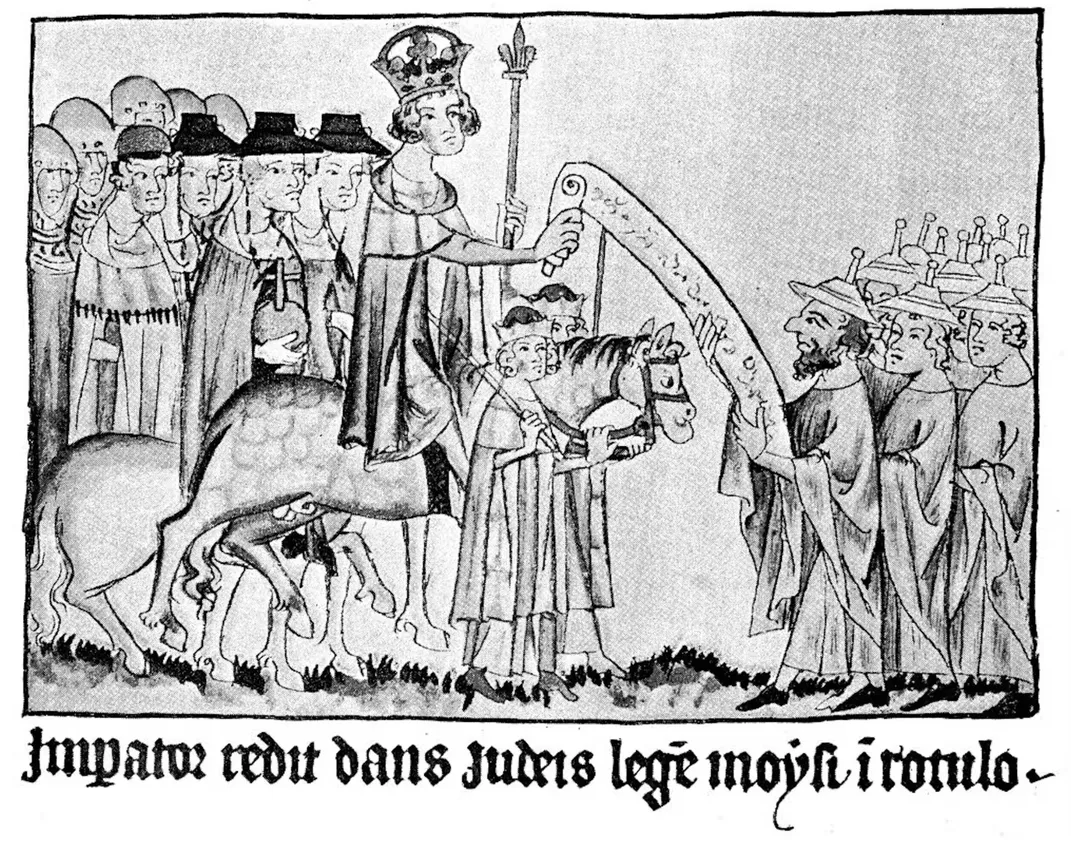
Emperor Constantine in 321 CE issued regulations which shows us that Jews had a community with rabbis and elders at Cologne, Germany and that they had already settled on the Rhineland at the time.  Jewish soldiers were in Roman garrisons as well.  The Carolingian royal house of the 8th -9th century adopted a pro-Jewish policy and encouraged the settlement of Jews in its German dominions with the object of developing trade. By 9th century, Jews lived in Augsburg and Metz;  by the 10th, they lived in Worms, Mainz, Magdeburg and Ratisbon.  On the Rhineland was Mainz, Speyer, Worms, Cologne, etc. where intellectual life developed by the 11th century.   Jews in pointed hats receive confirmation of their privileges from Holy Roman Emperor Henry VII in the Codex Trevirensis, circa 1340
Jews in pointed hats receive confirmation of their privileges from Holy Roman Emperor Henry VII in the Codex Trevirensis, circa 1340 Bildagentur-online / Universal Images Group via Getty Images     

Then in 1348, Germany was hit with the Black Death and Jews were blamed.  200 Jewish communities were wiped out by angry mobs.  By the 14th century, Jews were kept perpetually impoverished by the imperial authorities' cancellation of the debts  due to them. In fact, the Black Death was present in the Holy Roman Empire between 1348 and 1351. The Holy Roman Empire, composed of today's Germany, Switzerland, Austria, Belgium and the Netherlands, was, geographically, the largest country in Europe at the time, and the pandemic lasted several years due to the size of the Empire. .   

– At the time, Lithuania had no cities in the western sense of the word, no Magdeburg Rights or closed guilds. In the 14th century, the Grand Duchy of Lithuania expanded into Galicia–Volhynia (see Galicia–Volhynia Wars) and the Principality of Kiev (see Battle on the Irpin River and Battle of Blue Waters), territories already inhabited by Jews. After the death of Casimir III (1370), the condition of the Polish Jews changed for the worse. The influence of the Roman Catholic clergy at the Polish court grew; Louis of Anjou was indifferent to the welfare of his subjects, and his eagerness to convert the Jews to Christianity, together with the increased Jewish immigration from Germany, caused the Polish Jews to become apprehensive for their future.

In 1387, The Christian-Catholic religion was introduced all over Lithuania.  The Christian-Roman decisions about Jews reached Lithuania in a much slower manner.  


Vytautas and KÄ™stutis imprisoned by Jogaila. Painting by Wojciech Gerson

Jogaila:   In 1387, he converted Lithuania to Catholicism. His own reign in Poland started in 1399, upon the death of Queen Jadwiga, lasted a further thirty-five years, and laid the foundation for the centuries-long Polish–Lithuanian union.

One year later, in 1388, Lithuania granted the Jews a preferred civil status and incomparable bills of rights in many different spheres, such as protecting their bodies and property;  freedom to maintain their religious rituals;  significant alleviation in the field of commerce, and money lending---this being permitted in relation to Christians.  there was even a particular regulation to protect Jews against blood libels!  This after a history of anti-Semitism?

Most of the privileges from the time of Vytautas were left intact, even after this event, and for a long period they were of some importance in preserving the legal, civil and economic status of the Jews.  He was also known as Vytautas the Great    from the late 14th century onwards, was a ruler of the Grand Duchy of Lithuania. He was also the Prince of Grodno (1370–1382), Prince of Lutsk (1387–1389), and the postulated king of the Hussites.  


Treatment of Jews was a topic of discussion when Christianity was first introduced to a world of pagan polytheistic religions.  The Roman Emperor, Constantine (27 February 272 – 22 May 337)), had a lot to say about it.  Actually, he preferred to keep his Roman gods and was a polytheist, but he mother, Helena, was quick to convert to Christianity and even journeyed to Jerusalem looking for souveniers.  

  "The Middle Ages, for the Jew at least, begins with the advent to power of Constantine, the Great Roman emperor from 306 to 337 CE.  He was the 1st emperor to convert to Christianity from the years 306 to 337.  He was also the 1st Roman emperor to issue laws which radically limited the rights of Jews as citizens of the Roman Empire, a privilege conferred upon them by Caracalla in the year of 212. 

As Christianity grew in power in the Roman Empire, it influenced the emperors to limit further the civil and political rights of the Jews.  Most of the imperial laws that deal with the Jews since the days of Constantine are found in the Latin Codex Theodosianius of 438 CE and in the Latin and Greek code of Emperor Justinian of 534CE.  Both of these monumental works are therefore very important, for they enable us to trace the history of the progressive deterioration of Jewish rights.

The real significance of Roman law for the Jew and his history 

is that it exerted a profound influence on subsequent Christian 

and even Muslim legislation. The second-class status of 

citizenship of the Jew, as crystallized in the Justinian code, 

was thus entrenched in the medieval world, and under the 

influence of the Church the disabilities imposed upon him 

received religious sanction and relegated him even to lower 

levels.

In our first selection - laws of Constantine the Great - Judaism 

is denied the opportunity of remaining a missionary religion 

because of the prohibition to make proselytes.


The laws of Constantius (337-361), the second selection, 

forbid intermarriage between Jewish men and Christian 

women. A generation later, in 388, all marriages between 

Jews and Christians were forbidden. Constantius also did 

away with the right of Jews to possess slaves. This prohibition 

to trade in and to keep slaves at a time when slave labor was 

common was not merely an attempt to arrest conversion to 

Judaism; it was also a blow at the economic life of the Jew. It 

put him at a disadvantage with his Christian competitor to 

whom this economic privilege was assured.


The third selection, a law of Theodosius II (408-410), prohibits 

Jews from holding any advantageous office of honor in the 

Roman state. They were compelled, however, to assume 

those public offices which entailed huge financial losses and 

almost certain ruin, and they were not even granted the hope 

of an ultimate exemption. This Novella (New Law) III of 

Theodosius II also makes a direct attack on the Jewish 

religion by reenacting a law which forbade the building of new 

Jewish synagogues. This prohibition was known a generation 

before this. It was reenacted now, probably to pacify the 

aroused Christian mob in the Eastern Empire which desired to 

crush the religious spirit of the Jews who were massing at 

Jerusalem and confidently looking forward to the coming of a 

Messianic redeemer in 440. This disability, later taken over by 

some Muslim states, was reenunciated by the Church which 

sought to arrest the progress of Judaism, its old rival.

A Latin law of Justinian (527-565), the final selection, does not allow a Jew to bear witness in court against an orthodox Christian. Thus as early as the sixth century the Jews were already laboring under social, economic, civil, political, and religious disabilities." 

Jews were being expelled in many countries.  It happened in England by 1290 and they weren't allowed to enter again until 1655.  Jews in France were then expelled by 1306.  In 1355, 12,000 Jews were massacred by the mob in Toledo, Spain.  Starting in 1349, Jews were being expelled from Hungary and this went on until 1360.   Back in France  by 1420, the Jewish community in Toulouse was annihilated. Austrian Jews were then expelled in 1421.   

In 1478 Pope Sixtus IV issued a papal bull, or decree, authorizing the Catholic Monarchs to name inquisitors in order to enforce religious uniformity and to expel Jews from Spain. Ferdinand and Isabella sought to use the Inquisition to increase their absolute power over the centralized regime.

Then in 1492-Columbus sailed the ocean blue, and the Roman-Christian rules about Jews had been dragged along after its introduction of Christianity.  Jews were forced to leave Spain if they wanted to remain Jewish. 180,000 Jews were expelled.  50,000 remained but had to convert to Christianity to do so.   Only Christians were allowed to inhabit Spain.  So the Jews went over to Portugal, where the same treatment greeted them after a few years.  

By 1495, the Grand Duke Alexander Jagiellon, 5 August 1461 – 19 August 1506) of the House of Jagiellon was the Grand Duke of Lithuania and later also King of Poland. He was the fourth son of Casimir IV Jagiellon. He was elected grand duke of Lithuania on the death of his father (1492) and king of Poland on the death of his brother John I Albert (1501)

He expelled all Jews in 1495, as soon as he took power--who numbered more than 6,000 people---from Lithuania and confiscated their property!  This must have given him political power as he was elected King of Poland 8 years later by the joint rule of 2 countries ruling Poland then.  

Surprisingly, with this power on the throne, he allowed Lithuanian Jews to return to their homes and gave them back part of their property.                                      


By 1566 and lasting until 1572, the Jewish badge was introduced and Jews were also disqualified from giving evidence in court. Muslim caliphs, medieval bishops, and, eventually, Nazi leaders used an identifying badge to mark Jews.  Here's one from Nazi days.  

I traced my Goldfus/Goldfoot family back to 1730 in Telsiai (Telz), Lithuania.  Why hadn't they left ages ago?  There were no better countries that would take in Jews.  That's why.  When South Africa and the USA opened up, many Jews immigrated to both places.                  

Resource:

https://sourcebooks.fordham.edu/jewish/jews-romanlaw.asp

https://en.wikipedia.org/wiki/Constantine_the_Great

https://en.wikipedia.org/wiki/History_of_the_Jews_in_Lithuania

https://www.myjewishlearning.com/article/jewish-clothing-in-the-middle-ages/

Facts about Israel, published by he Division of Information, Ministry for Foreign Affairs, Jerusalem

The New Standard Jewish Encyclopedia

Thursday, September 22, 2022

Why Jews Migrated to Germany Long Ago and Later Left

 Nadene Goldfoot


Depiction of German Jew of long ago, forced to dress like this.

    "The Jewish hat, also known as the Jewish cap, Judenhut (German) ("horned skullcap"), was a cone-shaped pointed hat, often white or yellow, worn by Jews in Medieval Europe. Initially worn by choice (I question that), its wearing was enforced in some places in Europe after the 1215 Fourth Council of the Lateran for adult male Jews to wear while outside a ghetto to distinguish them from others."  it was their badge of shame, like wearing the star of David during WWII. .


 Like the Phrygian cap that it often resembles, the hat may have originated in pre-Islamic Persia, as a similar hat was worn by Babylonian Jews.

We have to go back to Roman days to find out that there were Jewish soldiers in the Roman garrisons of Germany.  The Romans had taken Jews alive in 70 CE as slaves and may have used them as fodder in their army.  We believe this from archeological finds that demonstrate their presence.

By 1096, the German Crusade massacred Jews in European towns.  The Jewish community in Jerusalem was massacred by the Crusaders by 1099. 

However, by 321 CE, Roman Emperor Constantine issued regulations which indicate the existence of an organized Jewish community with rabbis and elders at Cologne.  It's probable that Jews were settled elsewhere on the Rhineland at that time.  They enjoyed some civil liberties, but were restricted regarding the dissemination of their culture, the keeping of non-Jewish slaves, and the holding of office under the government. They were considered more as 2nd class citizens, just as they were in Arab states.  Being Jewish made you different to others.  


In the 8th and 9th centuries, the Carolingian royal house  adopted a pro-Jewish policy!  They encouraged the settlement of Jews in its dominions because they needed them to develop trade.  New Jewish communities began to be created in the principal commercial centers.


By the 9th century, Jews were living in Augsburg and Metz.

In the 10th century, Jews were living in Worms, Mainz, Magdeburg, Ratisbon, etc.  The dense settlement was in the Rhineland that took in Mainz, Speyer, Worms, Cologne, etc.

By the 11th century, this is where an intense intellectual life developed under Franco-Jewish influence.  Conditions were generally not unfavorable, though the persecution recorded in 1012 was probably not unique.          

                                Anti-Semitic Acts Started

 However, in 1096, the Crusaders massacred the Jews throughout the Rhineland and the adjacent areas.  The moral atmosphere changed, and at all times of unrest or excitement in Germany, the Jews were attacked.  

The religious fervor against Jews caused Europe to react along against Jews which drove Jews out of trading and forced them increasingly into the profession of moneylending.  

The uptake on this was that as they were driven out of one area, another could receive them.  Germany figures preeminently in Jewish history as the land of martyrdom where expulsion was resorted to only locally and sporadically in order to complete the work of extermination.  This is when Jews moved into Eastern Europe's countries of Poland, Lithuania, etc. Jews were living in Poland from the 9th century on.  The 1st Jew could have been from the West like Germany,, Bohemia, et, or the South such as the kingdom of Kiev or the Byzantine Empire.  They must have been reinforced by the Khazar elements.  They no doubt were traders who in the Dark Ages helped to open up the area to civilizing influences.  The first Polish charter for Jews was granted in 905.  

In 1298, massacres of Jews happened, inspired by a knight named RINDFLEISCH, called the Rindfleisch Massacres.  The attacks took place on the Jews throughout Franconia and the surrounding regions after a Ritual Murder accusation at Rottingen..  They were instigated and led by this Bavarian noble, Rindfleisch.  146 communities were annihilated.                                    


Massacres of Jews happened again in 1336 at the time of the Black Death where Jews were accused of deliberately propagating.  People acted against Jews with complete barbarism.  Ove 350 localities of Jews suffered, and over 200 Jewish communities were utterly wiped out.                                     


By the 14th century in the 2nd half of it, the Jewish survivors were kept perpetually impoverished by cancelling debts due to them.  Those were the businessmen who suffered.  The Jewish intellectual life kept going in Germany throughout the Middle Ages by centering mainly on talmudic study.  Lithuania was home to Jews in 1495, after the 1492 expulsion of Jews in Spain.  Karaites were already there by 1321 with a community established by 1398.  

Toward the close of the Middle Ages most of the larger German cities banished the Jews after the beginning of the 16th century.  The only communities of importance left were Frankfort-on-Main and Worms.                             

As European commerce grew in the late Middle Ages, some Jews became prominent in trade, banking, and moneylending, and Jews’ economic and cultural successes tended to arouse the envy of the populace. This economic resentment, allied with traditional religious prejudice, prompted the forced expulsion of Jews from several countries and regions, including England (1290), France (14th century), Germany (1350s), Portugal (1496), Provence (1512), and the Papal States (1569). Intensifying persecution in Spain culminated in 1492 in the forced expulsion of that country’s large and long-established Jewish population. Only Jews who had converted to Christianity were allowed to remain, and those suspected of continuing to practice Judaism faced persecution in the Spanish Inquisition. As a result of these mass expulsions, the centres of Jewish life shifted from western Europe and Germany to Turkey and then to Poland and Russia.                           

The Protestant Reformation seemed to offer some amelioration in the Jewish position, but Luther ultimately reverted to the traditional German anti-Semitic standard.  

          pictured is Rabbi Wertheimer , a Court Jew

The 17th century saw after the 30 Years War the creation of many competitive states emerging.  Many hired Jews as factors, military purveyors, financial advisers, etc. and gave them privileged positions as Court Jews.  Of course they attracted other Jews and communities were formed.  The Jews of Hamburg were important after a Marrano colony was established there (Spanish hidden Jews) .  A few of our ancestors were court Jews Wertheimer, above  being one.  

Resource:

The New Standard Jewish Encyclopedia

https://www.myjewishlearning.com/article/jewish-clothing-in-the-middle-ages/


Sunday, October 25, 2020

THE DEADLIEST PANDEMIC OF ALL TIME- THE BLACK DEATH- A Bacteria Caused Plague

 Nadene Goldfoot                                                 


The Black Death was the deadliest pandemic recorded in human history. The Black Death resulted in the deaths of up to 75,000,000 to 200,000,000 (75–200 million) people in Eurasia and North Africa, peaking in Europe from 1347 to 1351. Plague, the disease, was caused by the bacterium Yersinia pestis.  The Y. pestis infection most commonly results in bubonic plague, but can also cause septicaemic or pneumonic plagues.

From the map, one can see a black broken line that was a border line between the principality of Kiev, (Ukraine) and the Golden Horde (a Khanate in Turkey) of 13th century; part of Mongol Empire).  It was a passage prohibited for Christians.  We can see by the color chart that the plague started in 1346 in the East and moved Westward across all of Europe.  It killed a great part of the population of Europe and led to murderous attacks on many Jewish communities, particularly in Germany by 1348-9.                      

 A bubos on the thigh that developed in the Bubonic Plague-connected to the Black Death, one of three types of plague caused by bacterium Yersinia pestis...but for now we're only concerned with the Black Death plague. 

It had travelled along the Silk Road, reaching Crimea by 1347. From there, it was most likely carried by fleas living on the black rats that travelled on Genoese merchant ships, spreading throughout the Mediterranean Basin and reaching Africa, Western Asia, and the rest of Europe via Constantinople, Sicily, and the Italian Peninsula. 

Current evidence indicates that once it came onshore, the Black Death was in large part spread by human fleas – which cause pneumonic plague – and the person-to-person contact via aerosols which pneumonic plague enables, thus explaining the very fast inland spread of the epidemic, which was faster than would be expected if the primary vector was rat fleas causing bubonic plague.                                                 

The superstitious masses readily listened to charges coming from Savoy, a country in Western Europe,  that Jews had caused the disease by poisoning their wells.  The fact was that Jews were less exposed to the plague because of their enforced segregation and that they kept kosher (their dietary and hygienic practices) that lent weight to the charges.  A practice in keeping kosher is the washing of the hands, and bathing (going to the mikva).    

Pope Clement VI issued a bull condemning the libel and ordering the Jews to be protected.  Even so, hardly a single Jewish community from Alsace eastward was spared from attacks.  Emperor Charles IV condemned the attacks in return for a share in the booty.  The hatred of the guilds for the lower nobility nd the lower patriin classes was diverted against their Jewish supporters.  Also, those that owed money to jews welcomed the opportunity to kill their creditors.  

In Germany alone, attacks took place on the Jews in about 350 places, while 60 large and 150 small communities were exterminated.  Many towns thereafter banished the Jews for all time, although some soon changed their minds.                    

This was the greatest disaster which happened to German Jewry in the Middle Ages.  Attacks on a smaller scale took place in Poland, Catalonia and Northern Italy.  

With such a large population decline from the pandemic, wages soared in response to a labour shortage. On the other hand, in the quarter century after the Black Death in England, it is clear many labourers, artisans, and craftsmen, those living from money-wages alone, did suffer a reduction in real incomes owing to rampant inflation. Landowners were also pushed to substitute monetary rents for labour services in an effort to keep tenants.

Recent research has suggested plague first infected humans in Europe and Asia in the Late Neolithic-Early Bronze Age.  Research in 2018 found evidence of Yersinia pestis in an ancient Swedish tomb, which may have been associated with the "Neolithic decline" around 3000 BCE, in which European populations fell significantly. This Y. pestis may have been different to more modern types, with bubonic plague transmissible by fleas first known from Bronze Age remains near Samara.

The symptoms of bubonic plague are first attested in a fragment of Rufus of Ephesus preserved by Oribasius; these ancient medical authorities suggest bubonic plague had appeared in the Roman Empire before the reign of Trajan, six centuries before arriving at Pelusium in the reign of Justinian I.  

In 2013, researchers confirmed earlier speculation that the cause of the Plague of Justinian (541–542 CE, with recurrences until 750) was Y. pestis. This is known as the First plague pandemic.

The importance of hygiene was recognised only in the nineteenth century with the development of the germ theory of disease; until then streets were commonly filthy, with live animals of all sorts around and human parasites abounding, facilitating the spread of transmissible disease.

One early medical advance as a result of the Black Death was the establishment of the idea of quarantine in the city-state of Ragusa (modern Dubrovnik, Croatia) in 1377 after continuing outbreaks.:  not cleanliness, garbage disposal, etc.  Do you remember reading FOREVER AMBER?  That was a good example of filth in her day.  Forever Amber is a historical romance novel by Kathleen Winsor set in 17th-century England. It was made into a film in 1947 by 20th Century Fox.  The book came out in 1944.  I remember vividly that Amber threw her garbage out her window.  

Explanation: From 1416 to 1847, the Duchy of Savoy was a country in Western Europe. It was created when Sigismund, King of the Romans, raised the County of Savoy into a duchy for Amadeus VIII. The duchy was an Imperial fief, subject of the Holy Roman Empire with a vote in the Imperial Diet

Resource: 

https://en.wikipedia.org/wiki/Black_Death

The New Standard Jewish Encyclopedia