Nadene Goldfoot

In the 1900s–1910s, Eastern European and Sephardic Jews settled in Portland, creating a vibrant, self-contained community in South Portland centered around synagogues, kosher markets, and social institutions.

Music in Portland between 1900 and 1910 was centered around live parlor piano, community choir performances, and early labor-movement protest songs. During this era, local cultural life relied heavily on traditional classical recitals, sheet music sales, and public gatherings rather than recorded media,
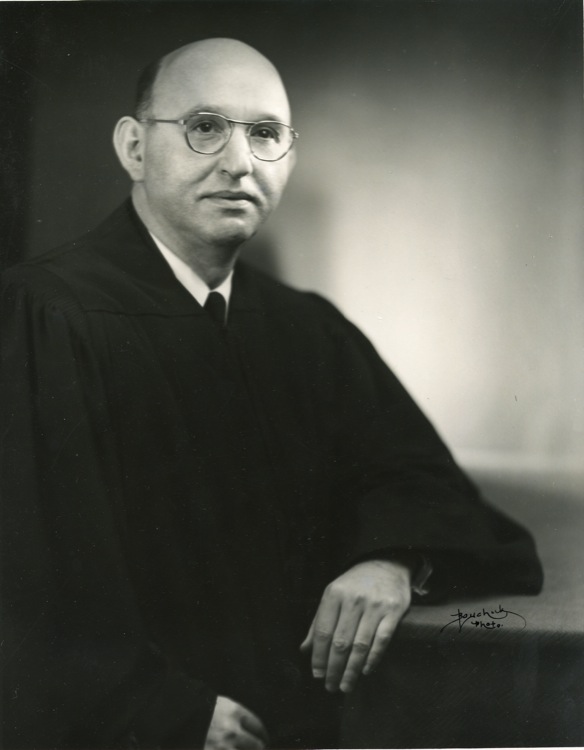
We had a famous judge come out of this period: Gus Solomon. 1906-1987

Gus Solomon was born on August 29, 1906 in Portland, OR. His mother was from Russia and his father, who worked in the men’s wear business, was from Romania. He went to Shattuck School and Lincoln and Jefferson High Schools. His family belonged to the Neveh Zedek Talmud Torah Synagogue. He began college at the University of Washington in 1922, and later transferred to Reed College and then to the University of Chicago, where he learned it was impossible for a Jewish student to receive a fellowship in history or many other subjects. He also attended Stanford and Columbia Law Schools. He began to practice law in 1929 at the start of the Great Depression. After being unable to find a job, he opened his own practice with Leo Levenson and Irvin Goodman. He describes himself as a political and economic liberal, operating under the simple belief that everyone is entitled to certain rights regardless of race, religion, or economic status.

- South Portland Hub: Immigrants from Russia, Poland, Lithuania, and the Mediterranean concentrated at the southern edge of downtown. Klezmer music first arrived in Portland with the large waves of Eastern European Jewish immigrants around the turn of the 20th century, while its modern local revival blossomed decades later during the nationwide klezmer revival.
- Daily Life: The area featured kosher butcher shops, bakeries, Yiddish libraries, and communal gathering spaces.
The Neighborhood House circa 1925 at SW 2nd and Woods St., South Portland.
Image: Courtesy Oregon Jewish Museum. OJM 120 (Used by permission)
- Neighborhood House: Established in 1897 by the National Council of Jewish Women, it provided citizenship classes, health clinics, and youth activities. My father became Billy Meshke there, a professional boxer. The historic Neighborhood House in Portland was never located on SW 13th Avenue; its classic and original location was instead built in 1910 at SW 2nd Avenue and Woods Street in South Portland (later addressed as 3030 SW Second Avenue) .Olsen tells us the story of the Neighborhood House, a place that South Portland European immigrants went to to learn how to be Americanized in the early 20th Century. Created by the National Council of Jewish Women in 1897, the Neighborhood House modestly began as a sewing school. When the house was built in 1910, it grew to be a place for the community with athletics, a Hebrew School, classes for immigrants, and clubs.

- Shaarie Torah (1902/1905): Founded as an Orthodox congregation by Russian Jewish immigrants.
- Ahavat Achim (1911): Established by Sephardic Jews who immigrated from the island of Rhodes.
- Kesser Israel (1912): Founded by Eastern European immigrants and noted as a historic anchor of the early community. The Shul of my Bobba and Zaida. Zaida was killed in 1912 in his horse and wagon accident. His wagon held no ID. and Bobby didn't know why he didn't show up for Shabbat. Coming all that way from Lithuania via England, Ireland, then here to be in an accident. My father was 4 when he was killed. Bobba only spoke Yiddish and they didn't know where he had buried his money.
- Tifereth Israel (1914): Also known as the Alberta Shul, serving a small offshoot community in Northeast Portland.
Lipman, Wolfe & Co. - 1894 Oregonian archives
From the archives: "Elevated lumber sidewalks were erected in front of the Lipman, Wolfe & Co. store in the Dekum building at 3rd and Washington streets during the big Portland flood of 1894. After this picture was taken the water rose another two feet, forcing the store to raise the walks. Horses and carts got around where water was not too deep, but most travel was by boat."
Meier & Frank c. 1885
Founded in Portland in 1857, Meier & Frank started as a small dry goods store on Front Street (now Naito Parkway). This photo likely shows the retailer's second location, a two-story masonry building, on Taylor Street between First and Second.
Olds, Wortman & King - 1910
This 1910 picture shows Olds, Wortman & King on 5th and Washington in downtown Portland as the retailer built a new, larger store, now the Galleria. Portland-based department store Lipman-Wolfe and Company built its flagship store here at 5th and Washington in 1912. The renovated building is now home to Hotel Monaco. The first Olds, Wortman & King store opened at Front (now Naito Parkway) and Oak Streets in 1851, and was Portland's first general store.


No comments:
Post a Comment