Showing posts with label Judeans. Show all posts

Monday, October 11, 2021

Part of Ten Lost Tribes From Assyrian Attack Found

 Nadene Goldfoot                                         


Back in 1975, Dr. Magen Broshi,(1929-2020)  an archaeologist at the Israel Museum, scholar of the Dead Sea Scrolls, and longtime curator of Israel's "Shrine of the Book,"  wrote in the Biblical Archaology Review, that part of the lost tribes of Israel appear to have been located.  


In 721 BCE, the northern Kingdom of Israel, composed of 10 of the ancient Israelite tribes descended from the sons of Jacob, was conquered  by King Sargon of Assyria and destroyed by him.  Sargon annexed the country, deported 27,290 Israelites to Assyria and Media, and replaced them with Syrian and Babylonian prisoners that they didn't want to keep. The next year of 720, Sargon defeated a military alliance which included the remnants of the Israelites of Samaria (northern tribes).  By 712 BCE, he was assassinated.                                               

         War Scene of Assyrians

The Assyrians were among the cruelest people ever to walk across the stage of history.  Contemporaneous Assyrian reliefs have been found in which prisoners of the Assyrians are led through the street like dogs, with ropes attached to rings inserted in the septum of the noseIn other reliefs, parading Assyrians hold Hebrew prisoners aloft, impaled on Assyrian spears.

     Relief showing Assyrian soldier and 2 Jews being led away

In accordance with their usual practice, the Assyrians deported much of the upper classes of Israel and settled other peoples in their place. (How would they know who was of upper class?  Clothing, most likely.)

Those who remained in the northern section of Israel that they didn't kidnap wound up intermarrying with the newcomers, and out of this amalgamation came the people we read about as the Samaritans. (Samaria was the capital of the Northern kingdom of Israel, founded 880 BCE by Omri) .  The name of Samaria is also applied to the entire northern region of the central highlands of Eretz Yisrael.  Samaritans, originally calling themselves Bene Yisrael/Shomerim (the keepers of the Law) were descended from the tribes of Ephraim and Manasseh with an admixture of non-Israelite colonists (II Kings 17:24-41). 


                                   Assyrians
                   

As for those taken away by the Assyrians, they have been referred to as the Ten Lost Tribes.  Today we are sure that many of the Pashtuns of Afghanistan, Pakistan and India are remnants of these lost tribes.  Back in 1975, Dr Broshi, made a  different discovery about what had happened to some of those  Israelites that can explain where the rest went.

He found that many Israelites fled south into their neighboring kingdom of Judah in order to escape the Assyrian onslaught, probably those young enough to evade being caught.  There they melded with their Hebrew brethren and retained their Hebrew identity. 


 Tyropoean Valley: Jerusalem      

While all of the evidence had not yet been analyzed by December of 1975, it was becoming increasingly clear that Jerusalem underwent a major expansion during the 8th century BCE.  Until that time, Jerusalem was confined in the ridge east of the narrow, central valley of the city, known as the Tyropoean Valley.  

                                 Jerusalem today

Then, during the 8th century, Jerusalem exploded across the valley to the western ridge.  By the end of the 8th century, the archaeological evidence indicates, the city had expanded to 3 or 4 times its former size.  Most of the evidence of this expansion comes from Israeli excavations in the city since 1968.                     

 In 1970, Professor Nachman Avigad (1905-1992) found a massive wall between 20 and 23 feet wide on the western ridge, which he dates toward the end of the 8th century.  


Jerusalem had been the capital of the Kingdom of Judah during the Iron Age (the Kingdom of Israel’s capital was Samaria). Parts of the defensive wall were found half a century ago, though the identification of the remains had been controversial. Now the excavations, under director Dr. Filip Vukosavovi of the Ancient Jerusalem Research Center and Dr. Joe Uziel and Ortal Chalaf on behalf of the Israel Antiquities Authority, have apparently found another part of the great wall defending the city from the east, still standing after all these years.


Thus, by that time,, this section of the city was already enclosed by a wall.  Beneath this wall, and therefore earlier than it, Professor Avigad found a structure which may date somewhat earlier in the 8th century, indicating that the western expansion of the city started before the building of the wall there.  Excavations west of the wall indicate that by the end of the 8th century, Jerusalem had extensive suburbs outside of city wall.  Among the most exciting finds was the remnants of the Broad Wall twice mentioned in the Book of Nehemiah. Built to defend Jerusalem during the reign of King Hezekiah in the late 8th century BCE, there remains an 80-foot (24 m) stretch of wall, 23 feet (7.0 m) thick, rising from bedrock west of the Temple Mount. Nearby, Avigad also unearthed the Israelite Tower, a remnant of Jerusalem's Iron Age fortifications attesting to the Babylonian sack of Jerusalem in 586 BCE.           

          Armenian Garden

Other excavations on the western ridge of the city---in the Citadel, in the Armenian garden and on Mount Zion---have also revealed evidence of initial occupation during this period.  All of this makes it clear, in Dr. Broshi's words, "that Jerusalem at about 700 BCE had mushroomed, historically speaking, overnight".

According to Dr. Broshi, this expansion cannot be explained by natural population growth or by normal economic growth.  Moreover, the expansion was relatively sudden rather than gradual.  


For millennia, the Jebusite city of Jerusalem had been confined in a small area on the eastern ridge.  David's City was likewise limited.  Solomon expanded the city northward to include the area of the present Temple Mount.  This additional area was use primarily for the Temple, Solomon's royal palace and the administrative area allocated to government buildings.                                 

Dome of the Rock, Arabic Qubbat al-Ṣakhrah, shrine in Jerusalem built by the Umayyad caliph ʿAbd al-Malik ibn Marwān in the late 7th century CE. It is the oldest extant Islamic monument.

From the death of Solomon to the end of the 8th century BCE---almost 200 years---the city limits changed very little.  Then toward the end of the 8th century, the city expanded by a factor of 3 or 4.  Dr. Broshi estimates the population increased from about 7,500 to about 24,000.

Dr. Broshi attributes this expansion to 2 massive waves of immigration.  The 1st he associates with a population flight from the northern kingdom of Israel as a result of the Assyrian conquest in 721 BCE.  according to this theory, substantial numbers of the "lost tribes" took up residence in the newly settled parts of Jerusalem.

The 2nd wave of immigration which accounts for the expansion of Jerusalem came later in the 8th century, according to Dr. Broshi, from Judean territories. As a result of Sennacherib's invasion of Judah at the end of the 8th century, Judah lost considerable territory in the SW part of the kingdom to Assyria, which Assyria ceded to the Philistine city-states.  Many of the Judeans uprooted by this invasion, Dr. Broshi believes, also fled to Jerusalem. The evidence which Dr. Broshi cites for the flight of the refugees is not confined to Jerusalem.


In 1967 and 1968, a survey conducted by Professor Moshe Kochavi (1928-2008)of Tel Aviv University revealed that almost half of the settlements in the Judean hills which were occupied during the Judean monarchy were founded during the century before the First Temple was finally destroyed in 587 BCE.  Other scholars have found that numerous sites in other parts of the Kingdom of Judah---in the Negev, in the Judean desert, and along the Dead Sea---were 1st intensively settled in the 8th century. Kochavi was one of numerous archaeologists who in 2007 petitioned the Supreme Court of Israel to order an immediate cessation of digging operations being performed by the Jerusalem Islamic Waqf on the Temple Mount.

 Thus, according to Dr. Broshi, the Israelites from the northern kingdom fled not only to Jerusalem but also to numerous other sites in Judah.  In this way, large numbers of people from the "lost tribes" of Israel melded into the population of their sister kingdom of Judah.  A similar population increase at these sites also followed the loss of the western provinces of Judah at the end of the 8th century.  Some of our LOST TRIBES have been with us all this time.  (I wonder if DNA testing would reveal whether they were from the North or the South of Israel?) 

Resource:

The New Standard Jewish Encyclopedia

The Jewish Digest, December 1975, from The Biblical Archeology Review, Sept. 1975, Vol.1, No.31 is published quarterly by the Biblical Archeology Society, 1819 H Street, NW. Washington, DC 20006. 

https://networks.h-net.org/node/28655/discussions/6281944/passing-dr-magen-broshi

https://en.wikipedia.org/wiki/Nahman_Avigad

https://en.wikipedia.org/wiki/Moshe_Kochavi

https://www.haaretz.com/israel-news/MAGAZINE-israeli-archaeologists-find-new-section-of-jerusalem-s-ancient-defensive-wall-1.9998944


Thursday, September 2, 2021

A Transplanted People: Ancient Northern Israelites

 Nadene Goldfoot                                                

    The attack of King Sargon II of Assyria on the Northern 10 tribes of Israelites-721 BCE

It was the practice in ancient days of getting rid of an undesirable population and exchanging them with  one with better possibilities.  So was the thinking of the Assyrians in 721 BCE.  They had attacked the northern 10 tribes of the Israelite empire and had taken the young and virile population away who could bear up on the trek back to Assyria.  They most likely left the older population who were past the age of child bearing and who would never hold up on such a distance.   Then they brought deportees from other conquered territories to Samaria to take their place. Excavations at Tel Hadid, near Lod in Israel, have unearthed material remains that contribute to our understanding of these transformative years.    So for almost 200 years, Samaria was populated by foreigners exported by the Assyrians.                       

                               743 BCE Urartu: Since the beginning of history the Anatolian Peninsula has been the home of ancient civilizations .Hittites, Urartus, Greeks, Romans, Byzantines, Seljukides and Ottomans left precious remains in recent Turkey. Ancient waterworks are distributed all over the Anatolian Peninsula making it and neighbouring countries an open-air museum with respect to.water history.  

    They could have been the neighboring kingdoms like Urartu and Elam who were often making incursions into Assyrian territory, a professional army was also required for national defense.  That would be good reason to rid themselves of this people and exchange them for the Israelites.  Elam was an ancient state east of Babylonia, the modern Khuzistan:  capital : Susa, the Shushan of the book of Esther.  The Elamites, as several other non-Semitic peoples, are classed by the Bible as children of Shem.  They had been defeated by Abraham.    Urartu was an early first millennium BC kingdom located in the Armenian highlands. Thanks to its animosity with Assyria, it had a militaristic society and is thought to be the first kingdom to convert from bronze to iron weaponry leading Assyria to quickly follow suit.  The Palestinians of Samaria could be the descendants of such people.                                                         

The Northern tribes had broken away from Judea and Benjamin by virtue of geography;  they were further away from Jerusalem, their center of religious affairs.  Israel was more into business, making money, dealing with other countries than the south was.  They became competitors with the south, creating their own religious center and using some of the Cohens in their tribes to officiate in these new centers.

 It was Assyria's King Shalmaneser V's siege of Samaria and its capture in 721 BCE by Sargon, his successor who were the kidnappers of the Israelites.                                                                            

Sargon seized the throne on the death of Shalmaneser III during the siege of Samaria (northern Israel)  which he brought to a successful conclusion, exiling many of the people.  In 720 BCE, the next year,  he defeated a military alliances which included the remnants of the Israelites of Samaria. He was assassinated and was succeeded by Sennacherib.    

The House of Shalmaneser had fought against an alliance of Damascus, Hamath, and Israel headed by King Ahab of Israel, son of Omri (876-853 BCE) husband of Jezebel, daughter of the king of Sidon.  It was she who had introduced the worship of Baal into Israel, a real no no.  The Shalmaneser kings were against other peoples at Karkar in Syria in 854 and 853 BCE earlier, but had returned home unsuccessful.  Shalmaneser tried again later and this time ravaged the territory of Hamatha, and on his own testimony, received tribute from King Jehu of Israel (842-814 BCE)

                                        Jehu being anointed as King of Israel 

It was Jehu who killed the royal family including the queen-mother , Jezebel as well as the priests of Baal.  


    (the Black Obelisk of Shalmaneser shows Jehu paying tribute)

However, he was unsuccessful in his wars with Aram (Syria) and paid tribute to Shalmanaeser III of Assyria to get his protection.  On repelling the Assyrian threat, Hazael of Aram (Syria) deprived Jehu of much of his territory.  The dynasty of Jehu continued to reign for the next 100 years.  

 The next Shalmaneser IV reigned from 728 to 722 BCE and fought against Sidon, Tyre, and Acre. 


 King 
Hoshea,(732-724 BCE) last king of Israel, revolted against Shalmaneser but fell into his hands. He had become king with Assyrian help, too. His kingdom had been a small one, confined to the surroundings of Mt. Ephraim.  Finally he had reached the boiling point with Assyria and had rebelled and was then put in prison by Shalmaneser who then besieged and captured Samaria.   


 Shalmaneser V died during the siege of Samaria.   

Hosea, a prophet of Israel in 726 BCE threw off the yoke of Israel's exile but comforted it with visions of restoration after the people's repentance.  The way he saw their defection from southern Israel and their more serious observances of the Mosaic law was compared to a wife's marital unfaithfulness.                                 

 Nebuchadnezzar, king of Babylon of the land of Shinar, also known as the Kasdim (Chaldees) was the next king and conquered Judah.  

Babylon was the land that Abraham and his father, Terah, had left.  They had been living in Ur of the Chaldees, a little south of Babylon.  This king had inherited the Assyrian Empire, and from 605 to 562 BCE had conquered all the lands from the Euphrates River to the Egyptian frontier, including Judah.   In 597 BCE, after Judah revolted, he dispatched contingents which captured Jerusalem, replaced the young king Jehoiachin with his own nominee, Zedekiah, and exiled 8,000 of the local aristocracy to Babylon. They would return in 586 BCE.   

The Judeans of Babylon were able to remain in contact with the Judeans of Jerusalem and even supplied some of their leaders such as Hillel.   Babylonia had overwhelmed this remaining Judean population with their large army.                 

                        King Cyrus II who died in 529 BCE

The Israelites would return to Jerusalem in 538 BCE, in fact sent back by the king Cyrus of Persia, who overran the Babylonian empire, which included Judah  and rebuilt their Temple which Nebuchadnezzar had destroyed.  The total years of exile were about 70 years.  The Judeans were so grateful that they thought of Cyrus as a Divine agent. 


    There had been Israelites who were not exiled that had remained in Judah.  They had been under the rule of Gedaliah The story of Gedaliah represents a major turning point in our nation’s history.   If we dig a bit deeper, we may discover another very well known story lurking just beneath the surface, that carries a critical and much needed message for our day and age.  Gedalia had been the appointed governor of Judah by the Babylonians and was of a noble Jewish family.                                          

He had set up his office in Mizpah but soon was murdered by the commander, Ishmael ben Nethaniah and his followers who were apparently planning a revolt against Babylon in concert with the neighboring powers.  After the murder, Gedaliah's supporters fled to Egypt.  Ishmael was a military officer and now murderer, so he fled to Baalis, king of the Ammonites, who had for political reasons incited him to kill Gedaliah.  After the murder, Ishmael endeavored to take the remnants of the Jewish community to Ammon, but was prevented by Jonathan ben Kareah. (Jer . 40-1).  Before him, as the representative of the government, appeared the Israelitish generals Ishmael b. Nethaniah, Johanan and Jonathan, the sons of Kareah, and others.

A fast is held on the day after his assassination which destroyed any hope of holding their particular Jewish community together in Judah after the Babylonian conquest.  

The deportees taken to Mesopotamia (Babylon) were mostly peasants and craftsmen.  They had kept their religious identity.  When they returned, they were met by descendants of their own past people plus newcomers not familiar with their ways at all.  However, 70 years had past.  

Resource:

https://www.imdb.com/title/tt13552578/

https://www.worldhistory.org/Assyrian_Warfare/

https://www.alephbeta.org/playlist/hidden-meaning-behind-tzom-gedaliah

https://www.thetorah.com/article/assyrian-deportation-and-resettlement-the-story-of-samaria

Thursday, October 18, 2018

FIGHTING UNESCO; The Jewish Past and the Jewish Present of Israel Will Not Be Buried: Our Documentation

What we see today of the ancient Jewish Temple Mount on Mount Moriah in Jerusalem,
a Muslim Mosque over the exact spot where Solomon's Temple stood,

built during Solomon's lifetime from 961-920 BCE, about 2,938 years ago. "UNESCO's big fight with ISRAEL is erasing the Jewish history of this site.  "UNESCO’s draft resolution, sponsored by several Arab countries, referred to the Temple Mount and Western Wall only by their Muslim names and condemned Israel as “the occupying power” for various actions taken in both places.  "
                                                                         
Israel is a country that has returned to its own special history.  Its religion of Judaism is tied to its land in that G-d had told their ancient fathers to live on this special land to do their work.  One can't turn over dirt with a shovel without finding some remnant of Jewish history.  What the eye can see is recorded in the Torah and following books that make up the Tanakh, what others call the Old Testament.  It's all documented and recorded, there to find if anyone has the interest to read.
                                                                           
The Temple Mount in Jerusalem is the spot that King Solomon had built their 1st Temple. He was our 3rd king, following King Saul (c1050-1010 BCE) , King David (1010-970 BCE) and David's son, King Solomon 961-920 BCE).  Solomon was said to be the wisest king.  Here he solved how to find the true birth mother of a baby two women fought over.
                                                                       
Judeans forced by Babylonian soldiers to march to Babylonia in their conquest by Nebuchadnezzar II from 597 and 586 BCE. They may have met up with the Lost 10 Tribal members there as they were taken by the Assyrians in 721 BCE and Nebuchadnezzar inherited land and people from there.  
                                                                           
  It was destroyed by the Babylonian invasion in 586 BCE when the Judeans were taken away to Babylonia.  They were able to finally return 70 years later and rebuild a 2nd Temple on the same spot called the Temple Mount.  Then the Romans invaded Jerusalem and took it over, finally burning down that Temple along with the city and killing thousands of people in 70 CE.
                                                                       
Returning from Babylon to Jerusalem after 50 years of exile and rebuilding their Temple.
King Cyrus permitted this return to  Jerusalem. 


Rebuilding the 2nd Temple 

Renewing worship in the new 2nd Temple in 519 BCE.  
2nd Temple-from after 538 BCE to 70 CE it stood, over 600 years
               
2nd Temple rebuilt by Returning Judeans from Babylon 538 BCE
Ezra in Jerusalem giving the lessons from our holy books causing a spiritual
reform.  All nobles and 1/10th of the people were brought in to live
in Jerusalem.
                                                                           
                                                                                   
The Romans first occupied Jerusalem.   Their rule was unbearable and the people revolted in 66.
They had independence for 3 years, then were besieged by Titus.
The 2nd Temple burned down with Jerusalem by the Romans in 70 CE. Thousands
were starved to death as Josephus wrote all about it. In the siege of Jerusalem during the Roman War, the Temple served as a center of military activity but then was destroyed.  Romans built a temple on the site  with a mosque there afterward. 

 The Babylonian Jews rose up against the Roman Emperor Trajan in 116 CE.  when he ordered a massacre of Jews in Mesopotamia.  Judea was held down by his General Lucius Quietus. 

By 132 Judean General Bar Kochba revolted and held Jerusalem for 3 years before he
was killed in 135.  Emperor Hadrian rebuilt Jerusalem as a Roman Colony and renamed it Aelia Capitolina.  Jews were forbidden to approach it under pain of death.  Under Constantine it was Christianized.  Helena, his mother, visited in 335.  Now it had churches and monasteries; pilgrims and religious disputes.  

By 638, the city fell to the caliph OMAR who set up a place of prayer in the Temple esplanade, which was rebuilt in 691 as the DOME OF THE ROCK(also called the Mosque of Omar).   by the Umayyad caliph Abd-el Malik.   It was built in the center of the Temple area to replace the temporary structure set up by Caliph Omar 100 years earlier.  Omar was the 2nd caliph.  Under him, Jews were expelled from N. Arabia.  Now the city was under Arab rule and Jews were allowed to return. 

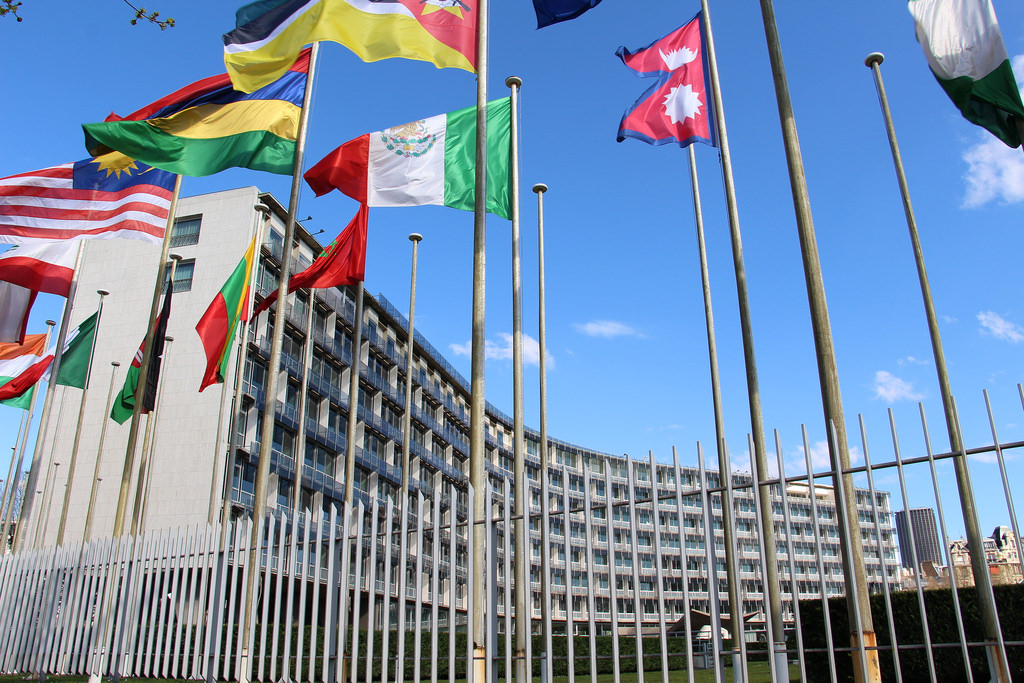
UNESCO The united NATIONS EDUCATIONAL, SCIENTIFIC AND CULTURAL ORGANIZATION headquarters in Paris, France. (Image source: Fred Romero/Flickr)
This organization works at odds in preserving historic sites in Israel, which Israel does. 

"The United Nations Educational, Scientific and Cultural Organization (UNESCO) has been treating Israel with hostility in recent years. Time and again, the organization adopts anti-Israel resolutions denying the Jewish people’s connection to the Land of Israel and Jerusalem and defining Jewish sites as "Palestinian heritage sites."

The USA and Israel are on the verge of pulling out from UNESCO with the USA planning on doing so the end of the year.  One lady " reportedly told the premier she was making big efforts to change UNESCO’s treatment of Israel, and added she would like to meet him at the sidelines of the UN session to discuss a possible postponement of Israel’s exit from the agency. "

The outgoing Israeli ambassador to UNESCO,  Carmel Shama-Hacohen,  said he welcomed “the new personality and the new energy brought by the new Director,” adding that he was going to recommend his government reconsider its decision to withdrawal or “at least to postpone it for a year.” These remarks are all the more surprising as they come from someone who was always quick to denounce the organization’s resolutions which in the eyes of the Israeli’s authorities use heritage protection as an excuse to deny any link between Judaism and its historic sites including Jerusalem.
Shavuot in June, dancing in 1967, first day to see the wall.
                                                                                 
1967 IDF see wall for 1st time
The Western Wall at night in Jerusalem
From 1948 Jews were cut off from this wall which was under Jordanian control, despite a paragraph in the Israel-Jordanian control,  and despite a paragraph in the Israel-Jordan 1949 Armistice Agreement affirming Jewish right of access.
It wasn't until 1967 Jews could again visit the Wall now under Jewish sovereignty for the 1st time since the 2nd Temple Period.  
On Shavuot 1967, the 1st day the public could visit, 200,000 people went there, a focal point for all Jews who come from around the world.  
Our Wailing Wall (Western Wall) the only place allowing Jews to pray
since Jordan controls the rules on the Temple Mount which Moshe Dayan
allowed in order to keep peace after the 1967 War when ISRAEL won against the
onslaught of all the Arab nations. 
Instead, UNESCO denies any connection between Israel and its historic Temple Mount and Western Wall also located in Jerusalem.  The Wall is the remnant of the ancient retaining wall of the ancient Jewish 1st and 2nd Temples that were repaired by King Herod.  You'd think this would be high priority on their list, but then they favor the Palestinians politically who are trying to take over the Jewish land.  

Resource: https://www.gatestoneinstitute.org/13123/unesco-israel-united-states
The New Standard Jewish Encyclopedia
https://www.timesofisrael.com/unesco-said-pushing-for-israel-to-rethink-exit-citing-work-to-end-bias/
https://www.washingtonpost.com/news/post-nation/wp/2017/10/12/u-s-withdraws-from-unesco-the-u-n-s-cultural-organization-citing-anti-israel-bias/?noredirect=on&utm_term=.6f1925399b1e
https://www.worldcrunch.com/opinion-analysis/can-middle-east-diplomacy-help-unesco-preserve-itself
https://www.ynetnews.com/articles/0,7340,L-5022375,00.html
https://www.ou.org/holidays/shavuot/capturing_the_wall_the_story_of_shavuot_1967/
http://www.templeinstitute.org/feedback.htm