Showing posts with label Emir Feisal. Show all posts

Friday, November 17, 2023

Hajj Mohammed Amin El-Husseini's Story Of How He Was Awarded by Samuel

 Nadene Goldfoot                                               

                Hajj Mohammed Amin El-Husseini was born in 1893 and died in 1974. Muhammad Amin al-Husseini was born in Jerusalem. His father, Haj Tahir al-Husseini, married twice: Zainab, with whom he had two sons, Muhammad and Kamel, and Mahbuba, with whom he had eight sons. Muhammad Amin had one son, Salah al-Din, and six daughters: Zainab, Suad, Asma, Nafisa, Jihad, and Amina.  He was educated in Jerusalem and then at al-Azhar Mosque in Cairo. He performed the pilgrimage with his family in 1913, while he was still a young man, and he was called “Haj” until the end of his life. In another directive, Amin was the half brother of Kamel; and being their father had 2 wives, it is possible to be confused.  Amin was said to be the younger brother of Kamel.  

 He was the first Arab leader to instigate others to attack Jews in Palestine.  He went against Emir Feisal, who later became King of Iraq and King of Syria and been on the plans for Palestine with the Jews' Chaim Weizmann and thought they were good until Husseini's riots changed his mind.                                             

     Edmund Allenby entering Jerusalem on foot out of respect, in 1917. (Public domain)

The Ottoman Empire entered WWI in 1915.  Foreign secretary Arthur Balfour, who would ultimately be responsible for his government’s Balfour Declaration in November 1917 (the Peel Commission would later hear secret testimony from Lloyd George, too.  A month after that declaration, British forces under General Edmund Allenby entered Jerusalem in triumph. Four centuries of Ottoman rule were over, and Palestine’s British era had dawned.

In 1917, the Ottoman-appointed mufti of Jerusalem was Kamel al-Husseini, the son and grandson of previous muftis of the Holy City. Kamel immediately made himself invaluable to the Crown, helping calm the nerves of local Muslims wary of coming under a Christian power that, worse still, had just pledged to facilitate a “Jewish national home” in their land.

Kamel’s relations with the Jews would be equally correct; World Zionist Organization chief Chaim Weizmann once called him “one of my best friends.” So satisfied were the British with his leadership that over the following years they made him a Companion of the Order of St. Michael and St. George and inflated his title to the hitherto unknown “grand mufti” of Jerusalem.                                         

Palestinian Arabs gather at the Damascus Gate in Jerusalem, in an anti-Zionist demonstration on March 8, 1920, prior to the Nabi Musa holiday on which violent rioting took place. (Public domain)

In April 1920,  the illusion of calm was broken at the annual pilgrimage festival of Nebi Musa. The crowd that year was far larger than in previous years — some 70,000 Muslims poured into Jerusalem, some of them armed, chanting nationalist and militant slogans. Prominent Arabs addressed them from the balcony of the Arab Club. The mayor — an older, more hardline relative of the mufti named Musa Kazem al-Husseini — urged the crowd to “spill their blood” for Palestine. Over the next three days, mobs attacked Jews in the Old City, looting shops and homes. Five Jews were killed and over 200 injured, including 18 critically. Two sisters, aged 25 and 15, were raped.

According to the British military governor of Jerusalem, the “immediate fomenter of the Arab excesses had been one Haj Amin al-Husseini, the younger brother of Kamel Effendi, the mufti. Like most agitators, having incited the man in the street to violence and probable punishment, he fled.” Amin al-Husseini (who was in fact the mufti’s half-brother) fled to Damascus, then later Trans-Jordan, and was sentenced to 10 years in absentia for incitement to riot.

So what did Britain do?  Britain hoped that replacing the military regime in Palestine with a civilian one might help calm tempers. Lloyd George tapped the only Jew in parliament, Samuel — author of the 1915 memo, and recently voted out of parliament — as high commissioner. He was to be the first Jew to govern the Land of Israel in 2,000 years.  It was just months after the Nebi Musa riots, and one of his very first acts was to order a complete amnesty to those sentenced to prison for their role in them. Those included Amin al-Husseini.

    Damage to a home in the city of Hadera caused during the 1921 riots. (Public domain)

In 1921, the high commissioner, Sir Herbert Samuel, appointed Amin el-Husseini  as the mufti of Jerusalem and head of the Supreme Moslem Council.  May Day 1921 brought an outbreak of violence in and around Jaffa that dwarfed anything seen the year before: nearly 50 Jewish dead and 150 wounded over six days of bloodletting, and a similar number of Arabs killed by British troops and police. As shocking as Nebi Musa had been, the 1921 Jaffa riots were modern Palestine’s first mass-fatality event.

Samuel noted that several other people had received prison sentences, including Jews. Vladimir Jabotinsky — the Zionist activist who had co-founded Britain’s Jewish Legion in the Great War — had been slapped with 15 years after police found pistols and ammunition in his Jerusalem home.  That amnesty was completely successful and the people who were amnestied gave no trouble.  “I repealed all that, wiped it out and said, ‘Let us start fresh,’ and it worked out very well,” Samuel testified. “That amnesty was completely successful and the people who were amnestied gave no trouble.”Six months after that amnesty was granted, grand mufti Kamel al-Husseini died suddenly. He was just 54. Samuel had been in Jerusalem less than a year and was already faced with a succession crisis.

The Ottoman law that the British had inherited stipulated that the new mufti be chosen through a vote by Muslim religious experts and local leaders. The top three candidates would be presented to Samuel — formerly, they would have been given to the religious authorities in Istanbul — who would then select one.

Herbert Samuel, seated center, with Jerusalem church leaders and British officials, 1922. (Public domain)

“When this vacancy took place there was a Husseini who had been trained for the post of Mufti, namely, the present Mufti, Haj Amin,” Samuel told the commission. “He was a Haj, he had been on the pilgrimage; he had also been at a University, the University of El-Azhar in Egypt, where he had a Muslim theological training with a view to his being the representative of the family in that post. He was the only man in Palestine with that qualification.”It was a less-than-persuasive defense. The fact that Amin al-Husseini had been on pilgrimage — he had been on Hajj to Mecca a decade earlier with his mother, at 16 — was not a rare distinction, as the children of many prominent families had done the same. Nor was his religious education particularly formidable: Of the three leading candidates for the position, all had attended El-Azhar, likely for longer spells, and all were significantly older. Each had superior religious qualifications — one was inspector of the religious courts, another was a respected theological scholar and head of the Sharia appeals court, and the third was a religious judge. Those credentials entitled them, unlike al-Husseini, to the honorifics of ‘alim (expert) and sheikh — far superior to the mere Hajj of the pilgrim.

Grand mufti Hajj Amin al-Husseini on the Temple Mount in Jerusalem in the late 1930s. (Library of Congress)

In 1936, as chairman of the Arab supreme Council, Husseini organized the Palestine disturbances for which he was sentenced to exile in 1937.  

         Husseini with Hitler in Germany

He then fled to Lebanon, and during World War II, participated in Rashidd Ali's pro-Axis coup in Iraq before going to Europe, where he assisted Hitler and was largely responsible for the liquidation of the Jews in the Moslem areas of Bosnia.

In 1946, he escaped to Egypt.  

After 1948, he set up a short-lived "Palestine Government" in Gaza, and then did the same thing later in Cairo, Egypt.  


Resource: 

https://en.wikipedia.org/wiki/1920_Nebi_Musa_riots

The 1920 Nebi Musa riots or 1920 Jerusalem riots took place in British-controlled part of Occupied Enemy Territory Administration between Sunday, 4 April, and Wednesday, 7 April 1920 in and around the Old City of Jerusalem. Five Jews and four Arabs were killed, and several hundred were injured.[1] The riots coincided with and are named after the Nebi Musa festival, which was held every year on Easter Sunday, and followed rising tensions in Arab-Jewish relations. The events came shortly after the Battle of Tel Hai and the increasing pressure on Arab nationalists in Syria in the course of the Franco-Syrian War.

https://jewishbubba.blogspot.com/2023/11/viscount-herbert-louis-samuel-who-chose.html

https://www.palquest.org/en/biography/6563/muhammad-amin-al-husseini

The New Standard Jewish Encyclopedia-1992, 7th edition

https://www.jewishvirtuallibrary.org/address-to-american-arabs-by-haj-amin-al-husseini

Tuesday, May 2, 2023

Mesopotamia AKA Babylonia AKA Iraq and How It Happened To Center on Oil

Nadene Goldfoot                                         


 Mesopotamia was ruled first by the Assyrians (Semites) from 20th century BCE on , who were later taken over by the Babylonians who inherited it from Nebuchadnezzar II in 604-561 BCE.  The land was conquered by the Arabs from Arabia in 637 after Mohammad died in 632.  His followers planned to fulfill his dreams even after he had died.

The Jews of the land favored and even assisted the Arab advance in the hope that it would afford them deliverance from the Sassanid persecution.                                

What actually took place was that shortly after the Arab occupation, Jews were expelled from Arabia and had to settle in Kufa. Kūfah, also spelled Kufa, medieval city of Iraq that was a centre of Arab culture and learning from the 8th to the 10th century. It was founded in 638 ce as a garrison town by ʿUmar I, the second caliph. The city lay on the Hindiyyah branch of the Euphrates River, about 7 miles (11 km) northeast of Al-Najaf.

The Ottoman Empire of the Turks of Turkey lasted a span of 400 years.  Palestine became a part by 1517 and lasted until the end of WWI in 1917. Ottoman Iraq (Arabic: العراق العثماني) refers to the period of the history of Iraq when the region was ruled by the Ottoman Empire (1534–1920; with an interlude from 1704 to 1831 of autonomy under the Mamluk dynasty of Iraq).

Oil became  the important source of profit for Iraq and those who ruled over it.  Even in ancient days it was known to exist in Iraq and western Iran.  In the late 19th century, the Ottoman Empire was told of the presence of oil in commercial quantities.  Foreign prospectors from 1904 to 1912 were very interested in acquiring concessions.  The Germans were involved through the Deutsche Bank; and British had an interest through D'Arcy's Anglo-Persian Oil Company.  The Royal Dutch shell Company had a subsidiary, the Anglo-Saxon Oil Company and the Americans began negotiating through the Chester group.  WWI (July 28, 1914-November 11, 1918)  prevented these countries from receiving firm concessions.  After the war each company claimed that they had one, so anxious were they to get oil.                                            

Politicians were evidently not aware of the business deals previously about oil, so they claimed.  Sykes and Picot were innocent. The Sykes -Picot Treaty was a series of secret agreements between Britain, France and Russia with a later addition of Italy done between 1914 and 1916.  They claimed that the concession to the Turkish Petroleum Company had been given to the Germans by the Ottomans in 1912 was valid, but this made life awkward to hold a concession for oil in a territory that was assigned to France after the war.   The Sykes Picot Agreement allocated to the UK control of what is today southern Israel and Palestine, Jordan and southern Iraq, and an additional small area that included the ports of Haifa and Acre to allow access to the Mediterranean. France was to control southeastern Turkey, the Kurdistan Region, Syria and Lebanon. 

 The Jews-Zionist leaders only discovered the terms early in 1917 and protested against the condominium which they believed would expose the Jews to dangers of a constant power conflict, and against the radical dismemberment of the country.  This "treaty" was partly responsible for the form of the post-war frontiers of Palestine.

France relinquished the province of Mosul to Britain in return for 25% of the shares in Turkish Petroleum originally to go to Germany.  A new map was created and the whole plan incorporated as part of the San Remo Agreement of April 24, 1920.  To the victor go the spoils, as they say.  WWI was the bloodiest of wars. Mosul became important again in the war, Desert Storm.  ISIL=The Islamic State, also known as the Islamic State of Iraq and the Levant, Islamic State of Iraq and Syria, and by its Arabic acronym Da'ish or Daesh, is a militant Islamist group and former unrecognized quasi-state that follows the Salafi jihadist branch of Sunni Islam.   

The total number of deaths includes 9.7 million military personnel and about 10 million civilians. The Entente Powers (also known as the Allies) lost about 5.7 million soldiers while the Central Powers lost about 4 million.  It was so bloody, it was thought never to be repeated.  Germany was the main country attacking others in WWI and then soon in WWII by 1939, raising thoughts of it by 1933. It was really the Ottoman Empire's fault for tagging onto Germany in WWI.  Turkey lost all their power;  all their control.  This also reflected on religions;  Muslims lost, Christian world won.  Only by now, in 2023,  with the Abrahamic Accords with Israel, has some Muslim countries come to terms with the Western world.  

         Feisal's Coronation as King of Iraq

 Emir Feisal (20 May 1885 – 8 September 1933) was King of the Arab Kingdom of Syria or Greater Syria in 1920, and was King of Iraq from 23 August 1921 until his death. He was the third son of Hussein bin Ali, the Grand Emir and Sharif of Mecca, who was proclaimed as King of the Arabs in June 1916.  He was a 38th-generation direct descendant of Muhammad, as he belonged to the Hashemite family.

It was Emir Feisal, a man originally for the state of Israel to be born again, who had to change his mind towards Jews after dealing with Haj Amin al-Husseini, the Sherif of Jerusalem, who ironically was chosen by a Jewish Britisher  to be seen as such a leader.  He didn't know the people, in that Husseini was terrible; leader of attacks against Jewish communities.  Feisal became king of Iraq from 1921 and king of Syria.  His whole name was Hussein Ibn Feisal (1885-1933).  He was the eldest son of Hussein, sherif of Mecca.  It was he who led the Arab "rising" against Turkey (1916-1918).  

Desert Storm War in Iraq

      Iraqi civilians and U.S. soldiers pull down a statue of Saddam Hussein in Baghdad. Jerome Delay/AP Photo

USA fought in Desert Storm in Iraq from 2003 to 2011.  In March 2003, U.S. forces invaded Iraq vowing to destroy Iraqi weapons of mass destruction (WMD) and end the dictatorial rule of Saddam Hussein. When WMD intelligence proved illusory and a violent insurgency arose, the war lost public support. Saddam was captured, tried, and hanged and democratic elections were held. In the years since, there have been over 4,700 U.S. and allied troop deaths, and more than one hundred thousand Iraqi civilians have been killed. Meanwhile, questions linger over Iraq’s fractious political situation.

Over the past two decades Iraq has been affected by several waves of intense conflict and violence. The 2003 invasion of Iraq by a multinational coalition led by the United States and United Kingdom toppled the Ba’athist regime of Saddam Hussein. It also ushered in years of chaos and civil war, as a variety of armed groups vied for power and territory and targeted coalition forces and the fledgling post-Ba’athist Iraqi Army. A period of relative calm in the early 2010s was broken by the rise of the extremist Islamic State group, which occupied large parts of the country from 2014 until it was largely defeated by Iraqi forces with the support of a US-led international coalition in 2017.

Today Iraq is enjoying its most stable period since 2003. Armed violence persists in different forms, but it is sporadic, fragmented and localized. However, the country remains fragile and divided, and its people face an array of deepening challenges that the state is struggling to address. This Topical Backgrounder aims to provide a snapshot of the situation in Iraq 20 years since the invasion.

A fragile, oil-dependent economy

Crude oil exports accounted for an estimated 95 per cent of federal revenues in 2020. Successive governments have done little to wean Iraq off this heavy dependency on oil rents and diversify the economy. This has led to a bloated public sector characterized by patronage and to a shortage of jobs for new graduates—especially those without the necessary connections and networks.

Resource;

https://en.wikipedia.org/wiki/Sykes%E2%80%93Picot_Agreement#:~:text=The%20agreement%20allocated%20to%20the,Kurdistan%20Region%2C%20Syria%20and%20Lebanon.

https://www.sipri.org/commentary/topical-backgrounder/2023/iraq-2023-challenges-and-prospects-peace-and-human-security

https://www.dni.gov/nctc/groups/isil.html

https://www.aljazeera.com/news/2017/7/16/battle-for-mosul-who-controls-what

Tuesday, December 27, 2022

How The Palestine 30 Year Mandate Came About But Kept Jews Out

 Nadene Goldfoot                            


In the two years after 1946, more than 100,000 people arrived in the new Israel.  Most were not allowed to stay because Britain held the 30 year mandate and kept them out.  

Israel

Jewish youth rescued from the Auschwitz Nazi concentration camp show their camp tattoos on their forearms on board the refugee immigration ship Mataroa July 15, 1945 at Haifa port, during the British Mandate of Palestine. 

Romans  didn't allow any Jews back into Jerusalem.  They were the keepers of the entrance.  Then after 630, the Arabs took over Palestine and kept Jews out.  The Jews' magnificent 2nd Temple of Solomon had been destroyed, burned down and looted.  Over that the Romans had built their Temple, and over that the Muslims built their mosque, a huge one at that. Jews prayed 3 times a day for their return to Jerusalem.  The famous Jewish Hillel, born in Babylon in the 1st century BCE from the days when Babylon in 597 BCE took hostages from Judah, made it to Palestine and worked as a laborer while studying the Torah with  the well-known teachers, Shemaiah and Avtalyon.  Getting to Palestine has never been easy in any year.                                               

After the resolution on 25 April 1920, standing outside Villa Devachan, from left to right: Matsui, Lloyd George, Curzon, Berthelot, Millerand, Vittorio Scialoja, Nitti.

WWI ended on November 11, 1918. Starting on July 28, 1914, it had been the bloodiest war ever known that lasted over 4 years.  

28 June 1919:  Versailles Conference: This Paris Peace Conference was the formal meeting in 1919 and 1920 of the victorious Allies after the end of World War I to set the peace terms for the defeated Central Powers. Dominated by the leaders of Britain, France, the United States and Italy, it resulted in five treaties that rearranged the maps of Europe and parts of Asia, Africa and the Pacific Islands, and also imposed financial penalties. Germany and the other losing nations had no voice in the Conference's deliberations; this gave rise to political resentments that lasted for decades.


  David Lloyd George was one of the 20th century’s most famous radicals. He was the first and only Welshman to hold the office of Prime Minister.  He was acclaimed as the man who had won the war, and in 1918 the coalition won a huge majority. It was the first election in which any women were allowed to vote. In 1919 he signed the Treaty of Versailles, which established the League of Nations and the war reparations settlement.


On April 24, 1920, it was formally decided by the Supreme Council of the Principal Allied Powers at the conference in San Remo that Britain should administer Palestine and be responsible for the implementation of the Balfour Declaration. 

The San Remo conference was an international meeting of the post-World War I Allied Supreme Council as an outgrowth of the Paris Peace Conference, held at Villa Devachan in Sanremo, Italy, from 19 to 26 April 1920. 

The San Remo Resolution passed on 25 April 1920 determined the allocation of Class "A" League of Nations mandates for the administration of three then-undefined Ottoman territories in the Middle East: "Palestine", "Syria" and "Mesopotamia". The boundaries of the three territories were "to be determined [at a later date] by the Principal Allied Powers", leaving the status of outlying areas such as Zor and Transjordan unclear.

The conference was attended by the four Principal Allied Powers of World War I who were represented by the prime ministers of Britain (David Lloyd George), France (Alexandre Millerand), Italy (Francesco Nitti) and by Japan's Ambassador Keishirō Matsui.

It was agreed –

(a) To accept the terms of the Mandates Article as given below with reference to Palestine, on the understanding that there was inserted in the procès-verbal an undertaking by the Mandatory Power that this would not involve the surrender of the rights hitherto enjoyed by the non-Jewish communities in Palestine; this undertaking not to refer to the question of the religious protectorate of France, which had been settled earlier in the previous afternoon by the undertaking given by the French Government that they recognized this protectorate as being at an end.

The High Contracting Parties agree to entrust, by application of the provisions of Article 22, the administration of Palestine, within such boundaries as may be determined by the Principal Allied Powers, to a Mandatory, to be selected by the said Powers. 


The Mandatory will be responsible for putting into effect the declaration originally made on the 8th [2nd] November, 1917, by the British Government, and adopted by the other Allied Powers, in favour of the establishment in Palestine of a national home for the Jewish people, it being clearly understood that nothing shall be done which may prejudice the civil and religious rights of existing non-Jewish communities in Palestine, or the rights and political status enjoyed by Jews in any other country.

While Transjordan was not mentioned during the discussions, three months later, in July 1920, the French defeat of the Arab Kingdom of Syria state precipitated the British need to know 'what is the "Syria" for which the French received a mandate at San Remo?' and "does it include Transjordania?" – it subsequently decided to pursue a policy of associating Transjordan with the mandated area of Palestine but not to apply the special provisions which were intended to provide a national home for the Jewish people West of the Jordan                                 

                   Weizmann and Feisal

Therefore, Transjordan, soon to become Jordan, was decided upon 3 months after the mandate was written in July of 1920 when they (British, French) had decided not to make it land that could be a part of the National Home for the Jews.                                 

Notes:  Faisal is mentioned who was Emir Feisal and would become King Faisal of Syria and of Iraq; was friends during the Conference with Chaim Weizmann (1874-1952). 

                              President Chaim Weizmann    

 Weizmann was a chemist who became a Zionist leader and 1st president of Israel.  Very likeable with terrific personality; liked by Lloyd George and Balfour.  

                           Britain's Herbert Samuel, 1st Jew to be a member of a British cabinet, happening in 1909.  He held office in the Liberal government from 1905 to1916; and then in the national government  in 1931 and 1932.  He wrote a memorandum to the Cabinet in 1914 concerning a British trust for the Jewish Home which influenced the Balfour Declaration.  

In 1920, Great Britain appointed Herbert Samuel, 1st Viscount Samuel as high commissioner and established a mandatory government in Palestine that remained in power until 1948.  It was the 30 year mandate. 

A mandate is:  the authority to carry out a policy or course of action, regarded as given by the electorate to a candidate or party that is victorious in an election.

Note:

  1.  Wilson (1988, pp. 46–48) Samuel then organised a meeting of Transjordanian leaders at Salt on 21 August, at which he would announce British plans... On 20 August Samuel and a few political officers left Jerusalem by car, headed for the Jordan river, the frontier of British territory at that time. ‘It is an entirely irregular proceeding,’ he noted, ‘my going outside my own jurisdiction into a country which was Faisal's, and is still being administered by the Damascus (Syria) Government, now under French influence. But it is equally irregular for a government under French influence to be exercising functions in territory which is agreed to be within the British sphere: and of the two irregularities I prefer mine.’... The meeting, held in the courtyard of the Catholic church, was attended by about 600 people..... Sentence by sentence his speech describing British policy was translated into Arabic: political officers would be stationed in towns to help organise local governments; 

  2. Transjordan would not come under Palestinian administration; there would be no conscription and no disarmament......On balance, Samuel's statement of policy was unobjectionable. Three things feared by the Arabs of Transjordan – conscription, disarmament, and annexation by Palestine – were abjured.... The presence of a few British agents, unsupported by troops, seemed a small concession in return for the protection Britain's presence would afford against the French, who, it was feared, might press their occupation southward... Samuel returned to Jerusalem well pleased with the success of his mission. He left behind several officers to see to the administration of Transjordan and the maintenance of British influence.

 Viscount Herbert Louis Samuel was the first Jew to be in English public office.  In 1920 he was the first High Commissioner for Palestine.  It was he who had appointed the Sherif of Jerusalem to be Haj Amin al- Husseini, who was the Jewish enemy in Palestine and had caused all the riots and killings of Jews. Evidently he didn't know because he was from a very high social group of Englishmen and didn't know the Arab people at all, only that Husseini had a title. Husseini was a little fish in a big pond and didn't want to lose his position. Husseini was also against the much bigger fish-Emir Feisal who was a very important man.  Husseini was not related to Feisal.

Feisal I of Iraq:  Faisal I bin Al-Hussein bin Ali Al-Hashemi 20 May 1885 – 8 September 1933) was King of the Arab Kingdom of Syria or Greater Syria in 1920, and was King of Iraq from 23 August 1921 until his death in 1933. He was the third son of Hussein bin Ali, the Grand Emir and Sharif of Mecca, who was proclaimed as King of the Arabs in June 1916.                    

The conference was attended by the allies, the US representative joining the meeting later in an observer capacity.United States of America (as observers):

"Zionist Rejoicings. British Mandate For Palestine Welcomed", The Times, Monday, 26 April 1920, following conclusion of the conference.

At the end of WWI, there was only one spokesman that qualified for the Muslims, and that was Emir Feisal.  He did his part by becoming the king of Syria and then king of Iraq.  

As to Arab population in Palestine:  here we see 
Year          Jews  Christ.  Muslims    Total
18904357432532
19149470525689
19228471589752
1931175897601,033
19476301431,1811,970
Estimates by Sergio DellaPergola (2001), drawing on the work of Bachi (1975). Figures in thousands.


  1. In 1920, the British Government's Interim Report on the Civil Administration of Palestine stated that there were hardly 700,000 people living in Palestine:

    "There are now in the whole of Palestine hardly 700,000 people, a population much less than that of the province of Galilee alone in the time of Christ. Of these 235,000 live in the larger towns, 465,000 in the smaller towns and villages. Four-fifths of the whole population are Moslems. A small proportion of these are Bedouin Arabs; the remainder, although they speak Arabic and are termed Arabs, are largely of mixed race. Some 77,000 of the population are Christians, in large majority belonging to the Orthodox Church, and speaking Arabic. The minority are members of the Latin or of the Uniate Greek Catholic Church, or—a small number—are Protestants. 

    Update: There were 750,000 Jews in Israel when the state was established in 1948.   

    The Jewish element of the population numbers 76,000. Almost all have entered Palestine during the last 40 years. Prior to 1850 there were in the country only a handful of Jews. In the following 30 years a few hundreds came to Palestine. Most of them were animated by religious motives; they came to pray and to die in the Holy Land, and to be buried in its soil. After the persecutions in Russia forty years ago, the movement of the Jews to Palestine assumed larger proportions. Jewish agricultural colonies were founded. They developed the culture of oranges and gave importance to the Jaffa orange trade. They cultivated the vine, and manufactured and exported wine. They drained swamps. They planted eucalyptus trees. They practised, with modern methods, all the processes of agriculture. There are at the present time 64 of these settlements, large and small, with a population of some 15,000.

    As Transjordan was eliminated from the Jewish National Home, so had the Jews been eliminated by the Brits.  Jews were kept out from 1933-1939 at a time they needed to be allowed in with the Nazis at their heels, while Muslims and Arab Christians were allowed in. 

         Exodus 1947

    From 1942 President Warfield served in the Second World War as a barracks and training ship for the British Armed Forces. In 1944 she was commissioned into the United States Navy as USS President Warfield (IX-169), a station and accommodation ship for the D-Day landing on Omaha Beach.

    In 1947 she was renamed Exodus 1947 to take part in Aliyah Bet. She took 4,515 Jewish migrants from France to Mandatory Palestine. Most were Holocaust survivors who had no legal immigration certificates for Palestine. The Royal Navy boarded her in international waters and took her to Haifa, where ships were waiting to return the migrants to refugee camps in Europe.

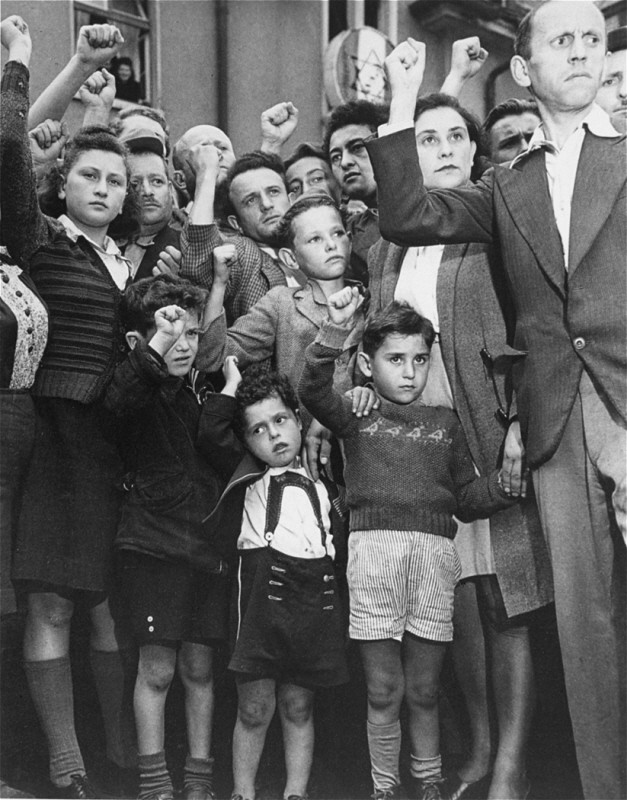
    Jewish displaced persons protest Britain's decision to send back to Germany the Jewish refugees from the ship "Exodus 1947." [LCID: 37201a]

    Protesting Britain's decision to return the passengers of the Exodus 1947 to Germany

    Jewish displaced persons protest Britain's decision to send back to Germany the Jewish refugees from the ship Exodus 1947. Photograph taken by Henry Ries. Hohne-Belsen displaced persons camp, Germany, September 1947.

    • Henry Ries / The New York Times Copyright © The New York Times.  
    • Aliyah Bet:
  2.  Aliyah refers to immigration to the Land of Israel, while "bet" (the Hebrew equivalent of the letter "B") here implies something unofficial or secret. The phrase Aliyah Bet describes the movement of Jewish refugees, many of them survivors of the Holocaust, not permitted to enter Palestine by the British authorities. Initiated by Zionist activists as the urgency for Jews to leave Europe intensified, this phenomenon was referred to by the British as "illegal" immigration. By 1948, well over 100,000 people had taken this route including more than 70,000 Holocaust survivors.

  3. clandestine immigration of Jews to Palestine between 1920 and 1948, when Great Britain controlled the area.

  4.  So we read:  By 1948, the population had risen to 1,900,000, of whom 68% were Arabs, and 32% were Jews (UNSCOP report, including Bedouin).  An example of one ship trying to get to Palestine from Germany below:  

    View of the damaged Exodus 1947 as it is towed into the port of Haifa, after its interception by the British navy. (July 1947)  Exodus 1947 was a packet steamship that was built in the United States in 1928 as President Warfield for the Baltimore Steam Packet Company. From her completion in 1928 until 1942 she carried passengers and freight across Chesapeake Bay between Norfolk, Virginia and Baltimore, Maryland.

  5. In July 1947, the President Warfield left Sète, France, for Palestine. It carried over 4,500 Jewish men, women, and children, all displaced persons (DPs) or survivors of the Holocaust. Even before the ship (by then renamed the Exodus 1947) reached Palestine's territorial waters, British destroyers surrounded it. On July 18 a struggle ensued between British naval forces and passengers on the ship. A Jewish crew member and two passengers were killed. Dozens suffered bullet wounds and other injuries. The people aboard the ship were tortured on other ships that got them to camps of death in Germany

  6. The Royal Navy brought Exodus 1947 into Haifa, where her passengers were transferred to three larger and more seaworthy ships for deportation: Empire Rival, Ocean Vigour and Runnymede Park. Members of the United Nations Special Committee on Palestine (UNSCOP) witnessed the transfer. (Brits wanted the Jews deported to Germany where they would be killed.)

  7. After her historic voyage in 1947, the damaged Exodus 1947, along with many other Aliyah Bet ships, was moored to the breakwater of Haifa port. In December 1947 the Palestine Railways' Ports Authority advertised the ships for sale in British shipping journals. The advertisement warned that some of the ships were fit only for scrap. But no-one bought Exodus 1947.  From Haifa, they would be deported back to Germany.

    The founding of the State of Israel in 1948 brought massive migration of European Jewish refugees from displaced persons camps to Israel. There was little time or money to focus on the meaning of Exodus 1947. Abba Khoushy, the Mayor of Haifa, proposed in 1950 that the "Ship that Launched a Nation" should be restored and converted into a floating museum of the Aliyah Bet. As the ship was being restored, an unexplained fire broke out aboard her on August 26, 1952. Fireboats fought the fire all day, but she burned down to her waterline. Her hulk was towed north of the Kishon River and scuttled near Shemen Beach.


  8. On September 29, 1947,  Response to Exodus 1947:  Zionist Irgun and Lehi militants blew up the Palestine Police Force headquarters in Haifa in retaliation for the British deportation of Jewish migrants who arrived on Exodus 1947. 10 people were killed and 54 injured, of which 33 were British. Four British policemen, four Arab policemen, an Arab woman and a 16-year-old were killed. The 10-storey building was so heavily damaged that it was later demolished. They used a barrel bomb, described by police as a "brand new method" and the first use of a barrel bomb by Jewish forces.  Irgun went on to make many more barrel bomb attacks in 1947–48.


  9. Resource:
  10. The New Standard Jewish Encyclopedia: Aliyah
  11. https://en.wikipedia.org/wiki/San_Remo_conference
  12. https://www.gov.uk/government/history/past-prime-ministers/david-lloyd-george
  13. https://en.wikipedia.org/wiki/Faisal_I_of_Iraq
  14. https://en.wikipedia.org/wiki/Demographic_history_of_Palestine_(region)
  15. https://en.wikipedia.org/wiki/SS_Exodus#:~:text=The%20Royal%20Navy%20brought%20Exodus,(UNSCOP)%20witnessed%20the%20transfer.