Showing posts with label Benjamin of Tudela. Show all posts

Wednesday, June 29, 2022

The Mesopotamian "Iraqi" Jews, From the Land of Shinar

 Nadene Goldfoot                                    

Iraq was originally  called Mesopotamia. It's where Babylonia lie.  In the Torah it was also known as the land of Shinar or of Kasdim (Chaldees), as in Ur of the Chaldees-the city that Abraham was from.    Jews of Iraq are the Mizrachi Jews.  There are the Ashkenazim of Europe, originally of Germany, and the Sephardim of Spain and Portugal, and the Mizrachim of the Middle East.  Jews had gone or stayed as the Mizrachim did after 70 CE and the Roman destruction.  

The Torah says it was the cradle of humanity and also the scene of man's 1st revolt against G-d as we read about the Tower of Babel.  Many stories found in our Tanakh are found also in Babylonian literature such as the Flood story with Noah and his  Ark. 


Abraham had migrated from the big city of Ur to Canaan where he later fought against Amraphel, king of Shinar (Gen. 14).  Babylon, another great city, had a bad reputation with our prophets, known as sin city and a symbol of insolent pagan tyranny.  The Babylonian Nebuchadnezzar II (604-56BCE) inherited the Assyrian empire, and after his conquest of Judah in (597-and 586 BCE) exiled many Jews to Babylon as slaves.  

They in turn ran into the members of the Ten northern population of Israel who had been abducted 200 years earlier by the Assyrians.  Now there were a very large population of Jews living there against their will.  Many acclimated and of course, some of the younger generations knew very little about their history of why they were there, living in all Jewish cities such as Nehardea, Nisibis, and Mahoza.                                


Since the destruction of the First Temple there was a connection between Babylonian exiles and the Land of Israel. According to the Al-Yahudu Tablets, a collection of tablets from the sixth century BCE, multiple Jews were given names reflecting their families desire to return to Zion.  The Al-Yahudu tablets are a collection of about 200 clay tablets from the sixth and fifth centuries BCE on the exiled Judean community in Babylonia following the destruction of the First Temple. They contain information on the physical condition of the exiles from Judah and their financial condition in Babylon. The tablets are named after the central settlement mentioned in the documents, al-Yahudu (Akkadian: The city of Judah).

The earliest document in the collection dates back to 572 BCE, about 15 years after the destruction of the Temple, during the reign of Nebuchadnezzar II. The most recent tablet dates back to 477 BCE, during the reign of Xerxes I, about 60 years after the Return to Zion began and about 20 years before the rise of Ezra the Scribe.

The Jews were allowed to return to Jerusalem in 538 BCE, , but not all chose to leave as the 1st thing that the leadership wanted to do was to rebuild Solomon's Temple that Nebuchadnezzar had destroyed.  They would have to start the city from it's beginnings again, and in fact it was already re-populated by Samaritans and others that had been brought in by their captors, an exchange of population.  They got rid of slaves they were tired of and were hoping for a better batch of workers who were work-oriented, such as the northern tribes, they thought.   

However, there were Jews there who did remember, and they were able to keep in touch with Jews back in Judah and even supplied some of their leaders like Hillel.  

During the Roman occupation, the Babylonian Jews rose against the emperor, Trajan, the revolt being bloodily suppressed by his commander, Lucius Quietus in 116.  Under both Persian and Parthian rule, the Jews of Babylon enjoyed an extensive measure of internal autonomy, being headed by an Exilarch of Davidic descent who was the king's representative, while the community was governed by a council of elders.  

The Jews of Babylon created the Babylonian Talmud that was rated higher than the Jerusalem Talmud.  It reflected a society mainly based on agriculture and crafts.  They were learned students in their Jewish studies and had produced works of literary merit by such people as Ezekiel, Daniel and  Tobit.  

By the beginning of the 3rd century, Babylon became the main center of rabbinic studies.  They had academies that were founded by Samuel at Nehardea and by Rav at Sura, while in the later 3rd century, the academy of Purnbedita was founded to replace that at Hehardea which was destroyed in 261.  These schools were most important as they saw the abolition of the Palestinian patriarchate in 425 when Babylon became the spiritual center for all Jewry in the Middle East and possible even Europe as well, like Rome is for Catholicism.

The 5th century of the 400s was the start of much persecution against Jews which led to the Jewish revolt under Mar Zutra II who held out for 7 years, but was finally captured and killed. Mar-Zutra II was a Jewish Exilarch who led a revolt against the Sasanian rulers in 495 CE and achieved seven years of political independence in Mahoza. Mar-Zutra II became Exilarch of the Jewish community in Babylon at the age of fifteen in 483 CE, twelve years before the revolt. Wikipedia                 


 This was when the Talmud was concluded about this period.  Jewish position in the world continued to be difficult until the Arab conquest in the 7th century after Mohammad had died in 632.  Can you imagine?  It was Arabs who ended the anti-Semitism of the others, coming to the Jews' rescue. The Jews had assisted the Arabs in the take-over of Babylonia in the hope that it would deliver them from Sassanid persecution.  After the Arab occupation, what happened to the Jews in Arabia?  Strangely, the Jews there, making up several tribes, were expelled, so they settled in Kufa.  

For centuries, the land of today's Iraq continued to be the center of Jewish life.  The Exilarch and the Gaon (Jewish leadership) was recognized throughout the Diaspora (the world).  Jews wherever they lived would submit their religious questions to the geonim whose answers were accepted as binding.  There was internal Jewish problems due to newly-founded sects of Issawites and Yudganites, and especially by the rise of Kasraism.  

Then by 1040, their 2 famous academies were closed and Iraq lost her central position in the Jewish world, although geonim are recorded in Baghdad as late as the 13th century.  The Jewish leader (Exilarchate) was suspended in 1040, and then restored 2 centuries later for a short period.  

Jews suffered from restrictions laid down by Caliph Umar/Omar but weren't strictly observed by the Arab leadership.  Caliph Al-Muktadir in 908 allowed Jews to 2 state offices as physicians and bankers.  There were Jewish physicians, scientists and scholars among the Arab population.  Umar initially opposed Muhammad, his distant Qurayshite kinsman and later son-in-law. Following his conversion to Islam in 616, he became the first Muslim to openly pray at the Kaaba. Umar participated in almost all battles and expeditions under Muhammad, who bestowed the title al-Faruq ('the Distinguisher') upon Umar, for his judgements. After Muhammad's death in June 632, Umar pledged allegiance to Abu Bakr (r. 632–634) as the first caliph and served as the closest adviser to the latter until August 634, when the dying Abu Bakr nominated Umar as his successor.

On his orders, this 2nd Caliph ruled for 10 years and conquered Palestine, Syria and Mesopotamia.  Most of the Jews were expelled from N. Arabia, and also asked for more taxation from the Jews.  Omar set up the temporary structure situated on the traditional site of Mt. Moriah before the modern Mosque of Omar was built by Caliph Abd al-Malik in 738.  

Because of heavy taxation on cultivated land, Jews left agriculture and concentrated in the larger towns, especially Baghdad, Basra and Mosul, where they mostly became traders and craftsmen.  Some were financiers or participated in international commerce.  

                        Mongol Invaders

Benjamin of Tudela visited Iraq in 1170 and reported places with up to15,000 Jewish people.  Then the Mongols invaded the land in the 2nd half of the 13th century who were free from religious prejudice, the the Jewish position of being considered 2nd class citizens (Dhimmis) improved as they were no longer discriminated against because they were Jews, and even the highest state offices were now open to them.  But....

Mongol rulers became converted to Islam!  Then they introduced those old discriminating laws.  In 1291, the Jewish administrator and physician, Saad ad-Daula, was assassinated, and this was  followed by a general attack on the Jews of Iraq.  Nobody heard from them for  several centuries.

The city of Timur was invaded at the end of the 14th century and Jews suffered along with the rest of the population, and then along come the Turks and their conquest of Iraq in 1534 which bettered everyone economically.  The Turkish domination was of the Ottoman Empire, and it didn't take much for Jews to be treated badly by them

                                   from Zeyad al-Ahmed

Many Iraqi Jews were doctors, pharmacists and journalists. The first Hebrew newspaper in the country, Hadover (“speaker” or “spokesman”), was printed by the first Hebrew printing press, established in 1863 by Musa Baruch Mizrahi. The Jews of Iraq had an Arabic dialect of their own, and they wrote books in Judeo-Arabic, written in Hebrew letters.. 

 In 1914, the first Zionist organization was founded by Menashe Hakim, Maurice Fattal and Raphael Horesh under the name "Zionist Association of Baghdad", to promote the Zionist cause in Mesopotamia. The short-lived organization collapsed in November of that year when the Ottoman Empire declared  war on Britain.   

Jews were appointed to high government offices and some served in the Iraqi army.  In 1932, Iraq gained their independence.   and this brought out persecution of the Jews.  At the time, Jewish leaders were speaking with the League of Nations in making Palestine the Jewish Homeland.       


Rashid Ali al-Gaylani and 
Haj Amin al-Husseini, speaking at the anniversary of the 1941 Iraqi coup in Berlin-right.  
  Prime Minister of Iraq, Rashid Ali  He is chiefly remembered as an ardent Arab nationalist who attempted to remove the British influence from Iraq by starting a coup against the government in 1941. During his brief tenures as Prime Minister in 1940 and 1941, he attempted to negotiate settlements with the Axis powers (Hitler) during World War II in order to counter British influence in Iraq.  WWII wasn't over until 1945.  
 Hundreds of Baghdad Jews were killed and wounded in a pogrom during the revolt of Rashid Ali al-Gaylani in 1941.

  Iraqi troops participated in the 1948 attack on Israel on the central front. Despite their defeat, Iraq never concluded an armistice agreement with Israel.  the great majority of Iraqi Jews left the country, chiefly for Israel in Operation Ezra and Nehemiah, and their property in Iraq was confiscated, so they were left penniless.

      123,000 Iraqi Jews reached Israel since 1948.  Those that remained were subject to severe restrictions, especially after the Six Day War of 1967 when the treatment of Iraqi Jews led to international protests.  The Jewish population in 1991 was 150 who had remained, chiefly in Baghdad, where one synagogue still operates. Egyptian Jews experienced the same situation, with a few remaining to caretake the synagogue and cemeteries. 

Iraqi Jews in Israel, also known as the Bavlim (Hebrew for "Babylonians"), are immigrants and descendants of the immigrants of the Iraqi Jewish communities, who now reside within the state of Israel. They number around 450,000.  They live mostly in Or Yehuda, Givatayim and  Kiryat Gat.                                             

 Moshe Levi, IDF Chief of Staff (Hebrew: משה לוי, April 18, 1936 – January 8, 2008) was an Israeli military commander and the 12th Chief of Staff of the Israel Defense Forces (IDF). He served in this position from 1983 to 1987, towards the end of the first Lebanon war and the establishment of the South Lebanon Security Belt. He was the first Chief of Staff of Mizrahi origin.  Levi, born in Tel Aviv to an Iraqi-Jewish family, was known by his army nickname Moshe VaHetzi (Hebrew: משה וחצי ("Moshe and a half") because of his towering height, which was about 1.96 metres (6 ft 5 in).  While serving as Chief of Staff and after retiring from the army, Levy lived in Kibbutz Beit Alfa in northern Israel. In his last years, he was the founding chairperson of the supervisory board of Highway 6, also known as the Trans-Israel Highway.

Resource:

Updated 7/19/22

https://jewishfactsfromportland.blogspot.com/2014/02/could-iraqis-have-jewish-roots.html

The New Standard Jewish Encyclopedia

https://en.wikipedia.org/wiki/Rashid_Ali_al-Gaylani

https://en.wikipedia.org/wiki/Iraqi_Jews_in_Israel

https://en.wikipedia.org/wiki/Moshe_Levi

https://en.wikipedia.org/wiki/Al-Yahudu_Tablets

https://www.reuters.com/article/us-israel-archaeology-babylon/ancient-tablets-reveal-life-of-jews-in-nebuchadnezzars-babylon-idUSKBN0L71EK20150203

https://www.archives.gov/press/press-releases/2013/nr13-96.html

 https://www.jns.org/opinion/iraqi-jews-share-a-deeply-rooted-heritage/?gclid=CjwKCAjwrNmWBhA4EiwAHbjEQFL1vDJM-MbFjsky1-zFvau0m6K1eX4FHPTK2vkS3b-FVaTEI8K_aRoCsS4QAvD_BwE


Thursday, November 18, 2021

Jews Who Loved To Hike and Wander About

Nadene Goldfoot                                              

Jews were prompted to undertake long journeys from early in their history either by  the desire for travel and thirst for knowledge, or for commercial and political purposes.  Their dispersion over the whole populated world facilitated such travels.

In the 9th century, Jewish merchants, called RADANITES regularly undertook distant journeys from Europe to the Orient, from Franconia (southern France)  to China.  They are known mainly from a description by the early Arab geographer, Ibn Khordadbeh, (846 to 886) who stated that they spoke Arabic, Persian, Roman and the languages of the Franks, Andalusians, and Slavs.  He describes in detail 4 trade routes that they followed.  The 1st was via the Mediterranean to Alexandria, overland to the Red Sea, and via the Indian Ocean to the China Sea.  The 2nd route went overland via Damascus, Baghdad, and Basra and then continued as in the previous route.  The 3rd of the routes was entirely overland across North Africa to Palestine, Baghdad, and then into the interior of China, while the 4th went across central Europe.                  

Isaac the Jew

       Caliph Haroun al-Raschid

The emperor Charlemagne sent a deputation to the caliph, Haroun al-Raschid, which included a Jew, Isaac, who alone returned.  Charlemagne or Charles the Great was King of the Franks from 768, King of the Lombards from 774, and Emperor of the Romans from 800. During the Early Middle Ages, Charlemagne united the majority of western and central Europe.

Eldad HA-DANI son of Mahli the Danite', living in 883,  a philologist (A philologist is someone who studies the history of languages, especially by looking closely at literature. If you're fascinated with the way English has changed over time, from Beowulf to Beloved, you might want to become a philologist. Linguistics is the study of language, and a philologist is a type of linguist.),  who made adventurous journeys, but the historical value of his reports is disputed.  He was a Jewish, Hebrew-writing merchant and traveler of the ninth century. He professed to be a citizen of an independent Jewish state in eastern Africa, probably Ethiopia,  inhabited by people claiming descent from the lost Tribes of Dan, Asher, Gad, and Naphtali. Eldad visited Babylonia, Kairouan, and Iberia, where he spread fanciful accounts of the Ten Lost Tribes and halakhot which he claimed he had brought from his native country.  "And a Jew, a Merchant from the tribe of Issachar, found me and bought me for 32 gold pieces and brought me back with him to his country. They live in the mountains of the seacoast and belong to the land of the Medes and Persians."

Eldad's Hebrew narrative, Sefer Eldad, established his reputation as a philologist whom leading medieval Jewish grammarians and lexicographers quoted as an authority on linguistic difficulties. His halakhot, which dealt with the laws of shechita, differ in many places from the Talmudic ordinances, and are introduced in the name of Joshua ben Nun, or, according to another version, of Othniel Ben Kenaz. Eldad's accounts soon spread, and, as usual in such cases, were remolded and amplified by copyists and editors. There are numerous differing versions in several languages, made adventurous journeys, but the historical value of his reports is disputed.  

Caliph of Cordova                                                  


                                        Ibrahim ibn Jakub

About 970, the caliph of Cordova, Spain sent a deputation to Germany, incorporating a Jew, Ibrahim ibn Jakub/ Ibrahim Ben Yacub al-Israili of the 10th century who wrote an account of his journey. His descriptions of his travels have only survived in quotations.  He started from Spain in about 965  and traveled through Central Europe, visiting the court of Otto 1st of Germany and reaching Stettin, Poland.                                       

The most famous Jewish traveler was BENJAMIN OF TUDELA Spain, who, about 1160 to 1173, visited about 300 places, journeyed from Spain to France, Italy, Greece, Syria, Palestine, Mesopotamia, and Persia.  His account in 1543 gives much information about the Jewish communities visited.  Benjamin was interested not only in the Jewish communities but also in economic and political conditions generally, and collected information on many places which he did not himself visit.  

               Regensburg, Germany

Later (1178-1185) a German Jew, PETHAHIAH OF REGENSBURG, traveled through Poland, Russia, Crimea, the land of the Khazars, Armenia, Media, Babylonia, Mesopotamia, Syria, and Palestine.  His travels served as material for a book. Petachiah of Regensburg, also known as Petachiah ben Yakov, Moses Petachiah, and Petachiah of Ratisbon, was a German rabbi of the twelfth and early thirteenth centuries CE. At some point he left his place of birth, Regensburg in Bavaria, and settled in Prague.

Many Jews undertook journeys to Palestine and others went in search of the Lost ten tribes.  Other notable Israelites were Abraham Ibn Ezra 1089-1164-a scholar and poet from Spain until 1140 but from then on journeyed extensively.  He visited Italy, France, England, and perhaps Palestine.  His writings are in Hebrew, was also a Hebrew grammarian of importance, translating from the Arabic and writing several compositions.  He was also a scientist and author of several studies on astrology in which he firmly believed.  His son, Isaac, was also a poet who lived in the Near East and for a period, professed Islam; Judah Al-Harizi 1170-1235  Spanish Hebrew poet and translator.  He traveled widely through Mediterranean countries.  His wanderings are reflected in his writings, the most important of which is his Tahkemoni (Hebrew for "The Wise One").  The book is of historical importance as it describes the communities visited by Alharizi and gives appreciations of contemporary Hebrew poets.  He translated many books from Arabic into Hebrew, and from Maimonides' Guide to the Perplexed. His style was light and humorous;  and Estori Ha-Psariji, who wandered through Palestine for 7 years and wrote a valuable book on the topography.  

In the 15th to 17th centuries, individual Jews played some part in the expeditions of the Portuguese and the English.  The crew of Christopher Columbus is known to have included at least one hidden Jew, eluding the Spanish Inquisition.

At the end of the 18th century, Samuel Romanelli of Mantua, described his travels from Gibraltar to Algiers and Morocco and in the 19th century, the missionary, Joseph Wolff, traveled to Bokhara.  Nathaniel Isaacs explored  Zululand and Natal.(KwaZulu-Natal, a coastal South African province, is known for its beaches, mountains and savannah populated by big game. The safari destination Hluhluwe-iMfolozi Park, in the northeast, is home to black and white rhinos, lions and giraffes. Durban is an Indian-influenced harbor city and a popular surfing spot. Cultural villages around the town of Eshowe showcase the traditions of the indigenous Zulu people.  Arminus Vambery penetrated to Central Asia, and Emin Pasha investigated Central Africa.  Eduard Glaser and Hermann Burchardt explored Arabia;  Aurel Stein explored Central Asia, Arminius Vambery explored Peris.  Other African explorers were Angelo Castelbolognesi, Eduard Foa, Louis Binger and Henry Aaron Stern.  The Artic explorers included Rudolf Samoilovich, Isaac Israel Hayes, and August Sontag.  

Jews have been most known for their contribution to exploring through providing maps and nautical instruments, but there were many who got involved in the exploration of the unknown places as well. 

 Gasper Da Gama was one from 1444 to 1510.  He was an interpreter ("Língua", in old Portuguese) and guide to several fleets of the Portuguese maritime explorations. He was of Jewish origin and was probably born in Poznań in the Kingdom of Poland. In 1498 he was taken captive aboard Vasco da Gama's fleet on its return voyage to Portugal from India. He was known to speak multiple languages including Hebrew and Chaldean, as well as a mixture of Italian and Spanish.  There are several versions of his life before meeting Vasco da Gama in India. 

Some of these were sourced at Gaspar da Gama himself, but he probably tried to hide some "inconvenient" facts about his own past. According to Gaspar's own account, he became a Jewish traveller, making his way to Jerusalem, and then Alexandria, where he was taken prisoner and sold as a slave in India.  In India he secured his freedom in the service of the ruler of Goa. 

The chronicler Gaspar Correia states that, when found by the Portuguese, Gaspar da Gama was Captain of the fleet of Yusuf Adil Shah, the Sultan of Bijapur, Arab governor of Goa in India. Damião de Góis says Gaspar da Gama was a Jew born in the city of Poznań in the Kingdom of Poland and that at that time he did not speak Spanish, but the Venetian language, the very language used in European based commercial centers in the East. Could that have been Yiddish? 

In 1502 Gaspar da Gama participated in another travel to India commanded by Vasco da Gama, and again in 1505 with the recently appointed viceroy Francisco de Almeida. During these trips, he learned a few African languages.

   Massai with donkeys in Africa

All this took place at a time when man's only available means of a faster transportation other than his feet, were donkeys and camels, then horses.   Horses were first domesticated around 3500 BC, near the steppes of southern Russia and Kazakhstan. At about 2300 BC, horses were brought to the ancient Near East, and by 2000 BC, they were used to pull carts, chariots, wagons, and riding. Even with donkeys they must have done plenty of hiking, themselves, possibly with packs on their backs.  

Resource:

The New Standard Jewish Encyclopedia

https://en.wikipedia.org/wiki/Eldad_ha-Dani

https://en.wikipedia.org/wiki/Caliphate_of_C%C3%B3rdoba

https://sites.google.com/site/historyofeastafrica/eldad-ha-dani

https://en.wikipedia.org/wiki/Gaspar_da_Gama- big article 

https://en.wikipedia.org/wiki/Petachiah_of_Regensburg

https://en.wikipedia.org/wiki/Szczecin


Sunday, August 29, 2021

Tracking Our 10 Lost Tribes' History By Ancient Historians and Recent DNA Discoveries

 Nadene Goldfoot                                                    

 "KARACHI. The ethnic Afghans, or Pashtuns, originated from the biblical Lost Tribes of Israel. It's an old theory. And many Pashtun tribes proudly subscribe to it. But it's not just a theory. Not just a hypothesis. We have historical, physical and anecdotal evidence to establish a genetic connection. This is what Rabbi Harry Rozenberg believes, at least. What happened was that the 10 Northern tribes of Israel were attacked and taken away by the Assyrians in 721 BCE.  They were never heard from again.  None had returned.  

"Pashtunwali makes it very clear to us who they [the Pashtuns] are," says the Jerusalem-based rabbi while referring to an unwritten tribal code the Pashtuns have been following unfailingly for centuries now. "It's the Mosaic Law in its most primitive form that these people in Afghanistan and Pakistan are keeping to this day."

If the Pashtuns accept their Israeli [Jewish] origin, their identity, it'll be the fulfillment of an ancient prophecy, says Rozenberg, a social entrepreneur who heads iTribe.us, a global platform to connect the Israelite tribes scattered across the world."

                                                                     
  Scientists doing a Genetic analysis of mitochondrial DNA ( of the female line only) control region variations in four tribes of Khyber Pakhtunkhwa, Pakistan and  have " linked the unexplored genetic connection between Ashkenazi Jews and Pashtun. The presence of specific haplotypes J1b (4%) and K1a1b1a (5%) pointed to a genetic connection of Jewish conglomeration in Khattak tribe. This was a result of an ancient genetic influx in the early Neolithic period that led to the formation of a diverse genetic substratum in present day Pashtun."

The most common haplogroups among Pashtuns reported in this study are: South Asian haplogroups M (28%) and R (8%); whereas, West Asians haplogroups are present, albeit in high frequencies (67%) and widespread over all; HV (15%), U (17%), H (9%), J (8%), K (8%), W (4%), N (3%) and T (3%). Now, this was all of the female line only.  K is a very common female Jewish haplogroup.  

Moses died in 1271 BCE before entering Canaan, so Joshua was the leader, drawing lots as to where each tribe would live. Gentile and Jewish dates differ a bit.  This happened 3,292 years ago Jewish calendar time.  

During this period, many other things were happening in the world such as the following:   Ötzi the Iceman. City of Liangzhu in China. Norte Chico civilization in Peru, first known civilization in Americas. Piora Oscillation – redesertification of the Sahara. Yamna culture, identified with the Proto-Indo-Europeans. Unification of Upper and Lower Egypt by Menes. Phonetic writing begins in Sumer (Cuneiform), Egypt, and Elam. Invention of toilet and sewerage systems (Indus civilization and Skara Brae). Soap-like substance produced in Babylon. Early Dynastic Period in Mesopootamia. Wire. Bell Beaker culture in Europe. Pyramids of Ancient Egypt. Indus civilization, Ur. Beginning of Old Kingdom of Egypt. Stonehenge. Camel domesticated in Bactria and Arabia. Great Sphinx of Giza (possibly).

A little later, these events occurred:  the "Destruction of Mari. Sargon of Akkad, Assyria  conquers Sumer, Mari, and Ebla.(721-712 BCE)  Courier services in Egypt. Maize cultivation in Mexico. Akkad sacked by the Gutians. 4.2 kiloyear event — a long drought that may have caused the collapse of the Old Kingdom of Egypt and the Akkadian Empire. Fall of Akkad. Gilgamesh epic Law code of Ur-Nammu. Possible time of the Great Flood of China and Yu the Great. Xia dynasty. Aegean Bronze Age ends. Argaric culture in Spain. Farming starts in Kentucky – Eastern Agricultural Complex  Bahr Yussef canal. Minoan Crete. Hammurabi. Avellino eruption of Vesuvius. Plimpton 322 tablet relating to Pythagorean triples. Calculation of the square root of 2 in Babylon. Rhind Mathematical Papyrus, implying an approximation of pi. Last mammoths. Thera eruption. Hollow glassware. Surgical and medical papyri in Egypt. Cannabis found in Turkmen shrine.     This gives us a feeling of what this period and its people might have been like and what they thought about.            (https://en.wikipedia.org/wiki/Detailed_logarithmic_timeline )                  

Benjamin of Tudela, the famous 12th century Jewish traveler/historian, reported that the Jewish tribesmen in Persia and the Arabian Peninsula were the descendants of the Lost Tribes of Israel because each tribe could have had its own founding matriarchs.  He wrote in his Book of Travels, "There are men of Israel in the land of Persia who say that in the mountains dwell 4 of the tribes of Israel, namely, the tribe of Dan, the tribe of Zevulun, the tribe of Asher, and the tribe of Naphtali.   Benjamin of Tudela came from Tudela, Spain who started traveling in abut 1165 CE  and returned home in 1172/3, having traveled for 7 years.  He visited about 300 places in France, Italy, Greece, Syria, Palestine, Iraq, the Persian Gulf, Egypt and Sicily. His Book of Travels was published in 1543, taken from his notes that he had left.  Many of these places were of information he had collected from others that he had not visited.  

About the Jews of Arabia, he wrote, "These tribesmen are of the tribes Reuven and Gad, and the half-tribe of Manasseh.  Their seat of government is a great city surrounded by the mountains of the North."  This accounts for 7 of the 10 Lost Tribes.  

There were other travelers that wrote of having come in contact with the Lost tribes throughout the centuries that caused them to be thought of as a myth or legend. Eldad the Danite of the 9th century who brought news of the tribes of Dan, Naphtali, Gad and Asher residing in the eland of Havilah, beyond the rivers of Ethiopia.  He had sent a letter to the Jews of Spain in 883 saying he was of the tribe of Dan and lived in east Africa near the Gulf of Aden. He said he arrived at their glorious kingdom, a land overflowing with precious gem, fertile livestock and exotic produce.  He described how the many tribes, located on either side of the rumbling Sambatyon River, communicated with one another.    Yiddls of Prague aka Gershon  ben Eliezer, of the 17th century, traveled to the Holy Land in 1624, visiting several lands in Africa and Asia on his way.  His experiences are recorded in a book he called "Sacred Epistles."  In one of his tales, he relates how he joined a caravan carrying iron from Salonika and, near the border of Greater India, came across the mythical River, Sambatyon, flowing ever more wondrous and miraculous.  Legends of the Sambatyon River and the Lost Tribes grew.  What would they have said if they ever saw the Columbia River of Oregon?                                      

    Pashtuns visiting Jerusalem, from India, Afghanistan, Pakistan

"Research shows a relationship between Pashtun and Jewish (Ashkenazi, Sephardic, Mizrahi) DNA and also that Pashtun DNA is 2nd closest (68.1) to Ashkenazi DNA after Iranian and Iraqi Jews (67.9). ... Many Pashtuns proudly claim that they are Beni Israel (Children of Israel).                                                   

We Jews are accepted as such if we had Jewish mothers, yet the Jews are divided into 3 groups through their fathers;  the Cohens, Levites and Israelites.   For starters, we were in the beginning Jewish because of our Jewish fathers; but by Talmudic days, this changed just as marriage changed from having plural wives to marriage to one only at a time.  

Cohens were descended from  Aaron, the older brother of Moses, and they were both of the tribe of Levi.  Levites were descended from Levi of the tribe of Levi but not of Aaron's line. Other Jews fit into the being the Israelites.  Being a Cohen is very special as they have certain synagogue responsibilities that others don't have.  They read first from the Torah on Shabbat.  The Levites read 2nd, then the Israelites.  Headstones in the cemetery often record this information.                                           

Moses arrived at Canaan with  603,550, Israelites.  He had lost 1,800 over the trek of 40 years that would have included losing the older generation and gaining babies born on the way.  Judah had the largest population with 76,500 who showed increase of 1,900.  We Jews are from this tribe.                              

In the 1930s, Lithuania had a population of  2,028,000.  Of that, 155,000 were Jewish.                                  Poland had a population of 32,183,000.  Of that, 3,113,000 were Jewish.                                Russia had a population of 169,789,000.  Of that, 3,121,000 were Jewish.   

  The population of Europe was 536,139,000.  Out of that, 9,654,000 were Jewish. Palestine had a population of 1,467,000.  Out of that, 475,000 were Jewish.  

By 1939 we Jews numbered 16, 658 (given in the thousands).  From Europe and Russia were 9,650.  From North and  South America were 5,500.  From Asia were 550.  From Africa were 625.  From Australia and New Zealand were only 33.  Then came the Holocaust when we lost 6 million Jews who were slaughtered.    On its birth of May 14, 1948, it had 650,000 Jews.  In 1948, Israel had only 806,000 people, and this included Arabs who stayed.  This number was very close to their original number of 603,550 when they entered with Joshua.  It was like beginning all over again, and just like then, they had to fight immediately for survival.  Now we number about 14,000,000 with 6 million in the USA, 6 million in Israel and 2 million elsewhere.                                                               

Today, Jews are a very small group of people.  We make up only 0.02% of the world population.  We make a perfect group for geneticists to study as we have lived in isolated groups for many years.  We are also an endogamous people; people who have married into our family  because of close contact over generations without knowing of our connections.   

Going through such deaths in large numbers in the language of geneticists  is called a bottleneck.  The bottleneck effect is an extreme example of genetic drift that happens when the size of a population is severely reduced. Events like natural disasters (earthquakes, floods, fires) can decimate a population, killing most individuals and leaving behind a small, random assortment of survivors.   We are the remnants of a major bottleneck of our people.    


  Albert Einstein is alleged to belong to Y Haplogroup E. Tested Einsteins from Germany belong to E1b1b1b2* (cluster SNP PF1952, formerly known as the E-Z830-B or "Jewish cluster").   A patrilineal descendant of Naphtali Hirsch Einstein (1733–1799), Albert Einstein's great-grandfather, was tested and belonged to E-M35 (E1b1b1).                                                                         

 Harry Ostrer. MD and Ph.D. from Colombia University, USA. Professor of Human Genomics at Albert Einstein College of Medicine, New York, USA, author and geneticist,
also having Y haplogroup E1b1b. 

Y is the letter used to denote a male line.  We trace the male line by finding out the Y-chromosomal haplotype.  The E3b, first named as E1b1b, was found among all of the Ostrer males.  Harry Ostrer is the author of the book, LEGACY, that I am using right now as a reference for my DNA Jewish findings.  My Uncle,  Werner Oster of Germany,  could be a relative, with surnames so similar.  He got out of Germany in May 1939, and died before DNA research was possible.  No match showed up on FTDNA, but an Oster tested had the Y haplotype of I-M253.  Sadly, Werner left no sons that could be tested if he was an E.  Chances are with this match that he was an I, which is rather rare.  The E3b  male ancestor lived 20,000 years ago and were the ancestors of descendants of people who once lived in the Middle East.   I have cousins who are of the E-L117 haplogroup, and are Jewish.  
                                                                           
As for mankind, The Y-chromosomal most recent common ancestor (Y-MRCA, informally known as Y-chromosomal Adam) is the most recent common ancestor (MRCA) from whom all currently living humans are descended patrilineally. Y-chromosomal Adam is estimated to have lived roughly 236,000 years ago in Africa.  
                                                                  

Moses being on the Exodus was far along on the development of man, Jewish men at that.  He was able to read and write.  His father-in-law, Jethro, gave him good advice as to delegate jobs, not to try to do everything himself.  
                                                                       

There are specific haplotypes found in Jewish men:  E3b, G, J1, J2, Q, R1a1,, and R1b; 7 different male lines.   They account for 80% of the total.  Of these, 5 Y chromosomal lineages, E3b, G, J1, J2, Q were part of the ancestral gene pool transmitted by Jews who migrated from the Middle East, and at least 2 ; the R1a1 and R1b, entered the Ashkenazi Jewish population after their dispersal to Europe. Haplogroup P1 (P-M45), the immediate ancestor of Haplogroup R, likely emerged in Southeast Asia. The SNP M207, which defines Haplogroup R, is believed to have arisen during the Upper Paleolithic era, about 27,000 years ago.

 My father was Q; with a deeper test showing QBZ67.  My mother's father was R1b1a2a1a1b4, later called (R-L21) and my son was R1b1a1a2, later (R-M269). (the "deepest subclade" of R-M269 (R1b1a1a2) – the most numerous branch of R1b in Western Europe,).  Neither founding father was Jewish. There is a line of Levites that are R1bs. They may have been forced to accept a mother's line instead of the father for a position as the Levite in a synagogue.    J1 is found in men carrying the Cohen gene.  Some J2s are also Cohens.  Levites should also be J1 or J2 being they are from the same tribe as the Cohens were; the tribe of Levi.  

J1 and J2 came from the ancient Middle East from J.  J1 may have arisen in Israel or southern Mesopotamia.  Many Arab men also carry J1c3d.


Ashkenazi Jews may be descended from 7 families, each of which has its own Y-chromosomal lineage.  They have an overall historical rate of 5% to 8% admixture on intermarriage with Europeans since the founding of the population. Today marrying out of the faith is more common as we are not all living in the same enclosed areas.  Men move more often to find positions in the work force.                                                                   

DNA, exclusively our own, passed down to us for thousands of years from our father and mother of mankind to our ancient ancestors and down to us. A life form existing for all these years, this is what DNA is.   Life if precious.  Each of us is a unique form of  homo- Sapiens, made up and controlled by DNA from 2 special beings who brought us this life. Our DNA contains a tag, found and read by scientists only in this age that tells them where our line on the tree of life was created.  This is a special time to live.  What wonderful secrets of the universe are being discovered today, and this even might include finding Aliens in space ships that may have been watching our development for thousands of years as well.  Living is exciting.                                              

 Besides studying population genetics, some  diseases have turned out to also be genetic, with Jews carrying certain ones.  It's reached the point where a couple that are both Ashkenazi might want to have their DNA tested for these genetic diseases  before starting a family.  Ostrer has studied Jewish inherited diseases.  

Tay-Sachs is a Jewish genetic disease, discovered in 1880s by Warren Tay.  Many years later doctors discovered it was common among Moroccan and Iraqi Jews, and also among Cajans and French-Canadians, people who most likely were also endogamous.   The disease causes death before the age of 4, and is a wasting away with pneumonia of the child.  It has affected one in 3,600 Ashkenazi Jewish children.  Each pregnancy faced a 25% risk of the disease.  With modern tools, the risk has dropped by 90%.  

Another Jewish genetic disease is Canavan, a spongy degeneration of the brain coming from the areas in Eastern Europe:  the Vilna-Kovno section of Lithuania, the adjacent Bialystok area of Poland, and the Volyhnia area of the Ukraine.  

Most Jewish families having children affected with Bloom syndrome, a condition of sun-sensitive skin, severe growth retardation, and predisposition to cancer at an early age, came from the area between Warsaw and Krakow in the east and Kiev and Chernovtsy in the west, from SE Poland-Galicia, and from SW Ukraine.  

Familial Mediterranean Fever is found among Ashkenazi, North African, and Middle Eastern Jews as well as Arabs, Turks, and Armenians.  With this, the young between ages 10 to 20 get short periodic attacks of fever and pain in the abdomen, chest, joints, or skin. 

Breast or ovarian cancer is common with those carrying BRCA and BRCA2 genes that come from mutations causing this genetic disorder during the periods of Jewish rule in Palestine.  Often, cancer runs in families.   The BRCA AG mutation is found in Ashkenazi, Iraqi, and Moroccan Jews, groups that are representative of the largest Jewish Diaspora communities.  The mutation is also found among Bene Israel Jews from India and among Hispanics in N New Mexico who are now, through DNA, finding their Jewish roots.  

It's a sad way to find one's heritage, but DNA tells it all.                                                        

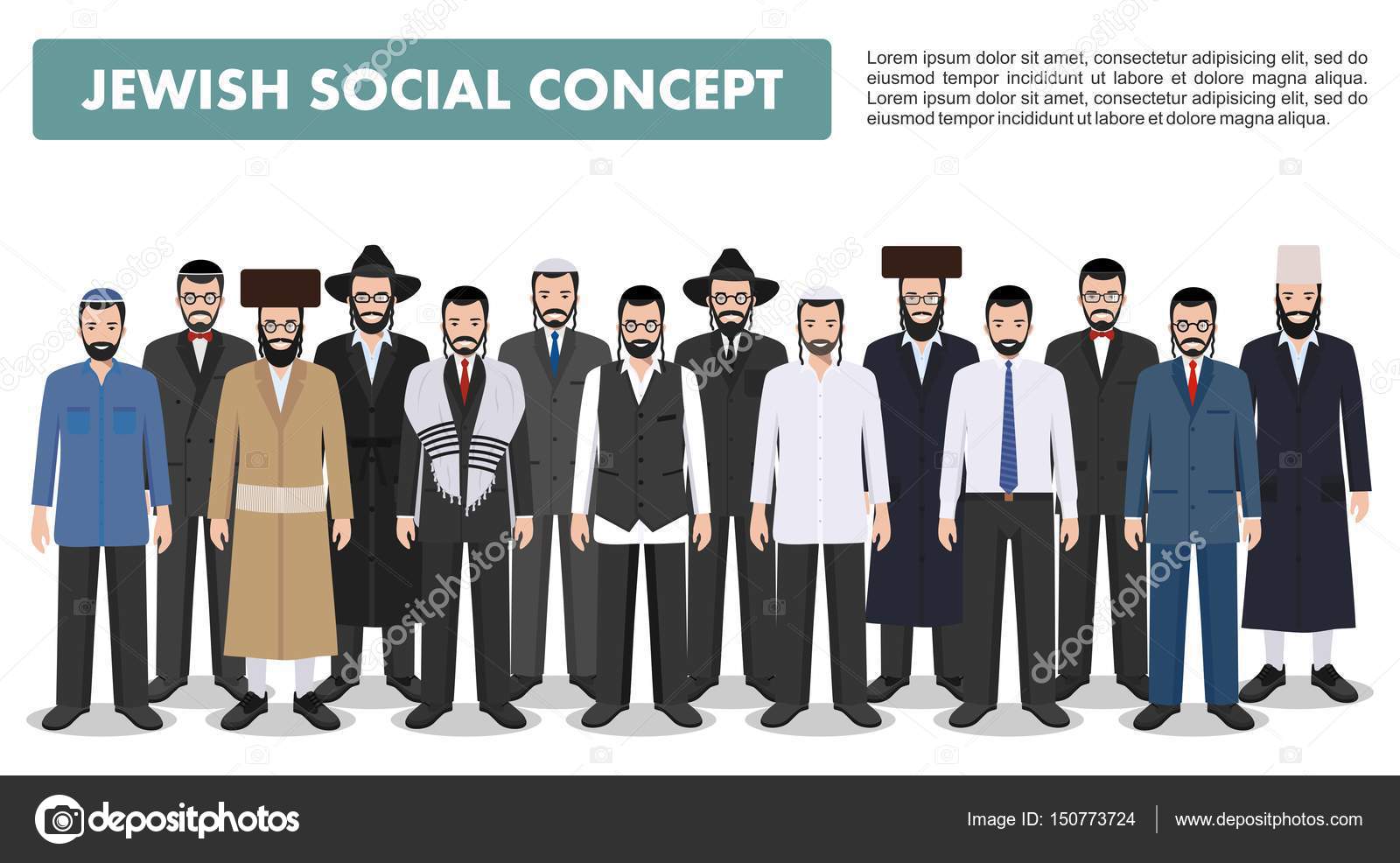
                  Jewish men standing together in different traditional clothes.  Within our group, we are  mixed;  Left, Right, Orthodox, Conservative, Reformed, Atheists, Nationalists, Communists, you name it, including all the various shades between.  

                            Another necessary form of the Jewish Social Concept                                  
                 Israel Defense Force-  
IDF soldiers in Jerusalem 

The state of Israel came to fruition just in time, enabling young Jews to mix; Sephardic, Mizrahi and Ashkenazi and produce healthy genetic -free of diseases children.  

Resource: 

https://newslab.tribune.com.pk/israeli-rabbi-calls-pashtuns-my-cousins-from-lost-tribe/#:~:text=%22Research%20shows%20a%20relationship%20between,and%20Iraqi%20Jews%20(67.9).&text=Many%20Pashtuns%20proudly%20claim%20that,Israel%20(Children%20of%20Israel).  by Rabbi Harry Rozenberg

https://www.tandfonline.com/doi/abs/10.3109/24701394.2016.1174222?journalCode=imdn21

Legacy, a genetic history of the Jewish people by Harry Ostrer

https://jewishbubba.blogspot.com/2021/08/iranians-is-it-possible-to-find-jewish.html

https://www.thoughtco.com/ancestry-of-albert-einstein-1421903

https://en.wikipedia.org/wiki/Detailed_logarithmic_timeline

The New Standard  Jewish Encyclopedia

Letters From Beyond the Sambatyon, the myth of the Ten Lost tribes, edited by Simcha Shtull--Trauring

facts about Israel: published by the division of information, ministry for foreign affairs, Jerusalem

Tanakh, The Stone Edition

https://www.khanacademy.org/science/ap-biology/natural-selection/population-genetics/a/genetic-drift-founder-bottleneck#:~:text=The%20bottleneck%20effect%20is%20an,small%2C%20random%20assortment%20of%20survivors.

https://en.wikipedia.org/wiki/Haplogroup_R_(Y-DNA)#:~:text=(R2*)-,Origins,era%2C%20about%2027%2C000%20years%20ago.

https://en.wikipedia.org/wiki/Human_Y-chromosome_DNA_haplogroup