Daniela Munitz: gymnast, Based on the latest reports from the 2026 European Cup in Baku (held in early May 2026), Israeli rhythmic gymnast Daniela Munits (sometimes spelled Munitz) is the gold medalist in the Cross Battle event, The Cross Battle event, specifically within the context of the 2026 European Cup in Rhythmic Gymnastics (held in Baku, Azerbaijan, from April 30 to May 3), is a unique competition format where gymnasts face each other head-to-head in direct elimination duels to advance to the next round.
Behind the Scenes: The 2026 competition is featured in a behind-the-scenes documentary titled "Chasing Perfection – Inside the Cross Battle," which explores the preparation of athletes, including Italian superstar Sofia Raffaeli and Bulgarian group captain Sofia Ivanova.
Paying for land was a mark of ownership over 3,871 years ago. Abraham paid 400 shekels of silver for his burial plot. It was a man's only proof of ownership.
The Cave of Machpela has an ancient history dating back to the earliest man and woman in the Bible. Adam and Eve are said to be buried in the cave, the first of four couples to be buried there.
The Cave of Machpela and the field around it were Abraham’s first acquisition in the Land that God promised to him and his descendants. Besides Adam and Eve, the three patriarchs and matriarchs of the Jewish people – Abraham and Sarah, Rebekah and Isaac, and Jacob and Leah – are buried there as well. These three holy couples gave birth to the Jewish people and brought the awareness of God to the world. Since Biblical times, the Cave of Machpela has been a place of prayer, meditation, and study. The cave is respected as a gateway to the Garden of Eden, where our prayers have a special potency.
Hebron was the first capital of the tribe of Judah. King David began his kingship here. From Hebron, he was crowned King of Judah seven years before he was crowned king of Israel in Jerusalem. Then he chose Jerusalem as his capital.
The Cave of Machpelah outside of Jerusalem was bought by Abraham who was born in the 2nd millennium or about 1948 BCE. The cave is a series of caves situated 30 kilometres (19 mi) south of Jerusalem in the heart of the Old City of Hebron in Judea (West Bank today). According to Judaism and the Abrahamic religions (Quran of Islam), the cave and adjoining field were purchased by Abraham as a burial plot,According toGenesis 23:1–20, Abraham's wife Sarah dies inKiryat Arbanear Hebron in the land of Canaan at the age of 127, being the only woman in the Bible whose exact age is given, while Abraham is tending to business elsewhere. Abraham comes to mourn for her.
When the Exodus arrived in Canaan, Joshua had assigned Hebron to Caleb, and it became a levitical city and a city of refuge. By 1890 CE, Jews numbered 1,500, later to decline, but after 1936's riot. the Jews were forced out. Today Hebron is an Arab city.
Abraham with the sons of Heth (Hittites).
After a while he stands up and speaks to the sons ofHeth. He tells them that he is a foreigner in their land and requests that they give him a burial site so that he can bury his dead. The Hittites flatter Abraham, call him a Lord and mighty prince, and say that he can bury his dead in any of their tombs. Abraham doesn't take them up on their offer and instead asks them to contactEphron the Hittite, the son ofZohar, who lives in Mamre and owns the cave of Machpelah which he is offering to buy for "the full price". Ephron slyly replies that he is prepared to give Abraham the field and the cave within it, knowing that it would not result in Abraham having a permanent claim to it.Abraham politely refuses the offer and insists on paying for the field. Ephron replies that the field is worth four hundredshekelsof silver and Abraham agrees to the price without any further bargaining.He then proceeded to bury his dead wifeSarahthere.
The burial of Sarah is the first account of aburialin the Bible, and Abraham's purchase of Machpelah is the first commercial transaction mentioned.
“Let him sell me the cave of Machpelah that he owns, which is at the edge of his land. Let him sell it to me, at the full price, for a burial site in your midst.” (Genesis 23:9) 3,800 years ago, Abraham purchased the cave to bury his wife Sarah and as an eternal inheritance to his children. The Bible tells the story of this purchase in detail, the first Jewish acquisition of land in the Land of Israel.
Abraham bought the “cave at the edge of the field” for 400 silver shekels. Even though God told Abraham that this was his land as an inheritance and the Hittites offered to give him the cave for free, Abraham wisely insisted on pay full price for it, to insure that there would no question of ownership over this land and perhaps with prophetic insight into the future when others would try to claim it.
His purchase is also used as the source for establishing the four different methods by which land can be legally acquired in Jewish law – by money, by deed, by witnesses, and by physical possession. The Bible records that Abraham used all four methods to acquire the Cave of Machpela and field surrounding it, establishing him and his descendants – Yitzchak, Yaakov, and the Jewish people – as its rightful owners for all time to come.
And here we are in the year 2023, 4,000 years from the purchase and so people dare to deny the Jews their land.
David fighting the Ammonites (today in Jordan) who frequently attacked and suffered defeats by Jephthah and Saul.
David (1010 -970 BCE) , who became king of Israel, bought the Foundation Stone with a threshing floor from the Jebusite, Araunah. It's in Jerusalem. Araunah had also offered it as his gift, but David insisted on paying for it. The account of David’s census of the Israelites is found both at the end of 2 Samuel and in chapter 21 of 1 Chronicles.
Then the king said to Araunah, “No, but I will surely buy it from you for a price; nor will I offer burnt offerings to theLordmy God with that which costs me nothing.” So David bought the threshing floor and the oxen for fifty shekels of silver. (2 Samuel 24:24)
Then King David said to Ornan, “No, but I will surely buy it for the full price, for I will not take what is yours for the Lord, nor offer burnt offerings with that which costs me nothing.” So David gave Ornan six hundred shekels of gold by weight for the place. (1 Chronicles 21:24–25)
David values that which he buys over a gift, and that is true today. Many people who are given education for free-- value it far less than a class they had to pay for. It's sad, but they must physically feel the ownership; they can't imagine its value without this. Perhaps paying for something with your own money is a form of ancient sacrifice-the giving away of your own money. That shows you appreciate it.
Moses had the ark created and used gold several ways to cover it inside and out. Where did he get the gold when he was the responsible man moving 600,000 people from Egypt to Canaan, which could be done today in 9 hours and 25 minutes on route 90 by car from Cairo to Jerusalem. Then, by walking that many people on a different route, it took 40 years. A troy ounce of gold today would cost us $1,851.05.
We remember that Jacob, grandson of Abraham, took his family of 70 which included an extended family, to Egypt at a time of extreme famine, which should have been walking or riding donkeys or camels along the same route 400 years earlier than Moses's Exodus. He settled in Goshen in Eastern Egypt, and his family multiplied, and their increased population scared the pharaoh, thinking they would take over Egypt or at the least, assist their enemies. So The Egyptians solved that predicted problem by taking them as slaves. Jacob, however, had died before that had happened at age 147 and was buried in the Cave of Machpelah in Hebron along with Sarah, Abraham and Isaac, his father. Time was counted as 400 years in Egypt from the time of entrance to the time of the Exodus.
The Exodus with Moses happened in about 1225-1215 BCE during the reign of Pharaoh Memeptah or even earlier in 1445 BCE.
Exodus Expedition About to Leave for Canaan
The Israelites acted on Moses' word and asked the Egyptians
for silver and gold jewelry and for clothing. And the Lord gave
the people such favor in the Egyptians' sight that they gave
them what they requested. In this way they plundered the
Egyptians (Exodus 12:35–36).
"The children of Israel carried out the word of Moses. They requested from the Egyptians silver vessels, gold vessels, and garments. HaShem (G-d) gave the people favor in the eyes of the Egyptians and they granted their request----so they emptied Egypt." Example: Finger Ring depicting King Akhenaten and Queen Nefertiti as Shu and Tefnut (1353-1336 BCE). This ring was found at Amarna. The hieroglyphs may be read as an ideogram. The two seated figures are probably Akhenaten (left) and Nefertiti (right) as the deities Shu (air as indicated by the feather he holds) and Tefnut (moisture). They were father and mother of the earth and sky. / Photo courtesy MMA, Public Domain
They felt they deserved some compensation after being slaves for some 400 years.
This event was remembered forever by being in the
Torah as a written law. (See below).
"But when you send him away from you free, you
shall not send him away empty-handed. Adorn him
generously from your flocks, from your threshing
floor, and from your wine cellar....."
(Deuteronomy15:13–14, )
And the Egyptians; where did they get all their gold in the first place?
Ancient Egyptian gold statue of the protecting goddess, Serket at the Tutankhamun exhibition. / Photo by mountainpix, depositphotos, Creative Commons
Egypt is/was a land rich in gold, and ancient miners employing traditional methods were thorough in their exploitation of economically feasible sources. In addition to the resources of the Eastern Desert, Egypt had access to the riches of Nubia, which is reflected in its ancient name, nbw (the Egyptian word for gold). The hieroglyph for gold—a broad collar—appears with the beginning of writing in Dynasty 1, but the earliest surviving gold artifacts date to the preliterate days of the fourth millennium B.C.; these are mostly beads and other modest items used for personal adornment. Gold jewelry intended for daily life or use in temple or funerary ritual continued to be produced throughout Egypt’s long history.
Pendant in the Shape of an Uraeus (2030-1650 BCE). The uraeus was a royal symbol of protection, as the representation of a rearing cobra could magically spit fire at the enemies of Egypt from its perch on the king’s forehead. / Photo courtesy MMA, Public Domain
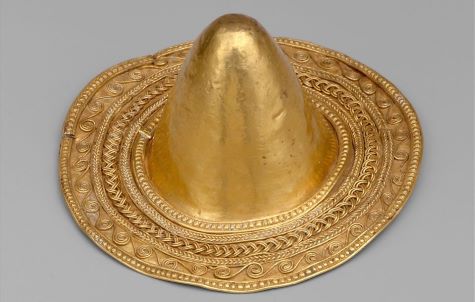
This cone, found among the items in the Tell Basta treasure, would have been attached at the inner center of an elaborately decorated bowl. (c.1279–1213 BCE) / Photo courtesy MMA, Public Domain
Usually today, people who have worked for a company for many years are given a present. There is also a retirement fund set up for workers. This may have started back with the Israelites, who had to ask for such compensation.
Carrying the Ark of the Covenant on the Exodus The Ark of the Covenant, also known as the Ark of the Testimony, is a gold-covered wooden chest with lid cover described in the Book of Exodus as containing the two stone tablets of the Ten Commandments.
The Ark of the Covenant was the chest where the 2 Tablets of the Law were kept. In Exod. 25:10-22, we read the description of what it looked like.
Acacia tree, the real bible tree of Israel Hebrew name: Shita Scientific name: Acacia Family: MimosaThree species grow in the Land of Israel in the desert and one rare species in the Mediterranean region. In large areas of the desert lands of the Negev and Sinai, acacia trees are the only trees.
It was made of acacia wood and was inlaid with gold and also covered with it. Gold has certain properties. A molding of gold surrounded it and there were 4 gold-overlaid wooden staves that were placed through 4 rings on its side, then had a cover of gold over it. Two golden cherubim with wide wings screened the cover of the ark. This is where the Shekhinah (Divine presence) stayed. The ark contained the Tablets of the Law which was the covenant between G-d and His people.
Fresco, 1816
The tribe of Levi was the one to handle the ark. Moses and his brother Aaron were of this tribe. Aaron was chosen to be the high priest and his male descendants would also be cohens. Today we find that most Cohens serving in the synagogue have the J1 "cohen" gene. Aaron had placed a jar of manna before the ark for safe-keeping to show the future Jews that was fed to those on the Exodus. We've lost that evidence, too.
It was considered being so sacred to them that even the high priest, the Cohen, was only allowed to see it once a year under a cloud of incense...as explained in Lev. 16.16:1-6. From the time of Moses to building King Solomon's 1st Temple, the ark was taken out from the Holy of Holies in case of national need to lead the people on their journey and help them in battle. "Another account says that Solomon foresaw the eventual destruction of the Temple, and set aside a cave near the Dead Sea, in which Josiah eventually hid the Ark (Maimonides, Laws of the Temple, 4:1).
Let there be music while on the Exodus with the Ark
In I Samuel 4:5, it tells about the Philistines stealing the ark, and bringing it from Eben-ezer to Ashdod, and its presence was causing them so much trouble that they decided that they needed to return it. The whole city had become panicked and it was returned with the gold objects they had also stolen. They also included other guilt offerings. "According to the Tanakh, Uzzah or Uzza, meaning strength, was an Israelite whose death is associated with touching the Ark of the Covenant.Uzzah was the son of Abinadab, in whose house the men of Kirjath-jearim placed the Ark when it was brought back from the land of the Philistines."
During the time of the 1st Temple between 961-920 BCE, the ark was kept in the Temple area called the Holy of Holies and was never removed. The Temple was in Jerusalem.
Our 10 northern Tribes were carried was by the Assyrians in 722-721 BCE
King Solomon's Temple
The tribe of Judah was attacked by the Babylonians in 597 BCE and again in 586 BCE causing the Jews to be taken by Nebuchadnezzar to Babylon. They were able to return 40 years later in 538 BCE The Babylonians carried away many of their vessels but the ark was not mentioned. Our Talmudic tradition is that it had been hidden "in its place" by King Josiah who ruled from 637-608 BCE so we can presume that it was hidden before the Babylonians had attacked. However, they had destroyed the TEMPLE! The Jews returned and were instructed by Cyrus the Great of Persia to rebuild their TEMPLE, and they did. Was the ark there?
In 70 CE, the Romans, who had been occupying Jerusalem for about 150 years, destroyed the 2nd Temple and burned down Jerusalem while they were at it, taking many Jews as slaves. Others scattered in all directions that lived through the ordeal. They had been starved to death during the siege. It was an inhumane ordeal for the living. The Romans stole all the gold fixtures in the Temple, making their Jewish slaves carry them all the way to Rome as seen in the scene of the Arch of Titus in Rome. Did they remove the Ark of the Covenant? Is it hidden among all the other gold items somewhere in the catacombs of Rome?
Levites carrying ark during the divided sea allowing the crossing
The ark served as the only manifestation of G-d on earth, referring to the Shekhina on the cover, for we do not believe that man can be G-d, except that we are all G-d's children. We have that spark. This doesn't mean that any of us can say a particular man is G-d. We do not even make pictures of G-d. This is offensive, and against the teaching from Moses. The Romans did believe in man being able to be god and they had many half gods. They believe in a whole world of Olympus where the gods lived. This belief came to them through the Greeks who believed in it first.
"A more plausible claim is that of archaeologist Leen Ritmeyer, who has conducted research on the Temple Mount and inside the Dome of the Rock. He claims to have found the spot on the Mount where the Holy of Holies was located during the First Temple period. In the precise center of that spot is a section of bedrock cut out in dimensions that may match those of the Ark as reported in Exodus. This section of the mount, incidentally, is the one from which the creation of the world began, according to midrash (T. Kedoshim, 10). Based on his findings, Ritmeyer has postulated that the Ark may be buried deep inside the Temple Mount. However, it is unlikely that any excavation will ever be allowed on the Mount by the Muslim or Israeli authorities."
Tudor Parfitt, in his book, THE LOST ARK OF THE COVENANT, had thought he had found the ark in Africa. I think it was the dumbest idea, since this one is described as a drum. Whatever did he think of the description in the Torah? He's a professor. We agree on one point, that it could have been stolen at the time of the Babylonian invasion. However, Parfitt was called by the Wall Street Journal as a "British Indiana Jones." His life work has been spent tracking down the lost tribes of Israel, looking for them in Africa and Asia. He's been a professor of Jewish studies in London at their School of Oriental and African Studies, and is a fellow of the Oxford Centre of Hebrew and Jewish Studies, but Parfitt, a DRUM? That's not even close to the Torah's description, he he declares it's "similar." He says he found it with the Lemba Tribe in Africa in which some men have been found to have some of the Cohen genes after DNA testing.
"Lemba people. The Lemba, wa-Remba, or Mwenye are a Bantu ethnic group native to Zimbabwe and South Africa, with smaller, little-known branches in Mozambique and Malawi. According to Tudor Parfitt, Professor of Oriental and African Studies at the University of London, in 2002 they numbered an estimated 50,000.
In 2002 he published his Lost Tribes of Israel: the History of a Myth. Dr Shalva Weil, from Hebrew University in Jerusalem studied the Pashtos of Afghanistan, Pakistan and parts of India and she didn't come up with any myth. She found many customs many of these people had continued that were Jewish customs such as lighting candles on Friday night. In fact, they've recently held a conference about the Pashtos in Jerusalem and their being of the 10 Northern tribes, the descendants of Jacob. One thing he did is something I highly approve of. "Seeking more data, in 1996 and later years Parfitt organised Y-DNA studies of Lemba males. These found a high proportion of paternal Semitic ancestry, DNA that is common to both Arabs and Jews from the Middle East. The work confirmed that the male line had descended from a few ancestors from southern Arabia. In recognition of this work, he was made corresponding fellow of the Académie Royale des Sciences d’Outre-Mer." This could have been the J1 Y haplogroup, which is the Cohen gene found in Jews, though many Arabs carry a variation of it that holds just a slight difference. Both Jew and Arab can be told they have the J1c3d haplogroup. It could be that Jewish traders met up with the Lemba tribe and children were born. The traders could have been carrying these genes, that is if proven they were Jewish genes. They could also be Arab since Arab countries border the continent of Africa on the north side. . Moses could not let anybody carry the ark. A reaction was induced by it if touched by the wrong people. Being G-d's presence was said to be in the cover protecting the laws, this was backed up by this reaction.
Gold (Au), chemical element, a dense lustrous yellow preciousmetal of Group 11 (Ib), Period 6, of the periodic table. Gold has several qualities that have made it exceptionally valuable throughout history. I believe Moses had found something through G-d that even Nostradamus may not have known about by the Middle Ages. "Gold is one of the densest of all metals. It is a good conductor of heat and electricity." It does not corrode. I'm thinking about batteries that can carrode. Somehow, could some form of electricity have been charged up when being carried as part of the ark? "Because of its high electricalconductivity (71 percent that of copper) and inertness, the largest industrial use of gold is in the electric and electronicsindustry for plating contacts, terminals, printed circuits, and semiconductor systems. Thin films of gold that reflect up to 98 percent of incident infrared radiation have been employed on satellites to control temperature and on space-suit visors to afford protection. Used in a similar way on the windows of large office buildings, gold reduces the air-conditioning requirement and adds to the beauty." "Alluvial deposits of gold found in or along streams were the principal sources of the metal for ancient Egypt and Mesopotamia. Other deposits were found in Lydia (now in Turkey) and the lands of the Aegean and in Persia (Iran), India, China, and other lands. "
Resource: https://en.wikipedia.org/wiki/Tudor_Parfitt
https://www.britannica.com/science/gold-chemical-element
https://www.jewishvirtuallibrary.org/the-ark-of-the-convenant
https://www.jewishvirtuallibrary.org/the-ark-of-the-convenant#where
Tanakh, The Stone Edition. index, ark...
https://www.britannica.com/plant/acacia
http://www.kkl-jnf.org/tourism-and-recreation/touring-holy-land/trees/acacia.aspx
https://www.encyclopedia.com/arts/educational-magazines/parfitt-tudor-vernon-1944


 ISRAELI PRIDE – PURE GOLD
  Daniela Munitz just made history – European Champion